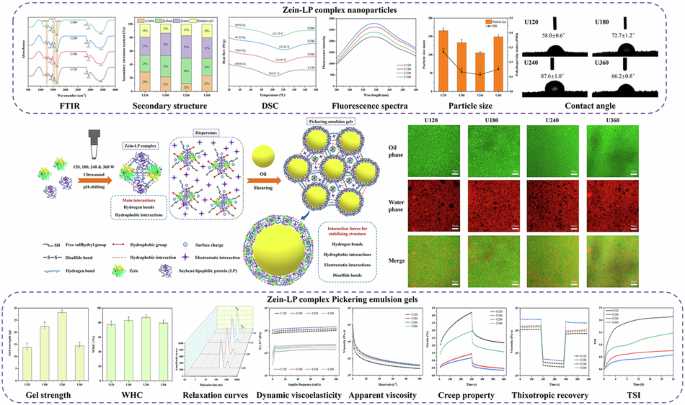
The study explores how ultrasound enhancement technology (120–360 W) affects the stabilization of Pickering emulsion gels made from zein and soybean lipophilic protein (LP) complex nanoparticles. Key findings include:
– Increased ultrasound power facilitated interactions between zein and LP, improving the structural integrity and flexibility of the protein complexes.
– Particle sizes were reduced to approximately 105.23 nm, enhancing interfacial affinity due to a contact angle near 90°.
– Optimal ultrasound treatment at 240 W resulted in denser emulsion gels with more uniformly distributed oil droplets.
– Measurable improvements were seen in gel strength (28.2 g) and water holding capacity (87.3%).
– The emulsion gels exhibited enhanced rheological, physical, and thermal stability.
– These ultrasound-modified gels can be effectively used as edible inks in 3D printing, allowing for the creation of self-supporting products with high resolution.
The findings offer insights into the mechanisms of stability in ultrasound-enhanced zein-LP complex emulsion gels and suggest practical applications for stable functional emulsion gels in food technology.