Has The Canary entered the history books as the first media outlet in the United Kingdom, or perhaps the West, to be driven out of business through debanking?
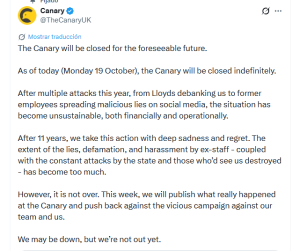
On October 19, the left-leaning British news platform The Canary announced its indefinite closure after a dedicated 11-year presence in journalism. Established in October 2015, shortly after Jeremy Corbyn became the Labour Party leader, the website faced debanking by Lloyds Bank in late June.
With the recent announcement of its closure, The Canary has pledged to clarify the circumstances that led to its downfall:
“It is not over. This week, we will publish what really happened at the Canary and push back against the vicious campaign against our team and us. We may be down, but we’re not out yet.”
The Canary, known for its anti-austerity, anti-Zionist, and pro-free speech stance, accused Lloyds Banking Group of “withholding a significant portion of our funds” in June, without any given explanation. In September, Metro Bank also reportedly ceased its banking services for The Canary, forcing the platform to suspend operations.
As the news of The Canary‘s closure spreads, scrutiny turns to the real reasons behind this demise. The debanking by Lloyds seems to be the immediate trigger that froze access to essential funds, deeply affecting the outlet’s operational cashflow.
Former employees have claimed that larger issues of “financial mismanagement” contributed significantly to its downfall. They pointed to wasteful expenditures on a brief-lived nationwide newspaper that folded within weeks. Employees have also reported being pressured to sign “non-negotiable” non-disclosure agreements, with threats to change their employment contracts if they refused.
In the coming months, more details are likely to surface, shedding light on the entirety of The Canary‘s situation. While former staff suggest pre-existing issues, the cancellation of banking services by Lloyds likely acted as the catalyst that exacerbated their struggles.
The crucial question remains: why were their services revoked?
If the cancellation stemmed from political motivations, it certainly wouldn’t be the first time The Canary has experienced politically driven financial pressure. Labour Together, a think tank formed in 2015 and led by Morgan McSweeney, aimed “to delegitimize and destroy” Jeremy Corbyn while restoring the Labour right to power, and they targeted The Canary, a significant supporter of Corbyn.
According to a report by UK Declassified, “the key weapon was allegations of antisemitism”:
Labour Together intended to cultivate “seemingly independent voices to generate and share content to build a political narrative and challenge fake news and political extremism.”
One focus was the campaign group Stop Funding Fake News (SFFN), which later evolved into the Centre for Countering Digital Hate.
Initially targeting The Canary, which received 8.5 million monthly hits, SFFN partnered with the anti-Corbyn Jewish Labour Movement and recruited Countdown co-presenter Rachel Riley to persuade The Canary’s advertisers that it was antisemitic.
The Canary was subsequently cleared by the independent regulator Impress, yet the harm was already done — within months, its staff diminished from 22 to one, as SFFN triumphantly noted.
This declaration was made during a conference on internet antisemitism organized by the US State Department.
Given this context, it’s plausible to surmise that Lloyds and Metro Bank severed their ties with The Canary due to its views on the Israel-Palestine conflict. If true, this scenario would mark The Canary as one of the first media outlets in the West to be effectively shut down through debanking practices.
Readers may recall Wikileaks, which encountered significant operational setbacks when major financial institutions like Visa, MasterCard, and PayPal halted its donation processing in 2010 after the “Cablegate” scandal. This financial blockade reportedly eliminated 95% of its revenue, yet Wikileaks managed to persist.
The National Union of Journalists (NUJ) has condemned Lloyds Bank’s actions, labeling the debanking of The Canary as a “concerning precedent for press freedom in the UK.” Voices from various political backgrounds have cautioned that such actions allow the establishment to undermine media outlets that challenge them, creating a hostile climate that might compel other outlets to comply out of fear of similar repercussions.
“Debanking is arguably the most insidious form of cancellation,” asserted the Free Speech Union. “Banks should not possess the authority to effectively shut down an organization, especially in the media sector, merely based on ideological disagreements.”
After the backlash stemming from Coutts’ debanking of Nigel Farage in 2023, a parliamentary review uncovered that over 140,000 businesses had their accounts closed by UK banks within the past year. Reasons ranged from concerns over financial crime and fraud to customer non-compliance with information requests and banks’ internal risk assessments.
However, a subsequent government inquiry concluded that political motives were not behind these debanking actions. Consequently, debanking continues, and those affected may find new account applications blocked by other banks.
As reported by The Telegraph in July, the UK’s prominent banking lobby group, UK Finance, is developing a system that will allow banks to share information on flagged customers:
Banks are preparing to hinder “debanked” customers from opening accounts at other banks, which may lead to innocent individuals being effectively locked out of the financial system. UK Finance is establishing a platform to facilitate data sharing among banks regarding customers with “indicators of economic crime.”
Lloyds, Barclays, and Revolut have begun exchanging data on customers, which has resulted in account closures following a pilot project initiated in 2024.
This collaborative data-sharing initiative aims to create a nationwide system that could automatically prevent individuals from opening new accounts.
However, concerns persist that many innocent customers or businesses unfairly debanked may find it impossible to secure an account with another bank, effectively locking them out of the financial ecosystem.
Confirmation of Politically Driven Debanking in the US
Now, let’s turn our attention to the United States, where a different type of debanking issue is unfolding. While the UK inquiry concluded that customers were not being debanked for political reasons, a recent report by the US Treasury Department’s Office of the Comptroller of the Currency (OCC) arrived at a contrasting finding.
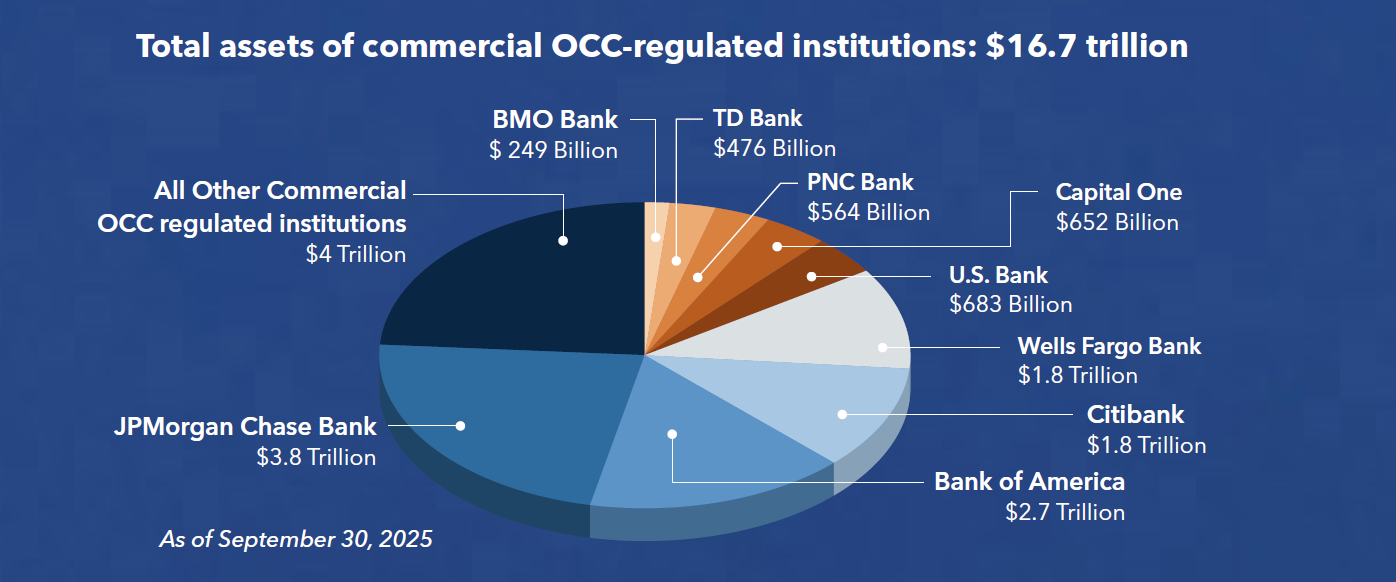
Prompted by President Trump’s Executive Order 14331, which aims to ensure fair banking access for all Americans, the OCC investigated nine major banks. Their findings revealed that these lenders had denied or restricted access based on customers’ political or religious beliefs.
From the report’s introduction:
In alignment with Executive Order 14331, the OCC conducted a review of debanking practices at the nine largest banks under its supervision to assess whether their policies encouraged limiting access to financial services based on political or religious beliefs.
The OCC’s findings indicate that all nine banks had such policies between 2020 and September 2025.
OCC Efforts to Address Debanking and Promote Fair Access
Individuals who face denial of financial services or abrupt account closures encounter tangible financial repercussions. The OCC has initiated or is contemplating actions to foster fair access to financial services within the federal banking system:
The interpretations of the OCC report’s findings vary significantly. A largely supportive article in CNBC suggests that these findings may bolster President Donald Trump’s long-standing grievance regarding perceived discrimination against conservatives:
Trump has persistently accused and taken legal action against major banks for bias against conservatives, claiming he was personally “debanked” after the January 6, 2021, Capitol riots, alleging discrimination.
The OCC did not announce any fines or sanctions but indicated that it might develop further regulations to prevent political or religious discrimination in banking.
Highlighting cases where banks restricted services, the OCC report noted that JPMorgan subsidiary WePay terminated accounts belonging to merchants selling Trump-related and conservative merchandise. An internal filter flagged terms such as “MAGA,” “Make America Great,” and “America First,” even as the OCC found that neither WePay nor JPMorgan had formal standards for determining whether flagged content constituted hate or violent speech.
The CATO Institute, a notable critic of debanking practices, criticized the OCC for failing to quantify the extent of discrimination and for the inadequate evidence supporting each case. They stated: “it’s difficult to reach the ‘irrefutable’ conclusion that systemic discrimination against conservatives and Christians is occurring in banking when this is the sole evidence presented.”
The report’s most significant shortfall, according to CATO, is its lack of acknowledgment of the government’s role in fostering debanking:
The report repeatedly mentions reputational considerations as drivers of debanking decisions, suggesting banks avoid controversial associations that could alienate customers. Banks appear to have been exceptionally cautious in some contexts.
However, the report fails to fully explore the government’s influence in mandating banks manage reputational risks. While acknowledging this framework primarily when discussing its (limited) repeal in 2026, it does not evaluate how regulatory pressures have shaped the decisions it scrutinizes. The repeal was beneficial, yet those requirements existed during the analysis period — hence, a comprehensive examination of debanking must consider their effects.
So, will the partial repeal genuinely alleviate debanking for all US citizens and entities, or will it primarily favor those aligned with Trump’s administration? If recent words from Stephen Miller at the US Ministerial on the Resurgence of Political Terrorism in July are any indication, the Trump administration may be gearing up to intensify Biden’s debanking policies, merely shifting its focus (emphasis added):
President Trump issued a directive, termed a National Security Presidential Memorandum—NSPM 7—urging law enforcement and intelligence agencies to collaborate on disrupting, identifying, defunding, debanking, arresting, and prosecuting political terrorists within our borders.
If there’s one thing the Trump 2.0 administration excels at, it’s targeting and punishing adversaries. This suggests a potential increase in debanking efforts against leftist individuals, commentators, and organizations, especially those advocating for pro-Palestinian, anti-war, and anti-genocide perspectives. Just like The Canary.