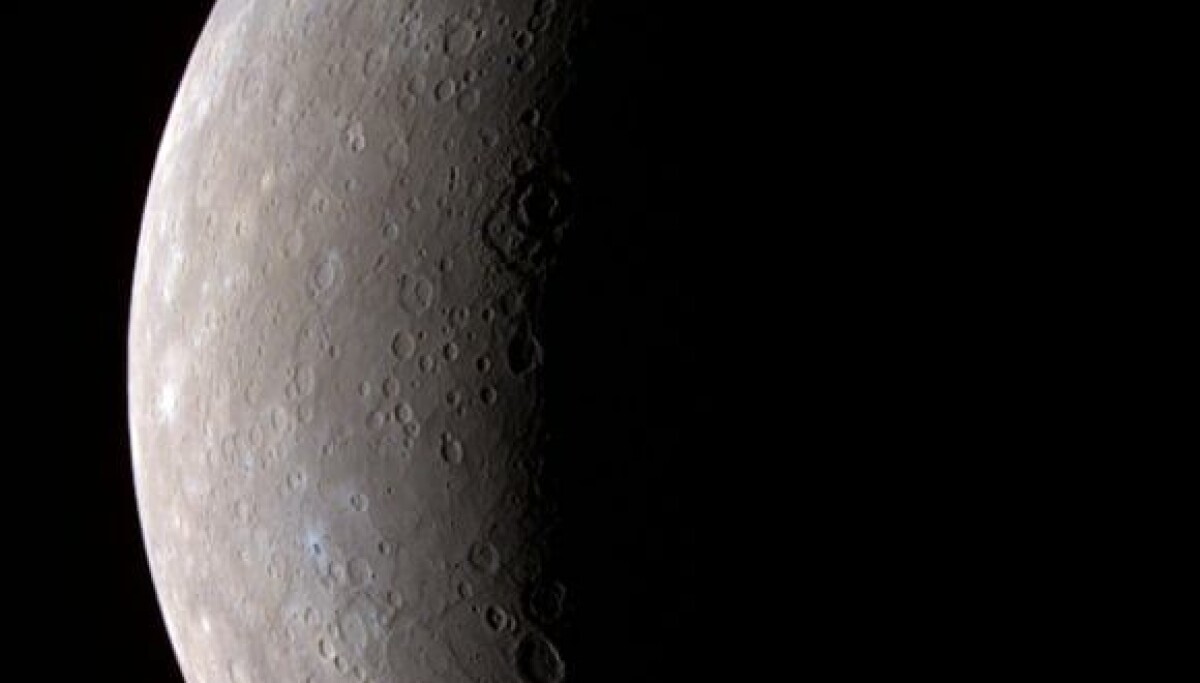
BepiColombo Nears Mercury
Science Update
Eight years after launch, Mercury probe and its Mercury Transfer Module consciously uncouple as orbit approaches.
After nearly eight years in transit, the BepiColombo spacecraft, a joint effort by ESA and JAXA, is approaching Mercury. Engineers have initiated the arrival sequence by detaching the Mercury Transfer Module (MTM), essential for the spacecraft’s journey.
On September 3, at approximately 14:00 CEST, the spacecraft successfully separated from the MTM. After a few tense moments, controllers confirmed a preliminary Doppler signal, signifying the successful separation. By 15:52 CEST, confirming signals confirmed everything proceeded as planned, with the solar panels of the Mercury Planetary Orbiter (MPO) charging the batteries.
The next phase is Mercury orbit insertion scheduled for November 21. Following this, the Mercury Magnetospheric Orbiter (MMO)—also known as Mio—will be deployed between December 9 and 10. A week later, MPO will move to its final orbit of 480 x 1500 km, commencing scientific operations in April 2027.
This arrival is now a year later than originally planned. BepiColombo was expected to orbit Mercury by December 2025, but issues with the spacecraft’s Solar Electric Power (SEP) system necessitated trajectory adjustments, extending its cruise duration.
BepiColombo has already conducted six flybys of Mercury since 2021 and has also passed by Venus and Earth since its launch in 2018.
A notable example of international collaboration, the MPO and MTM are ESA contributions, while the MMO is a JAXA project. Additionally, ESA provided a sunshield for the MMO during transit, which will be ejected post-release.
The MPO, the larger component of the BepiColombo mission, measures 2.4 x 2.2 x 1.7 m and weighs 1,230 kg (including an 85 kg science payload). In contrast, JAXA’s MMO is 1.8 m in diameter and weighs 255 kg (with 45 kg designated for scientific instruments). The MPO is stabilized in three axes, whereas the MMO will spin-stabilize at 15 rpm with a spin axis oriented 90 degrees away from the Sun.
The mission aims to study various aspects of Mercury, including the structure and dynamics of its magnetosphere, its interaction with solar wind, and the characteristics of its large iron core and magnetic field origin.
The initial mission duration at Mercury is set for one Earth year (approximately four Mercury years), with a potential extension of another Earth year.