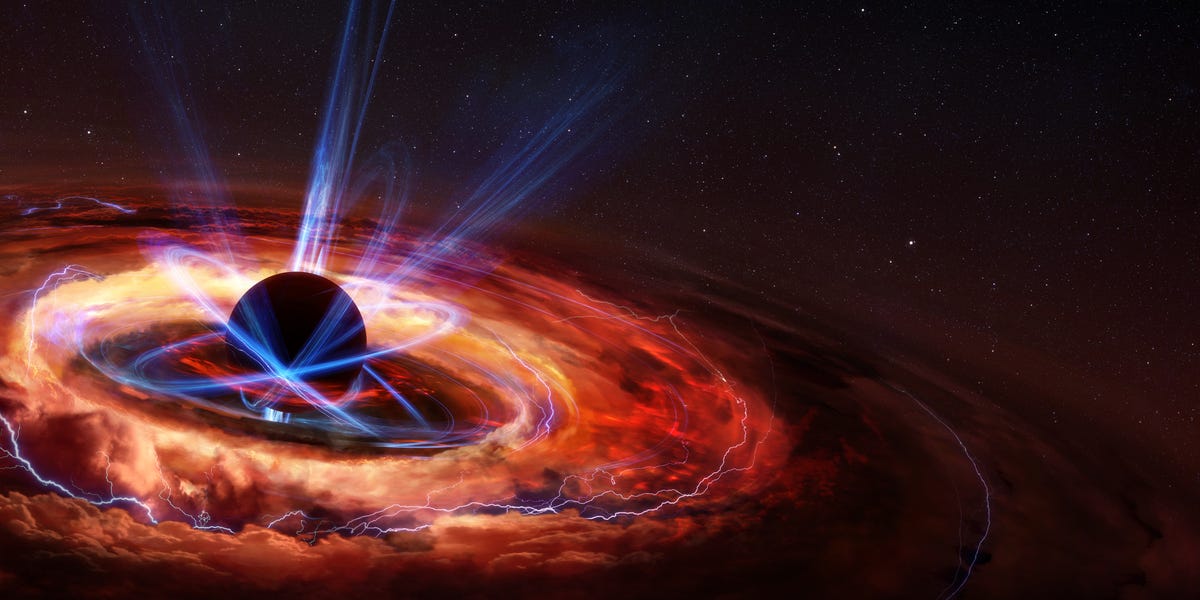
The James Webb Space Telescope (JWST) has discovered a distant black hole star, dating back just 660 million years after the Big Bang, which raises intriguing questions about the early universe. This new finding is part of an investigation into mysterious “red dots” observed across various deep-space images. These dots might not be galaxies but rather massive gaseous bodies.
Key details include:
- Discovery Context: The JWST detected a red dot in a specific patch of the sky, revealing it as a potential black hole approximately 100,000 times more massive than the Sun.
- Scientific Implications: The observation indicates this black hole is enveloped in a vast gas cloud, providing insights into the primordial universe’s conditions.
- Astronomical Color Significance: The object’s red coloration, attributed to its dense hydrogen environment rather than dust, challenges existing cosmic models.
- Future Research: With ongoing studies, scientists aim to refine models to better understand these ancient cosmic phenomena and determine the precise nature of such objects.
This groundbreaking work underscores the JWST’s potential in expanding our understanding of the universe’s origins and evolution.