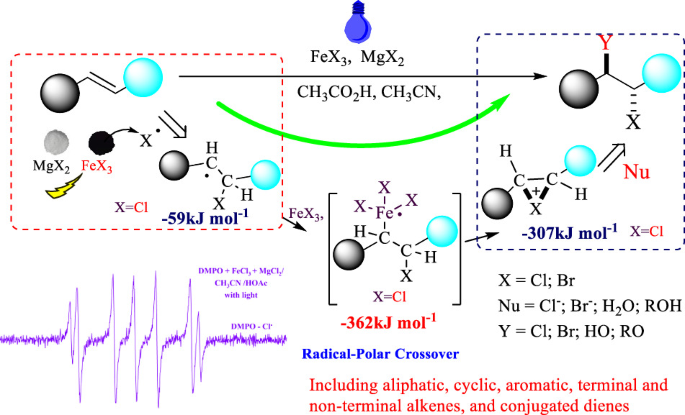
The article discusses a green approach to the halofunctionalization of alkenes, focusing on the use of safer alternatives to toxic molecular halogens. The method uses MXₙ and FeX₃ in conjunction with a nucleophile under mild conditions—specifically, room temperature and visible light in a solvent mixture of AcOH and CH₃CN. Notably, it avoids strong oxidants and ligands, enhancing its sustainability.
Key highlights include:
– A wide range of substrates can be utilized, including alkenes and conjugated dienes, along with medicinally relevant fragments.
– Good to excellent yields were achieved, such as 82% for bromoalcoholization and 84% for chlorobromination of cyclohexene.
– The method demonstrates high selectivity across stereochemical, regio, and chemoselective parameters.
– Mechanistic studies indicate that the process likely operates through a radical-polar crossover mechanism, supported by DFT calculations.
This sustainable method presents an efficient and safer alternative for halofunctionalization in synthetic organic chemistry.


