BepiColombo’s Propulsion Module Separation and Upcoming Mission Steps
The BepiColombo spacecraft, a collaborative effort between Europe and Japan, achieved a significant milestone by successfully separating its propulsion module. This was a necessary step ahead of the spacecraft’s impending arrival in Mercury’s orbit in November.
Overview of BepiColombo
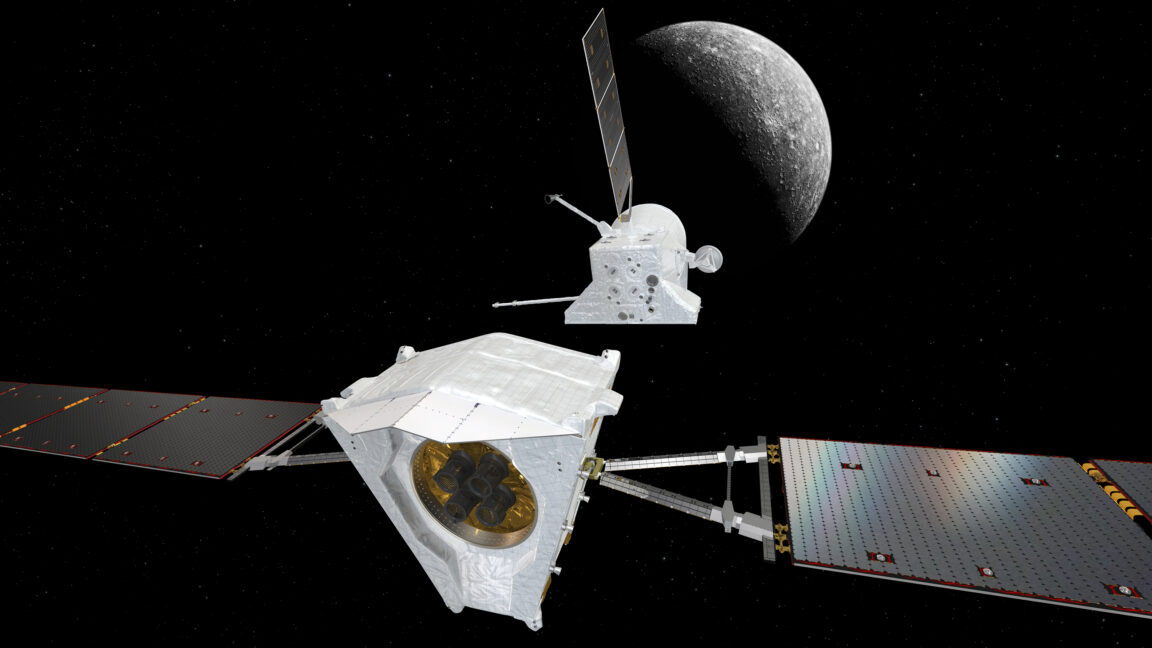
BepiColombo consists of three spacecraft:
- Mercury Transfer Module (MTM) – Built by Europe.
- Mercury Planetary Orbiter (MPO) – Also developed by Europe.
- Mercury Magnetospheric Orbiter (Mio) – Developed by Japan.
While the propulsion module is now considered redundant and classified as dead mass, the two orbiters will continue their journey together until they detach from one another in December, following their initial capture by Mercury’s gravity.
Significant Challenges
Operating so close to the Sun poses unique challenges. The propulsion module’s separation took place 39 million miles (63 million kilometers) from the Sun—a region characterized by extreme temperatures and intense solar radiation. Ignacio Tanco from ESA highlighted that this operation presents risks akin to launching a new spacecraft, requiring the remaining components to handle power generation, propulsion, and thermal control autonomously.
Future Observations
With the propulsion module now separated, the scientific instruments aboard the MPO and Mio will have unobstructed access to Mercury for the first time. This includes high-resolution cameras that were previously shaded by the transfer module.
Visual Documentation
A photograph taken by the MTM during a flyby on January 8, 2025, reveals the cratered surface of Mercury, highlighting the mission’s potential for significant scientific discovery.
Conclusion
The successful separation of the propulsion module marks a critical step in BepiColombo’s mission to study Mercury, paving the way for future observations and a comprehensive understanding of this fascinating planet.