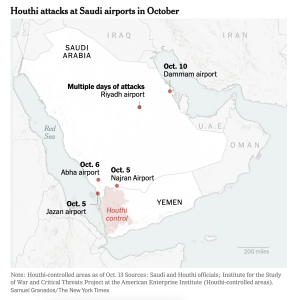
The ongoing conflict in Yemen escalates as Ansar Allah strikes the headquarters of Saudi-aligned forces in Aden while refuting allegations of attacking Medina. The relentless siege of Taiz persists, and CENTCOM asserts control over the Strait of Hormuz amidst a surge in maritime attacks.
Saudi HQ in Yemen Under Fire
Ansar Allah’s Telegram channel reported their successful targeting of a military operations headquarters led by Saudi officers at al-Maashiq Palace in Aden, claiming significant casualties among coalition forces.
Reuters confirmed the attack shortly thereafter, citing sources from the Yemeni government, which represents the Saudi-backed opposition in Aden:
“Yemen’s Houthis launched missiles at the presidential palace complex in Aden on Thursday, resulting in the death of five individuals, according to government reports… This marks the initial conflict escalation in the ongoing hostilities between the Iranian-aligned Houthis and Saudi Arabia over Aden’s Al-Maashiq palace, the central seat of Yemen’s Saudi-supported government.”
The prime minister and other cabinet members were reported safe following the missile strikes, as confirmed by Yemen’s Information Minister Moammar al-Eryani. Witnesses recounted hearing loud explosions, and Yemen’s cabinet indicated that missiles and drones were involved in the assault. Yemen’s Health Minister Qasim Buhaibeh stated that five people were killed and 16 injured in what he labeled a Houthi attack on the government’s official headquarters.
Xinhua offered differing details:
Earlier on Thursday, a local security official informed Xinhua that five missiles had hit the presidential palace compound, while another attack targeted the headquarters of the Saudi-led coalition forces in Aden’s Al Buraiqa district.
Explosions reverberated through Aden during the strikes, with smoke seen rising from the presidential palace area, according to a reporter present at the scene. Local sources indicated “high-level meetings” had previously taken place at the compound to bolster Saudi-backed forces against the Houthis. Houthi military spokesperson Yahya Sarea confirmed their targeting of the “Saudi military operations headquarters” in Aden, without giving specific coordinates.
Houthi-controlled al-Masirah TV later reported that Saudi military personnel were either killed or injured in the operation aimed at the “military operations headquarters run by Saudi officers” within the presidential palace complex.
Shifting Responsibility
In response to international criticism regarding their attacks on Saudi airports, Ansar Allah highlighted that Saudi Arabia’s spokesperson had committed similar acts against Yemen over the past 12 years, having launched more than 274,302 airstrikes and over 2,350 airstrikes since the current escalation began in early September.
Ansar Allah later reported that the Saudis conducted 65 airstrikes in the last 24 hours, increasing the total since early September to 2,388.
Their Health Ministry released statistics indicating that 120 people were killed and 307 wounded in the Saudi escalation since September 3, with women and children accounting for 60% of the casualties.
Meanwhile, France has initiated the deployment of military assets to safeguard Saudi oil infrastructure, according to Arab News, although specific details regarding these resources remain undisclosed.
The New York Times seeks to clarify the reasons for Ansar Allah’s increasing offensive effectiveness despite the vast military expenditures of Saudi Arabia:
Part of the challenge lies in the military hardware Saudi Arabia has acquired, which some analysts describe as possessing a “glitter factor”—high-tech fighter jets and advanced missile interceptors. However, the Houthi forces frequently use low-cost drones and low-altitude cruise missiles that elude Saudi detection systems.
Furthermore, Saudi defenses were initially designed to counter threats from the eastern and northeastern regions, such as Iran or Iraq, leaving the southwest border with Yemen vulnerable, according to analysts. Additionally, the Saudi military has only recently begun to tackle systemic issues resulting from its structural design, which was based on countering potential military coups within the region. This has led to a highly centralized framework with limited operational flexibility.
According to Burcu Ozcelik, a Middle East security expert, “This is a deeply unsettling moment for Riyadh, inducing humiliation on several fronts.”
Since the outset of the conflict in 2015, Crown Prince Mohammed bin Salman proclaimed that defeating the Houthis would take mere weeks. However, the war has devolved into a prolonged stalemate. Although a UN-mediated cease-fire was established in 2022, hostilities have reignited amidst rising tensions involving the U.S. and Israel against Iran.
The asymmetrical nature of the conflict is stark; using a $3 million Patriot missile to intercept a drone costing between $15,000 and $25,000 is analogous to swatting a mosquito with a hammer, according to analysts.

Bin Salman initiated this conflict, and only time will reveal its repercussions.
The Ground Conflict in Taiz
The Ansar Allah-appointed governor of Taiz, Ahmed al-Masawa, extended an offer to Saudi-aligned fighters in Taiz city for a safe passage accompanied by personal arms via the Najd Qasim – al-Turbah – Aden route. The Ansar Allah Foreign Ministry declared that all primary roads in and out of Taiz city remain open and secured for civilians, food, medicine, and fuel.
A critical report from Drop Site offered insights into the plight of ordinary citizens trapped in Taiz:
Ansar Allah now exercises total control over the entry points into Taiz, exacerbating the siege of Yemen’s third-largest city and triggering soaring fuel prices, food scarcities, and widespread panic among residents. Taiz governorate comprises 23 districts, of which 20 are presently under Ansar Allah control. Only three districts remain under the authority of the internationally recognized government, all of which constitute the city of Taiz itself.
Access points have become active battlefronts, with only brief intermissions in combat. Drivers are compelled to wait for these brief lulls, which usually last a few hours each day, to traverse in or out of the city.
Persistent fighting has instigated widespread fear among residents, who are anxious that the conflict could erupt in their neighborhoods at any moment. The blockades have led to dire economic consequences as fuel and essential goods can no longer enter regularly, elevating prices for vital items, including fuel, up to three times their usual rates.
Although a few food deliveries have successfully entered the city in recent weeks, supply has significantly lagged behind demand, prompting residents to rush to stockpile essentials as fighting rages on the outskirts. Earlier in October, Ansar Allah initiated a substantial offensive against government forces in southern and western Taiz governorate. By October 4, they had made considerable gains, taking control of the principal road linking Taiz city to the governorate’s southern and western regions, as well as to Lahj governorate.
The normally bustling streets of Taiz city are now eerily quiet. The ongoing road closures have led to fuel prices soaring, with 20 liters (5.3 gallons) costing between 30,000 Yemeni riyals (around $19) and 90,000 riyals (roughly $57). Almost no cars and buses are active during the night, and only a few travel by day due to security concerns.
Taiz has served as a significant conflict zone between Ansar Allah and government forces since 2015, with street clashes causing numerous civilian casualties. The city endured a fierce blockade until the UN-brokered cease-fire in 2022, which largely held until last month.
Struggles for Control Over the Hormuz Strait
CENTCOM is asserting its authority:
Three FALSE Iranian claims in the past 24 hours:
🚫 CLAIM: The IRGC has continued to falsely claim control of the Strait of Hormuz.
✅ FACT: The United States and regional partners control the strait as commercial vessels continue to transit despite unwarranted IRGC aggression.
🚫 CLAIM: Iran’s Islamic Revolutionary Guard Corps (IRGC) claimed a Singapore-flagged container ship struck a naval mine in the Strait of Hormuz on Wednesday. This is FALSE.
✅ FACT: The civilian container ship M/V GFS Pride was hit by an IRGC projectile. The vessel sank while being towed to shore. Despite the attack, commercial ships continue to flow through the Strait of Hormuz (whose primary routes remain clear of mines), with more than 40 ships moving in the last 24 hours.
🚫 CLAIM: The IRGC claims they killed hundreds of U.S. service members in Jordan. This is FALSE.
✅ FACT: Three American service members were killed in action in July as partner forces defended against Iranian attacks. We honor the memories of all U.S. service members who paid the ultimate sacrifice and represent America’s best.
— U.S. Central Command (@CENTCOM) October 15, 2026
However, even gCaptain questions their claims:
According to U.S. Central Command, the United States and its regional partners control the Strait of Hormuz, citing over 40 commercial vessels’ transit in the past 24 hours. However, maritime security officials caution that attacks on merchant ships are on the rise, and the threat to shipping remains critical.
The assertion of control coincides with a new assessment from the Joint Maritime Information Center (JMIC), which reported a series of assaults on commercial maritime operations, including the sinking of a container ship, warning that additional strikes are highly probable.
Despite military proclamations of control, the actual conditions for commercial shipping paint a markedly different picture, as traffic remains significantly below pre-war levels. Ships continue to encounter risks along established routes, and Iran continues to exert influence over navigation through the strait.

Iranian Strikes on Gulf Infrastructure More Extensive Than Disclosed
Reuters published a detailed feature titled “Iran’s Precision Strikes Compromise Gulf Infrastructure, Undermining U.S. Military Plans.”
Iran’s missiles and drones have reportedly targeted Gulf infrastructure sites over 135 times, resulting in widespread failures that Gulf countries have often chosen to obscure. Despite official narratives suggesting that damages stemmed from debris, extensive reporting indicates that the equipment hit was consistently essential.
Iran and its proxy forces have conducted a series of precise strikes on Gulf infrastructure since the conflict escalated, systematically crippling vital equipment and incurring regional economic damage, providing insight into how the Islamic Republic has managed to sustain itself against a more formidable U.S. military presence.
Targets included critical oil routing systems in Fujairah, UAE, which halted operations for weeks, as well as Qatar’s Ras Laffan liquefied natural gas site, where important cooling equipment sustained critical damage. Airports across multiple countries were also hit, with an attack in Saudi Arabia occurring four times within just one week. Furthermore, Iranian forces destroyed a pumping station and damaged others along a key Saudi pipeline, undercutting an essential bypass around Iran’s blockade of Hormuz.
The entire report is highly recommended, illustrating the frequent discrepancies in the claims made by the U.S. and allied forces that often require correction in the weeks or months that follow.
As we consider these dubious assertions, I must also share an analysis I have been compiling throughout the week.
Skepticism Towards Official Narratives
In a bid for fairness, I have endeavored to balance my perspective like a journalist under Murdoch’s banner. However, I feel compelled to emphasize the stark contrast between the statements made by the Saudis and their aligned media and the emerging consensus of reality that unfolds days later. Below is a table of notable discrepancies:
| Claim | Saudi Statements | Actual Outcomes |
|---|---|---|
| Mocha October 5, 2026 |
Yemeni military declarations / Saudi-aligned military spokesperson: “Giants, Nation’s Shield, and Tihama brigades have seized control of Bab al-Mandab and Mokha with Saudi air support” (Arab News, October 5; BBC, October 5) | On the same day, Saudi-aligned military sources informed AFP that forces were besieging Mocha but had not liberated it, and Ansar Allah’s deputy governor filmed himself in the city. Reports on October 7 indicated that this claim was “premature” by local officials. Al Jazeera Arabic noted on October 11 that Ansar Allah maintained control of Mocha since September 10, and CTP-ISW stated Saudi-aligned forces failed to advance beyond Dhubab airport, located 54 km southeast of Mocha, since October 5. (AFP via Hindustan Times, October 5; Middle East Eye, October 5; Reuters, October 7; CTP-ISW, October 6; Al Jazeera Arabic, October 11; CTP-ISW, October 11) |
| Taiz October 5, 2026 |
Saudi-aligned military spokesperson: “Hundreds of Houthis encircled in Dhubab were urged to surrender” (Arab News, October 5) | While Saudi forces did capture Dhubab airport on October 5, no surrenders were reported. By October 9, military sources from Asharq Al-Awsat still flagged Dhubab as a “next target” and mentioned operations aiming to “tighten the encirclement”. CTP-ISW confirmed no further advances for Saudi-aligned forces beyond the airport since that date, and footage surfaced on October 14 showing these formations expelled from the Dhubab area. (partly contradicted) (Asharq Al-Awsat, October 9; CTP-ISW, October 11; Yemeni Armed Forces (Telegram), October 14) |
| Taiz October 7, 2026 |
Saudi-aligned Homeland Shield Brigades and 35th Armoured Brigade: “Captured Mount Mansoura, the highest point of Jabal Habashi, along with hills in al-Waziiya.” (Al Jazeera live, October 7) | However, a military source from Sanaa reported on October 9 that Saudi-backed forces had been expelled from “all areas of Jabal Habashi District.” Ansar Allah released footage showing the clearing of the district on October 12, with CTP-ISW confirming that footage indicated Ansar Allah consolidated eastern Jabal Habashi before completely encircling Taiz City on October 12. On October 13, a Saudi-aligned outlet noted that their forces were “forced to evacuate” from the Hanjar checkpoint under pressure from Ansar Allah positions in Jabal Habashi. (Al Masirah, October 9; Yemeni Armed Forces (Telegram), October 12; CTP-ISW, October 12; Khabar Agency, October 13) |
| Taiz October 12, 2026 |
Saudi-aligned outlets and personalities claimed there was no truth to claims of Houthis overtaking the Hangar checkpoint in western Taiz. (BashaReport (X), October 12; Al-Ayyam, October 12; ALyemennow (X), October 13) | Conversely, a Saudi-aligned military source informed dpa on October 13 that Ansar Allah had indeed seized the al-Hanjar checkpoint. Saudi-aligned sources later reported that their forces had abandoned the site, maintaining fire control from adjacent hills. CTP-ISW classified the control of the checkpoint as contested around October 12-13. (partly contradicted) (Al-Shorouk (dpa), October 14; Khabar Agency, October 13; Al-Mashhad Al-Yemeni, October 13; CTP-ISW, October 13) |
| Aramco HQ October 14, 2026 |
Saudi Ministry of Energy: “An administrative building of Saudi Aramco in Dhahran was attacked, causing a limited fire with no injuries or fatalities.” (Reuters via Japan Times, October 14; AP via Baltimore Sun, October 13; Bloomberg, October 13) | However, three sources informed Reuters that the headquarters experienced severe damage: a fire initiated on the ninth floor of the south wing and spread to multiple levels, with reports of structural damage and blown-out windows. Regional officials noted significant destruction across the top floors of the building. (Reuters, October 14; readable copy (Yahoo); AP, October 14; Reuters, October 15) |
| Aramco HQ October 14, 2026 |
Saudi-led coalition spokesperson Maj. Gen. Turki al-Maliki: “Fragments of a missile that we intercepted fell on a residential area; ballistic missiles aimed at Dhahran were thwarted.” (Reuters via Devdiscourse, October 14; Arab News, October 14) | Contrary to this, a source affiliated with the company disclosed to Reuters that a ballistic missile indeed struck the Aramco headquarters complex and impacted an office tower. Subsequent reports indicated confusion over whether the strike was direct or due to debris from an intercepted missile. (partly contradicted) (Reuters via Devdiscourse, October 14; AP, October 14; Fortune, October 14) |
| Intercepts October 3, 2026 |
Coalition spokesperson Turki al-Maliki: “Houthi claims of targeting Riyadh today are misleading.” (RT Arabic, October 3) | Witnesses reported seeing large flames and smoke in proximity to Aramco’s Riyadh refinery, while NASA FIRMS recorded thermal indicators. Ansar Allah asserted it struck “the Aramco company” in Riyadh with ballistic missiles and drones, but Saudi authorities offered no explanation for the fire. (partly contradicted) (Reuters via The New Arab, October 3; AFP via The New Arab, October 3; Türkiye Today (FIRMS), October 3; Saba, October 3) |
| Intercepts October 6-7, 2026 |
Coalition spokesperson Turki al-Maliki: “A ballistic missile aimed at Khamis Mushait was intercepted and destroyed” (October 6); “Saudi air defenses intercepted a ballistic missile north of Riyadh” (October 7) (SPA, October 6; Arab News, October 7) | Subsequent reports indicated that dual attacks on Abha airport, adjacent to Khamis Mushait, resulted in two fatalities and 28 injuries, while attacks on King Khalid airport in Riyadh claimed one life and resulted in eight injuries. Although GACA did not specify the weapons used, Ansar Allah asserted responsibility for strikes using “numerous drones” on King Khalid and a ballistic missile on Abha. (partly contradicted) (Al Jazeera, October 7; Reuters, October 7; Gulf News, October 7) |
| Intercepts October 8, 2026 |
Coalition spokesperson Turki al-Maliki; Saudi Civil Defense: “Two ballistic missiles aimed at Riyadh and one at Khamis Mushait were intercepted and neutralized; Civil Defense teams responded to debris from an intercepted missile that damaged a kindergarten and a medical complex.” (Al Jazeera, October 8; Anadolu, October 8) | Reports confirmed thick smoke and flames at King Khalid airport, where a parked Saudia jet ignited. GACA disclosed that two attacks targeted the airport, with one hitting facilities and the other impacting a Saudia aircraft, resulting in three Saudi fatalities, including the captain. (Reuters, October 8; readable copy (Irish Times); Reuters, October 9; Arab News, October 9; MoloWarMonitor (X), October 8) |
| Other October 1, 2026 |
Coalition spokesperson Turki al-Maliki: “A Houthi drone struck the Taibah power distribution station, which supplies the Prophet’s Mosque in Medina, at 5:11 am on September 29; drone wreckage confirms Houthi responsibility.” (Al Jazeera, October 1) | Ansar Allah refuted the charge and labeled it a “lie,” with Abdul-Malik al-Houthi describing the accusations targeting Mecca and Medina as “a major falsehood.” Ansar Allah’s airspace alerts excluded both Mecca and Medina, with no independent confirmation available regarding the claims. (partly contradicted) (Euronews, October 2; Middle East Eye, October 6) |
| Other October 5, 2026 |
Unnamed sources to Reuters and Bloomberg stated, “Oil transports through Saudi Arabia’s East-West pipeline have proceeded without interruption; the Saudi East-West Oil Pipeline Is running as normal.” (Reuters via Devdiscourse, October 5; Bloomberg, October 5) | However, a source within the Saudi energy sector informed AFP that a pumping station near Riyadh in Khurais was hit on October 4, causing significant damage and halting the pipeline. Visual evidence showed smoke near an Aramco location at Khurais on October 4-5, and Bangladesh’s foreign ministry confirmed a Bangladeshi worker was killed due to a missile or drone strike at an Aramco facility in Al-Khurais. (partly contradicted) (AFP via Free Malaysia Today, October 5; Misbar, October 6; ANI, October 5) |
| Other October 5-9, 2026 |
Yemeni military statements, along with the Saudi ambassador Mohammed Al Jaber and Saudi-aligned military sources, declared “Mokha has been retaken and the Red Sea shipping route secured” (October 5); “Bab Al-Mandab is now free from remnants of the Houthi militia” (October 9); Giants and Nation Shield forces maintain control over Bab al-Mandab and Mayyun Island (October 9). | However, sources on October 10 revealed to AFP that Saudi-aligned forces had not secured the strait, with Mayun (Perim) island remaining under Ansar Allah control. By October 12, a Saudi-aligned commander informed the BBC that around 500 Ansar Allah fighters remained positioned on heights overlooking Bab al-Mandab, while Ansar Allah’s statement noted that they had also successfully struck Mayun on October 14. CTP-ISW referenced footage from Ansar Allah on October 14 illustrating their positioning near the strait. (AFP via France 24, October 10; BBC, October 12; AFP via Aaj, October 12; Yemeni Armed Forces (Telegram), October 14; CTP-ISW, October 14) |
| Other October 7, 2026 |
Saudi-aligned forces declared, “siege of the Kahboub mountains (Lahj/Taiz), which overlook Bab al-Mandab is now fully in their control” (Al Jazeera live, October 7) | However, The National reported on October 14 that the Kahboub mountains remained contested. Saudi-aligned channels detailed Ansar Allah attacks in al-Madaribah aimed at disrupting supply lines to the Kahboub and Bab al-Mandab fronts, and YNP indicated that Giants and Nation Shield units had withdrawn on October 13 from al-Saqiya and Ras al-Ara. (partly contradicted) (The National, October 14; Sky News Arabia (dpa), October 12; YNP, October 13) |
| Other October 9, 2026 |
Saudi General Authority of Civil Aviation (GACA): “Airport operations have resumed and air traffic is back to normal.” (Reuters, October 9) | However, Flightradar24 indicated a halt in traffic at King Khalid airport around 04:00 and again around 14:00 UTC on that day, with 132 flights canceled. Both flydubai and Pakistan International Airlines suspended their flights to Riyadh. (partly contradicted) (Al Masirah, October 9; Al Masirah, October 9; Gulf News, October 9) |
| Other October 12, 2026 |
Saudi Media Minister Salman Al-Dossary: “Life in the Kingdom is continuing as normal.” (Arab News Japan, October 13) | In stark contrast, King Khalid airport remained closed, and the closure was extended to October 17. Cirium recorded over 3,000 canceled Saudi flights within a week. Schools in Riyadh transitioned to online learning, financial institutions instructed staff to work remotely, and numerous sporting events were postponed. (Reuters, October 12; Travel Market Report, October 13; AP, October 14; Reuters, October 14; Reuters, October 15; Al Jazeera, October 14; Al Jazeera (AFP), October 14) |
Around the Tubes
Rifat Jawaid from Janta Ka Reporter expresses triumph over Ansar Allah’s successes.
Jon Elmer from the Electronic Intifada shares similar sentiments, enriched with more combat video and maps.
Please remain safe.
Support my work at NatWilsonTurner.com.