In this article, we explore the complexities surrounding the use of currencies by banks in nations facing international sanctions. Despite attempts to transition to alternative currencies, such as the Chinese yuan, the numerous ‘hops’ required in these transactions present significant challenges. Consequently, the anticipated increase in renminbi usage has been less pronounced than many experts had predicted.
By Gregor Matvos, Howard Berolzheimer Chair in Finance, Kellogg School of Management Northwestern University and Brent Neiman, Edward Eagle Brown Professor of Economics, Booth School of Business University Of Chicago. Originally published at VoxEU
Our understanding of the impact of financial sanctions is still developing. This article utilizes correspondent banking data to analyze how sanctions influence access to global payment networks. Currently, the dollar and euro networks remain the most efficient for linking banks across borders. Financial sanctions imposed from 2021 to 2026 have significantly restricted targeted banks’ access to major currency networks, complicating their ability to process payments. Although non-sanctioned banks in highly sanctioned regions are pivoting towards using the yuan, the overall transition away from the dollar remains limited.
The US Treasury’s recent ‘Operation Economic Outcast’ campaign against Iran exemplifies efforts to isolate the country financially. Do sanctions like these effectively sever financial ties? If they do, what are the mechanisms at play? Moreover, will the use of sanctions weaken their effectiveness in the future?
A growing body of theoretical literature seeks to answer these crucial questions. Scholars such as Farrell and Newman (2019) and Clayton et al. (2024, 2025) examine how nations can leverage control over vital networks to assert geopolitical influence. Bianchi and Sosa-Padilla (2025) model the potential for sanctions to reduce the future prominence of the dollar. However, empirical evidence detailing why international firms depend on the dollar or how sanctions impact banks’ access is still scarce.
Our recent study (Matvos and Neiman 2026) tackles these issues using correspondent banking data. We analyze commercial information from LexisNexis Risk Solutions regarding correspondent banking structures—specifically the accounts banks maintain with one another for facilitating cross-border payments—covering over 17,000 institutions in emerging markets and developing economies (EMDEs). This data is complemented by information about financial sanctions initiated by the US, EU, and UK from September 2021 to August 2026.
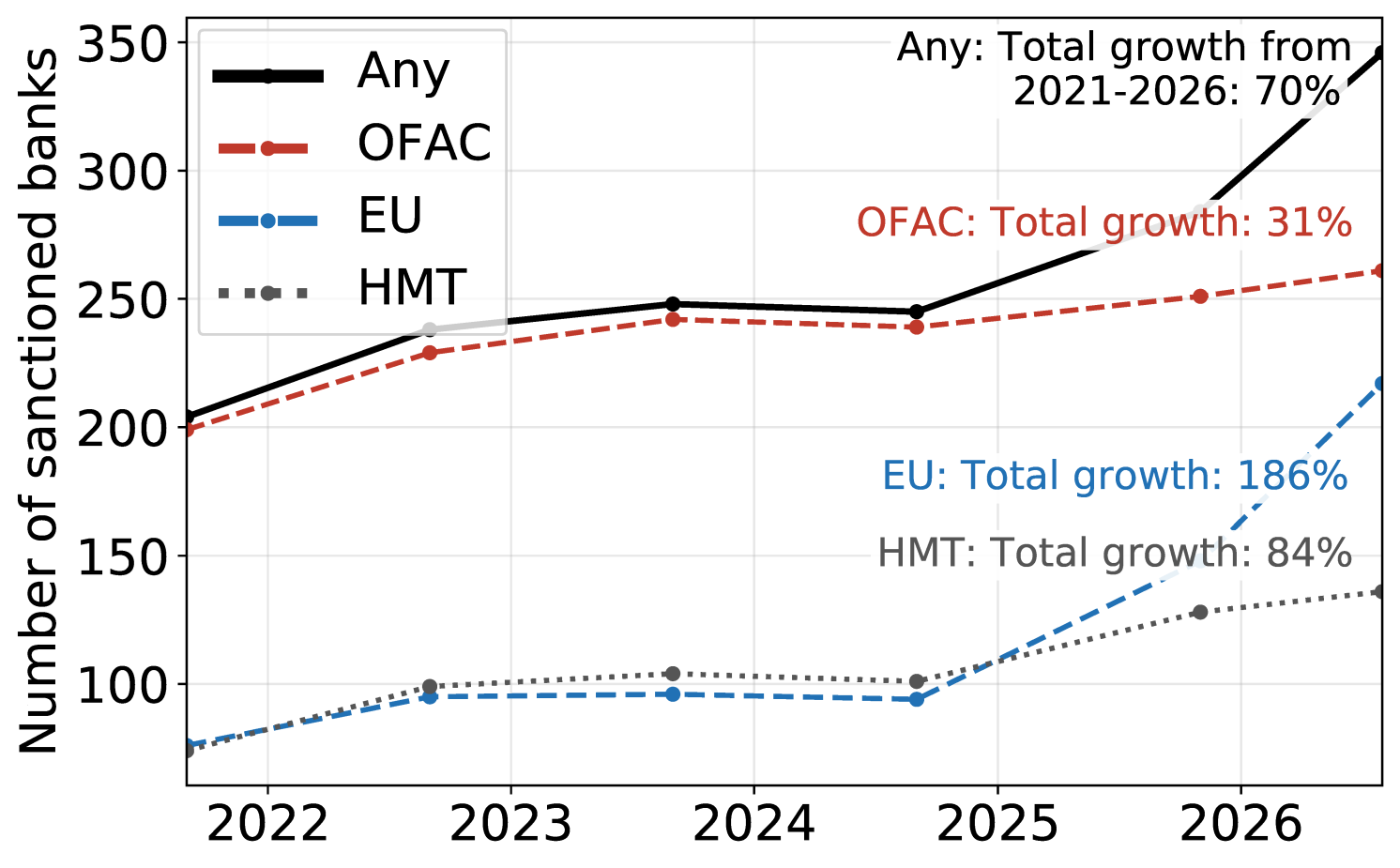
Understanding the functionality of financial sanctions is increasingly pressing, especially given their rising frequency over recent decades (Felbermayr et al. 2020). The number of entities on the US Treasury’s primary sanctions list has escalated dramatically from under 1,000 in the year 2000 to almost 20,000 today. In our study, the number of banks in emerging markets and developing economies sanctioned by the US, EU, or UK surged by roughly 70% over five years, increasing from 204 to 346 (Figure 1). Notably, Russian banks represent the majority of this increase, alongside significant growth in Belarus and Kyrgyzstan.
Figure 1 Emerging market and developing economy banks under sanctions, by authority, 2021-2026
Source: Matvos and Neiman (2026), Figure 3.
Our research investigates four critical questions:
1) Are the dollar (and euro) networks the most useful for global payments?
Yes, they are. We begin by elucidating the function of correspondent banks in international payments. Unlike domestic transactions, which are streamlined through a central bank, international ones require banks to hold accounts with corresponding institutions capable of processing payments in foreign currencies. For instance, in a transaction between an importer and an exporter, if both parties’ banks share a correspondent, the payment can be settled efficiently. If not, the transaction must traverse through multiple intermediaries, with each intermediary, or ‘hop,’ introducing fees and complicating compliance processes, along with increasing counterparty risks.
Dollar and euro networks generally involve fewer hops in payment pathways compared to other currencies. Among emerging market and developing economy banks, around 90% have connections for dollars while 88% connect for euros. In stark contrast, only 62% have connections through British pounds and a mere 34% through the yuan. Moreover, dollar and euro networks connect four to five times more cross-border bank pairs than yuan networks, averaging fewer hops as well—under three for dollars/euros compared to nearly four for the yuan. Approximately three-quarters of bank pairs linked across borders find the shortest payment pathway through the dollar or euro networks, with the yuan offering the shortest path about 3% of the time.
Significantly, the heightened connectivity of the dollar network can be attributed to key hubs situated within US jurisdiction. The ten most central banks, seen as hubs in the network, represent 77% of the overall PageRank of the dollar network, showcasing its concentrated centrality. In comparison, the euro and yuan networks display similar metrics at around half that percentage. The most efficient payment infrastructures are controlled by a small range of institutions, with access often denied by US and European authorities.
2) Do sanctions succeed in cutting targets off?
Generally, yes. Sanctions drastically reduce the access of targeted banks to major currencies across nearly all global payment channels.
Sanctioned banks ultimately lose their correspondent relationships. Specifically, for banks that are sanctioned and have previously identified at least one correspondent relationship, the probability of maintaining dollar correspondents plummets from 89% to 20% post-sanction by the US. Additionally, the percentage of those with a US-based dollar correspondent dwindles to 11%. Similar losses are evident for the euro, pound, and yuan correspondent ties of these banks.
Compounding the issue, their remaining network access deteriorates considerably. Prior to sanctions, the correspondent relationships of sanctioned banks accounted for roughly 15% of the total PageRank within the dollar network. Post-sanction, access to the most crucial correspondents diminishes, leading to a reduction to below 2%.
The chain length for payments from sanctioned banks to other global banks increases significantly. The number of hops needed for sanctioned banks to connect with banks in their home countries’ five largest trading partners climbs across all currencies we examined, except for the Russian ruble.
As a result, sanctions elevate the costs, duration, and risks associated with payments, frequently routing them through third-country intermediaries.
3) What happens to untargeted banks in heavily sanctioned countries?
In nations facing extensive sanctions such as Belarus, Kyrgyzstan, Myanmar, and Russia, even banks that are not directly targeted also experience diminished access to Western payment networks. These banks likewise face losses in correspondence with dollar, euro, and pound facilitators. This phenomenon is predominantly driven by a de-risking strategy: corresponding banks often sever ties with entire regions to mitigate the chances of incurring secondary sanctions or compliance violations. The implications for entire countries are staggering. For instance, Belarusian banks saw their cross-border correspondent relationships in dollars, euros, and pounds plummet from 139 in 2021 to just 19 by 2026. Furthermore, remaining dollar correspondents were situated in Kazakhstan and China rather than in the US.
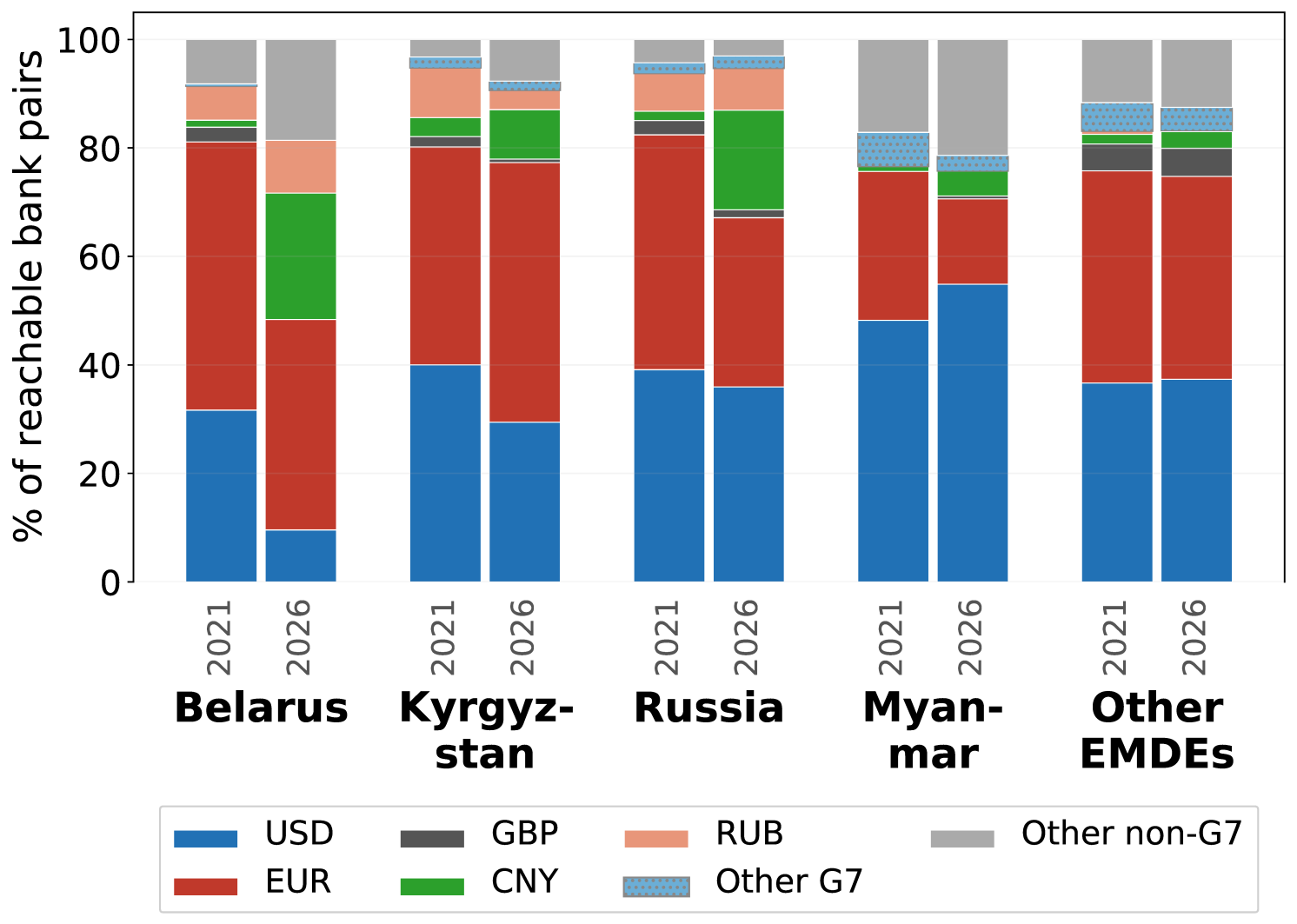
Conversely, non-sanctioned banks within these economies are shifting towards alternative payment networks. Their involvement with the yuan has surged significantly. As illustrated in Figure 2, this transition has profound implications for the relative efficiency associated with each currency’s network. In 2021, the dollar or euro accounted for the shortest payment path from Belarusian banks to over 80% of reachable foreign banks, while the yuan rarely provided the most efficient route. By 2026, however, this narrative had transformed. Together, the dollar and euro now comprise less than half of the set of shortest paths, whereas the yuan has come to account for around 20%, surpassing the dollar alone. Similar trends are seen in Kyrgyzstan and Russia.
Figure 2 Currency delivering the shortest payment route, 2021 versus 2026
Source: Matvos and Neiman (2026), Figure 15.
4) Is this evidence of a global decline in the dollar’s role?
No, according to our data, this is not yet the case. As illustrated in the final bars of Figure 2, the currency composition of the shortest payment routes amongst other EMDEs has seen negligible changes from 2021 to 2026. The dollar and euro still provide the most efficient route for about three-quarters of reachable bank connections, while the yuan’s share has grown by approximately one percentage point.
Interestingly, predictions by Brunnermeier et al. (2022) at the onset of the Russia sanctions suggested the enduring dominance of the dollar, and Eichengreen (2023) corroborated this assessment based on official reserve data. Our payment data thus far aligns with this outlook, revealing only a slight shift away from the dollar in the limited number of economies that have been most severely impacted by sanctions.
For references, see the original post.