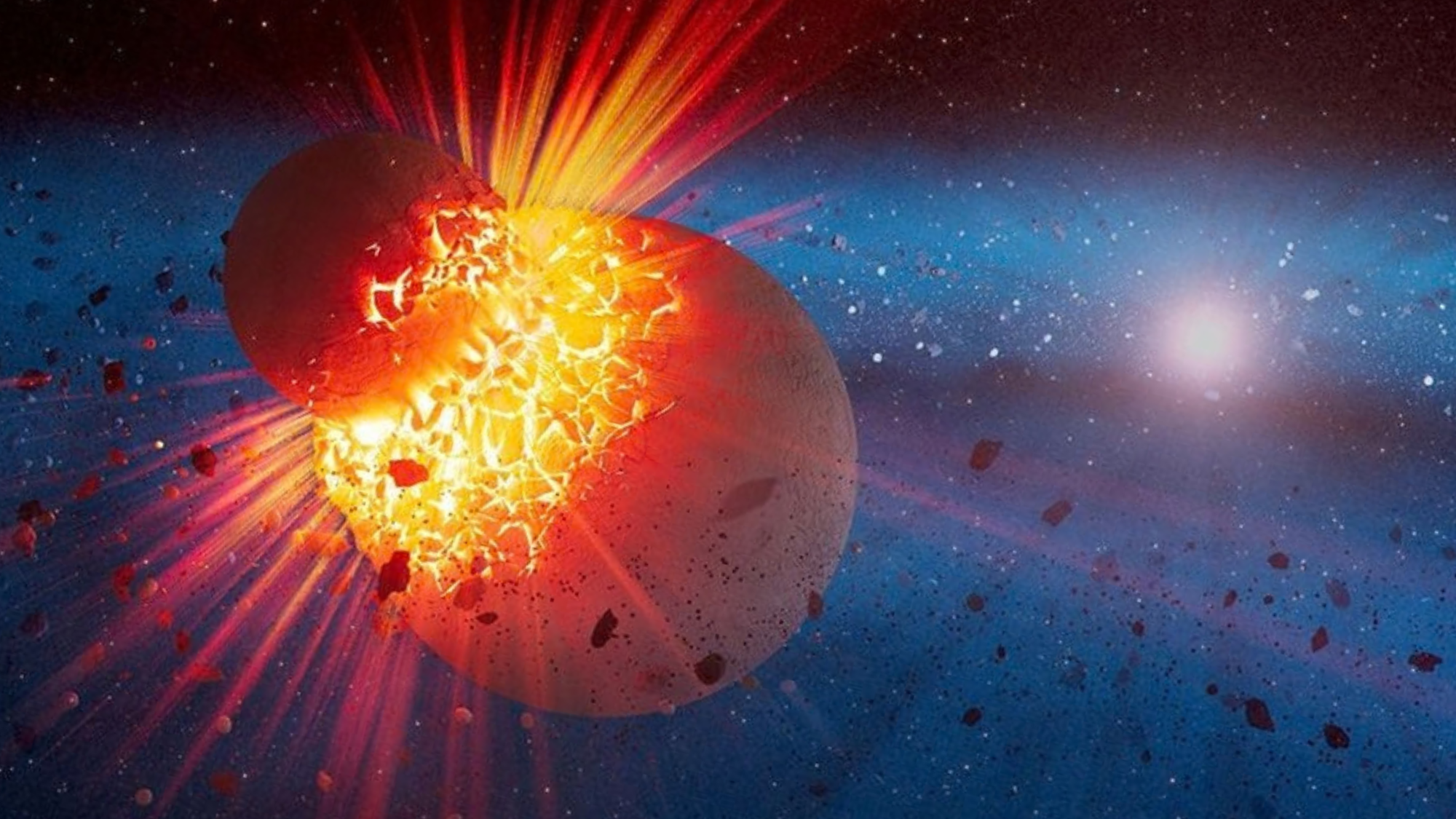
NASA’s James Webb Space Telescope (JWST) is allowing astronomers to examine violent planetary systems where celestial bodies collide. This research could provide insights into a theorized collision between Earth and a Mars-sized body known as Theia, which is believed to have contributed to the formation of the Moon.
Young planetary systems are known for their turbulence, characterized by protoplanetary disks filled with gas and dust. In these disks, planetesimals collide and fuse to form planets. However, the now-retired Spitzer Space Telescope identified a particularly violent category of protoplanetary disks called extreme debris disks, which contain significant amounts of warm dust.
These extreme disks are rare, estimated to exist around just 1% of stars, and it’s thought that our Sun might have once belonged to this group. A team of scientists utilized the JWST to study 21 such disks—four from Spitzer’s archives and 16 newly observed ones. This research has provided the most extensive dataset on extreme debris disks to date.
The team discovered three common properties among these disks: smaller dust grains compared to traditional protoplanetary disks, a high concentration of warm dust, and irregular brightness variations. They classified the minerals in these disks as either silica-rich or silica-poor, hinting at the types of collisions occurring within them.
Silica-rich disks, formed by high-energy impacts from Mars-sized bodies, are mostly vaporized, while silica-poor disks result from collisions between moon-sized bodies. About one-third of the extreme debris disks studied were silica-rich, observed mainly around stars under 300 million years old.
The findings are instrumental in understanding the formation and evolution processes of our solar system. Simulations suggest that terrestrial planets formed in the first few hundred million years, correlating with the ages of the observed silica-rich extreme debris disks. Furthermore, the solar system may have experienced a silica-poor phase during the Late Heavy Bombardment, potentially influencing the orbits of gas giants.
This research sheds light on the formation mechanisms of rocky planets and the evolution of gas giants, contributing to a composite understanding of solar system formation. The findings were published in The Astrophysical Journal.


