Superdome Decibels Debunked: How loud was the Dome when Steve Gleason blocked the punt?
NEW ORLEANS — When Steve Gleason blocked a punt during the Saints’ return to the Superdome after Hurricane Katrina, the roar that followed became part of New Orleans history. Twenty years later, fans who were there still describe it as unlike anything they’ve heard since. But just how loud can the Superdome actually get?
The Science Behind the Superdome’s Roar
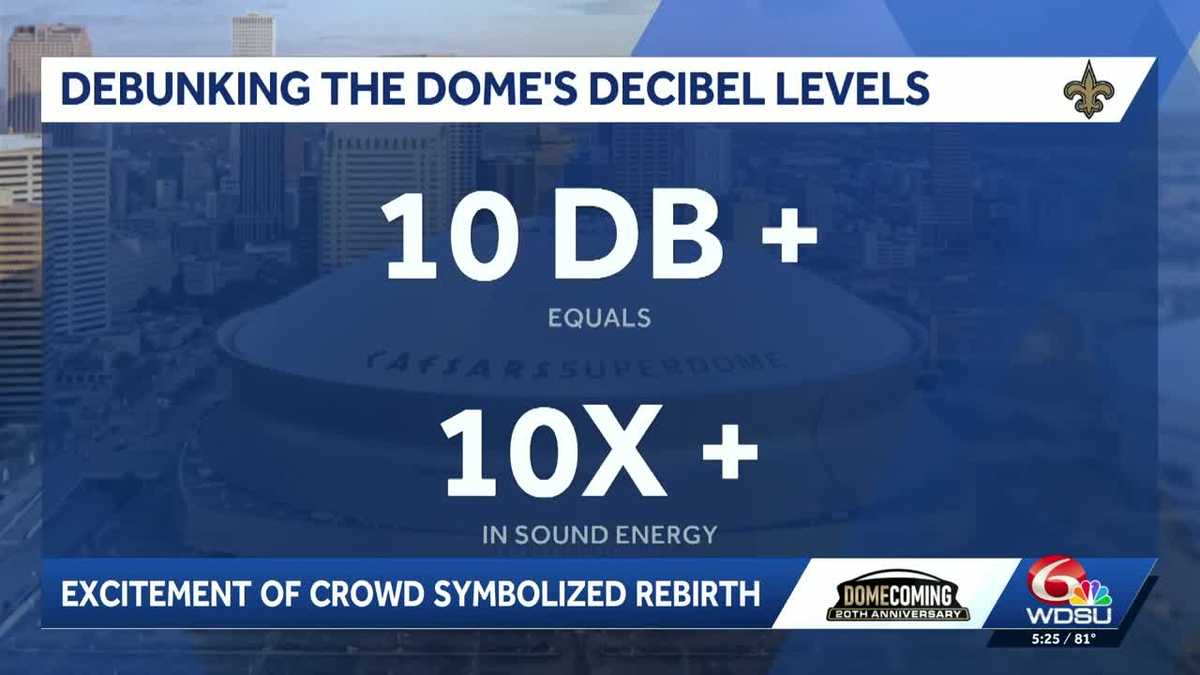
The Dome’s design amplifies sound, with its enclosed structure, curved roof, and hard surfaces reflecting noise back toward the field. This creates one of the loudest environments in the NFL, posing communication challenges for opposing teams. According to Commercial Acoustics, the Superdome ranks third on its NFL Loudness Index, measuring peak readings around 130 decibels. For context, a normal conversation is about 60 to 70 decibels, while raised voices can reach nearly 90 decibels. The loudest moments in the Superdome hit around 130 decibels, a significant increase on a logarithmic scale where every 10-decibel rise represents ten times the sound energy.
How Loud Was the Gleason Block?
While there isn’t an official decibel measurement from the moment Gleason blocked the punt on September 25, 2006, fans vividly recall the experience. They reported vibrating seats and floors, along with an overwhelming sense of energy. Fan Kat Ford described it as “an eruption of sound inside the Dome,” and Randy Smith noted it was “a feeling that couldn’t be recreated.” For many, it symbolized more than just noise; it represented the Saints’ return home after Hurricane Katrina.
Could Today’s Superdome Get Even Louder?
Marc Cordes believes that the acoustics of the Superdome could indeed produce even louder moments in the future. “We have the structure to do it,” he asserted. “We just need those moments. We need that pop.”


