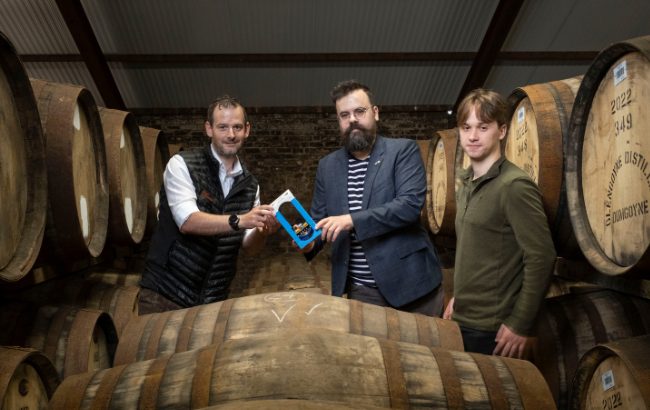
Whisky in Space: A Scottish-Japanese Initiative
A collaboration between researchers from the University of Glasgow and Japan’s Kyushu Institute of Technology is set to explore whisky making in the unique conditions of space. Slated for launch in 2028, a CubeSat satellite will carry 10ml of whisky and a fragment of cask into orbit, subjecting them to microgravity and fluctuating temperatures for up to five years.
Key Aspects of the Project:
- Monitoring Changes: An artificial ‘tongue’ will conduct rapid chemical analyses of the whisky and wood samples, tracking compositional changes over time.
- Potential Benefits: The research aims to explore how ethanol could be produced in space, opening the door for orbital factories capable of manufacturing complex molecules that are difficult to create on Earth. This could include high-value pharmaceuticals and cancer therapeutics.
Dr. Gilles Bailet, the project’s lead, mentions that past research suggests microgravity may allow for the growth of purer chemical crystals and novel protein folding techniques. The team’s goal is to gain insights into fermentation and chemical evolution in space, utilizing whisky as a well-understood model system.
Student Involvement
A team of seven final-year mechanical engineering students from the University of Glasgow is currently in Kyushu, collaborating on designing the satellite’s systems, including power and communication components. Their work is supported by Allen Associates, a distillery design consultancy, and the university’s societies focused on space projects.
Historical Context
This project draws a historical parallel to Masataka Taketsuru, a Japanese student who studied chemistry in Glasgow over a century ago and became the father of Japanese whisky. The current initiative aims to foster more Scottish-Japanese collaboration in scientific fields.
Previous Space Whisky Experiments
While this initiative will be the first to directly observe whisky in the vacuum of space, it is not the first time whisky has been sent beyond Earth. In 2011, Ardbeg Distillery sent whisky samples to the International Space Station, which were shown to have matured differently in microgravity.
Conclusion
As researchers venture into the cosmos with whisky, they not only explore the potential for alternative production methods but also celebrate the rich cultural ties between Scotland and Japan. This pioneering study may lead to new advancements in both chemistry and biomanufacturing in extraterrestrial environments.


