Welcome to a growing crisis in Europe, where years of neglect regarding basic population needs, coupled with extensive funding of the Ukraine conflict, have led to widespread unrest. As social upheaval unfolds across the continent, the pressing questions are whether the recent protests will have lasting significance and if there’s a chance for a shift in political priorities.
To understand the roots of this turmoil, we should first clarify what is driving the current demonstrations. Media outlets often simplify these events by labeling them “school” protests, much like the earlier yellow vest movement was merely brushed off as “fuel” protests. These labels only scratch the surface of a deeper, systemic illness characterized by neoliberalism and the compounding weight of war. If we examine the situation closely, we can identify widespread discontent as a central force behind the unrest, marked by:
- Escalating costs of living.
- Stagnant or declining real wages.
- Crumbling educational institutions.
- Inadequate preparation for climate change repercussions.
- Erosion of public services.
- Intensified by the ongoing war efforts.
- Exacerbated by complicity in acts of genocide.
- General neglect of voter concerns by the political elite.
The outlook is grim:
European diesel prices are skyrocketing, nearing $200/barrel… Today’s Eurostat report reveals that eurozone industrial production has contracted another 1.1% year-on-year. Germany’s output is already nearly 10% below 2021 levels. A massive energy shock is further crippling Europe’s industrial base. Rising diesel prices lead to increased transportation costs, production expenses, and, ultimately, inflation. Companies can’t sustain these costs indefinitely… Margins tighten, production declines, and factories become uncompetitive. Europe is facing yet another stagflationary shock. The ECB can curb inflation by stifling demand with interest rate hikes, further worsening deindustrialization and the sovereign debt crisis. Europe is in a precarious situation…
— Lukas Ekwueme (@ekwufinance) October 18, 2026
While Paris may be the focal point, it’s crucial to recognize that protests are also erupting in Italy, Belgium, Portugal, Spain, Germany, Albania, and beyond. The question looms: where will this mounting frustration lead?
Extraordinary scenes in France. It feels like we’re on the brink of a prolonged revolutionary moment. It’s difficult to predict when the pivotal point will arrive, but arrive it must.
What is sorely lacking are mass parties capable of harnessing this moment and guiding the populace toward a genuine struggle for political power rather than channeling their energies into mere electoral compromise.
— Paweł Wargan (@pawelwargan) October 17, 2026
I largely share this perspective. However, as we will explore, meaningful change seems unlikely without organized, strategic efforts over time. The political class remains deeply entrenched in neoliberal policies and military ambitions, while more citizens awaken to their precarious realities. The European Union appears set for extended instability, with no political forces emerging to adequately address the boiling discontent. In fact, a possible backlash may intensify the repression against protest movements.
The World Socialist Web Site offers a sobering overview of the current political climate in Europe as tensions escalate:
The EU summit last Thursday and Friday in Brussels demonstrated the alarming escalation of the international war crisis. While the Trump administration seeks temporary accommodation with Russia amidst its conflicts with European powers, EU governments, under German leadership, are pushing for the continuation and expansion of the Ukraine conflict. They aspire to assume a greater share of financial and military responsibilities and aim to establish Europe as an independent military force.
This escalation raises the risk of direct conflict between NATO and Russia, potentially even nuclear war. Concurrently, discussions surrounding rearmament, “competitiveness,” trade conflicts, and migration underscore the inseparable link between external war initiatives and increased social repression and authoritarianism at home.
Let’s now examine where the anticipated backlash is already beginning to materialize, followed by an analysis of the political landscape and predictions for the future.
Efforts to Shift Blame to Immigration
Initially, centrist politicians acknowledged some concerns raised by protestors but have pivoted towards a crackdown:
🚨 JUST IN: Macron addresses the nation after two days of unrest in France. The President vowed to penalize all looters and declared that there would be no tolerance. “As we watch these scenes, we ask ourselves: what were they thinking? How can the French people do this to their own country? Why burn down Limoges City Hall, destroy the tourism office in Lyon, storm Marseille City Hall, or attack the prefect’s residence in Bordeaux? Such actions are unjustifiable. We feel a mix of anger and shame. Observing our cities in disarray is unbearable.”
— NEXTA (@nexta_tv) October 18, 2026
In the US, Vice President JD Vance voiced a typical right-wing response to the chaos:
Western liberals have brought the Third World to France and other nations under the guise of diversity and compassion. They disregarded fundamental questions of assimilation and compatibility. We warned them this would lead to unrest, but they chose not to listen.
I hope that France—home to remarkable people—can restore order before more treasured sites are damaged.
And I urge Americans to take note; this is the future congressional Democrats envision for your nation.
— JD Vance (@JDVance) October 18, 2026
What Vance overlooks is that liberal immigration policies also serve capital by exerting downward pressure on wages through an oversupply of cheap, precarious labor. This is further complicated by the fact that even anti-immigration politicians like Vance and Italy’s Meloni support certain types of immigrants—not for reasons of cultural “compatibility,” but rather because they align with economic needs. In the United States, this is exemplified by guest worker programs under the Trump administration, which create a more vulnerable workforce that struggles to unionize.
In Italy, the Meloni government policy focuses on increasing non-EU workers while relegating others to detention centers in Albania—out of reach of EU human rights standards. Many centrist EU politicians have embraced this approach, once categorized as “far-right.”
This attempt to direct blame towards immigration serves to align the “silent majority” with parties like the Alternative for Germany and Le Pen’s National Rally.
The Political Landscape
Let’s consider the potential power of the workforce. Do they have the capability, and will they utilize it?
Union membership tends to be higher in Europe compared to the US, generally exceeding 10% in France, around 30% in Italy, and roughly in the middle in Germany. However, many unions have become passive, with leadership often suppressing active worker participation.
As trade unions and remnants of the yellow vest movement engage in ongoing protests against a fracturing social model in France, the yellow vest legacy serves as a stark reminder of the state’s potential response. This populist movement garnered extensive state repression until its momentum dissipated with the onset of the COVID pandemic, its demands largely ignored.
On November 5, a coordinated strike is planned across transport, education, healthcare, and energy sectors, accompanied by street demonstrations uniting Yellow Vests, students, and union members. This could represent a significant beginning.
To effectively pressure the neoliberal elite, a strategic and sustained interruption of economic activities may be necessary to induce losses. Such an initiative would also rely on community support systems and widespread public backing to sustain its momentum. The groundwork laid by the yellow vests may play a crucial role here; should this approach yield success, a strategy to navigate the international economic isolation marked by a “cordon sanitaire” enforced by Western powers would also be essential.
Moreover, a key question lingers about the stance of workers in defense-related industries as Europe’s political landscape shifts towards militarization and away from social spending. As military investments rise, how will these workers respond? Their actions could significantly capture the attention of policymakers. A concerted effort to reshape social priorities in European nations must address militarization and its implications on social services.
Currently, many workers in the defense sector appear more focused on securing better pay and benefits than contemplating the long-term purpose of their labor.
What about the political parties?
In Germany, there exists a left-wing party representing the working class that opposes high immigration levels, arguing it drives down wages and overwhelms an already strained state. However, the Alliance for Social Justice and Economic Reason has struggled to attain similar traction compared to the far-right AfD.
In Italy, Meloni faces mounting pressure from her right flank. While the Democratic Party is aptly named, its effectiveness remains limited in countering the neoliberal assault on social welfare and is currently led by Elly Schlein, formerly affiliated with Obama’s campaigns.
Should they gain power, the Democratic Party is expected to align with the prevailing EU-NATO agendas.
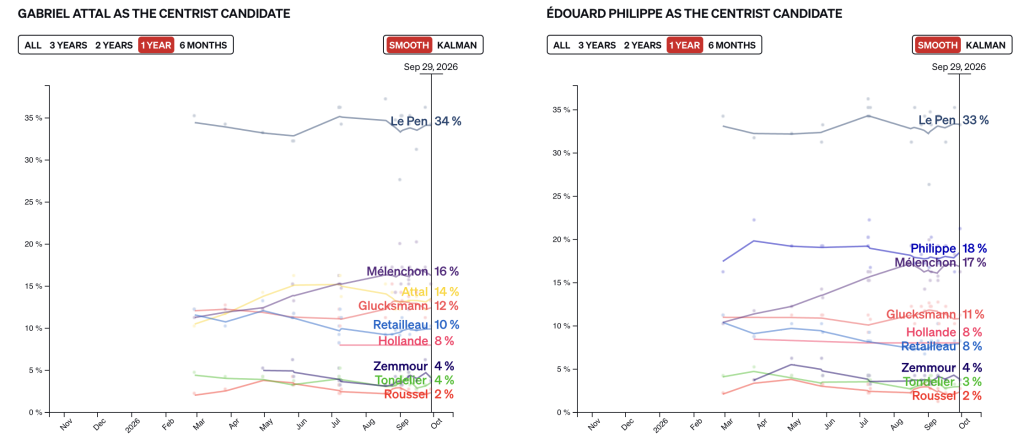
La France Insoumise, which has expressed support for the demonstrations, stands a strong chance of defeat; centrists are more likely to gravitate towards the National Rally.

While La France Insoumise enjoys popularity among young voters, they struggle with older demographics:

Ultimately, these protests may inadvertently bolster Le Pen’s support. Polls indicate that while the French public empathizes with the grievances, they tend to oppose the demonstrations and endorse police action. This sentiment has likely intensified following the recent riots over the weekend.
Thus, we face a significant risk that the EU’s three largest nations, by population and economic stature, may soon be led by far-right parties.
But what does this “far right” designation entail? The AfD and National Rally have previously expressed skepticism towards the Ukraine project and held anti-EU and anti-NATO stances. So, where do they stand now?
As they inch closer to power, we observe the typical procedural transformations: Le Pen is backpedaling on NATO and moving away from their critical position on the EU. From an imperial perspective, this evolution requires scrutiny.
How the “Far Right” in Power Could Facilitate Imperial Objectives
Making Ukrainians the Scapegoats.
The AfD, akin to their centrist counterparts, advocates for Ukrainian refugees to return home:
Alternative for Germany co-leader Alice Weidel insists that Ukrainian migrants should return, especially military-age men, arguing that Germany cannot sustain its welfare commitments to over a million Ukrainians. Her remarks come as the AfD strengthens its electoral position and the treatment of Ukrainian refugees becomes a growing political concern.
Time and the Facade of Change
New political parties entering office with vague promises to oppose NATO, the EU, and the war against Russia may temporarily quell rising dissent—at least for a while.
The case of Meloni in Italy illustrates this dynamic. Campaigning on such rhetoric helped her secure election, leading to the longest-serving government since WWII. However, she ultimately failed to fulfill these promises and instead neutralized anti-EU and anti-NATO sentiment, withdrawing Italy from the Belt and Road Initiative with China, and advancing her predecessor Mario Draghi’s plans to enhance costly American LNG facilities. Throughout this, she maintained nominal support for Ukraine; as her tenure likely nears its close, the likely outcome is a return to a pro-capital government that blames immigrants or a resumption of neoliberal identity politics under the PD. From an imperial standpoint, this represents over four years of functional servitude.
The Civilizational Agenda
As we discussed last week, Secretary of State Marco Rubio has a plan for how these European nationalists should align with imperial interests. His remarks in Athens equate nationalism with fidelity to US-led Western civilization, urging Europeans to make sacrifices:
The ancient Greeks fiercely believed in the idea of the great man: the exceptional individual who earns immortality through significant deeds. However, they also believed that glory and fame were earned through striving, sacrificing, and achieving greatness for a cause greater than oneself. In the ancient Greek narrative, heroes were those willing to pay any price for a cause worthy of their loyalty.
From the Greeks, the West inherited a profound sense of duty—an unwavering loyalty to one’s ethos, one’s principles, and one’s nation. Our heroes, the heroes of the West, are those who choose to remain loyal to their cause even when the cost is high: the person bound by their word, the soldier who never abandons their post, and the captain who goes down with their ship.
What does this imply? Presently, it mirrors what these “far right” parties are doing. As they approach governance, they discard parts of their agenda that challenge established power structures (EU, NATO) while retaining elements that reinforce imperial interests (privatization and militarization).
Both factions advocate for continued militarization and the dismantling of public services.
Currently, they still seek energy partnerships with Russia. However, as they back away from their critical stances on Brussels and Washington, one cannot dismiss the likelihood of abandoning those ties as well.
Nationalism and rearmament in faltering economies create a perilous mix. As public spending dwindles, struggling workers will increasingly rely on one of the only viable paths available: mobilization toward war.
Therefore, as portions of the population in Europe openly revolt and no effective political entities seem prepared to tackle the escalating grievances, we find many factions seeking to exacerbate the crisis.
Both the rising AfD and National Rally, advocating national rejuvenation programs that prioritize further cuts and privatization, vilify immigrants, and redirect funds toward American arms manufacturers and energy corporations, are a significant concern.
With no acceptable outlet for youthful and working-class discontent, it seems likely that we will witness more riots in the coming years. A relevant summary appears in Un-Diplomatic:
Anyone who has spent even a little time in leftist circles has encountered the cliché that “the answer to every problem is to organize!” It’s amusing yet true. But it is true because organizing—in its many forms—aims to build structural or positional advantages, ensuring that when it’s time for a campaign, the odds are stacked favorably. Organizing acts as a strategic endeavor, a war of position. Successful campaigns emerge from effective wars of position.
That’s why the French riots are unlikely to escalate significantly. It’s analogous to why anti-ICE protests have hit a ceiling; similarly, the #NoKings protests did not evolve into a more militant movement.
Oligarchs have either triumphed or are close to winning the war of position in various ways. Their erosion of union density has stripped civil society of its most substantial leverage. The oppressive capacity of modern national security states overwhelmingly favors those in authority, including oligarchs and capital holders.
Without capable wars of position paving the way for substantial actions, mass movements of refusal, while indicative of revolutionary potential, are positioned under a severe structural disadvantage. Thus, when activists confront the state—their protests met with batons, rubber bullets, and raids—it becomes a recurring reality.
Importantly, understanding the riot as a rejection of the status quo elucidates that even the state’s repressive power cannot deter future uprisings. The next outbreak may well occur soon.
Undoubtedly, various factors contribute to a volatile situation. The military push, with the risk of conscription looming, further complicates matters along with deteriorating economic conditions. A gradual decline in living standards is one thing; a steep drop within a few years signifies something far more alarming.
Additionally, an impending backlash from the Ukrainian conflict will likely reverberate across Europe. NC regular Ignacio recently highlighted an interview with historian Marta Havryshko, where she emphasized how far-right combatants are gaining modern warfare experience and developing PTSD—a situation that could foster racial conflicts across Europe. “These individuals need monitoring,” she insists, warning of potential terrorist transformations stemming from their experiences.
Ignacio further notes that the EU elite have been aware of these dynamics for years but have downplayed them, lest they legitimize Russian claims of de-Nazification.
The presence of intelligence-backed Nazi extremists and a persistent threat of war with Russia cast a looming shadow over Europe—beneficial to the entrenched powers, facilitating wealth concentration and dependency on the United States. This scenario resembles a repeat of Italy’s Years of Lead.