Insider Brief
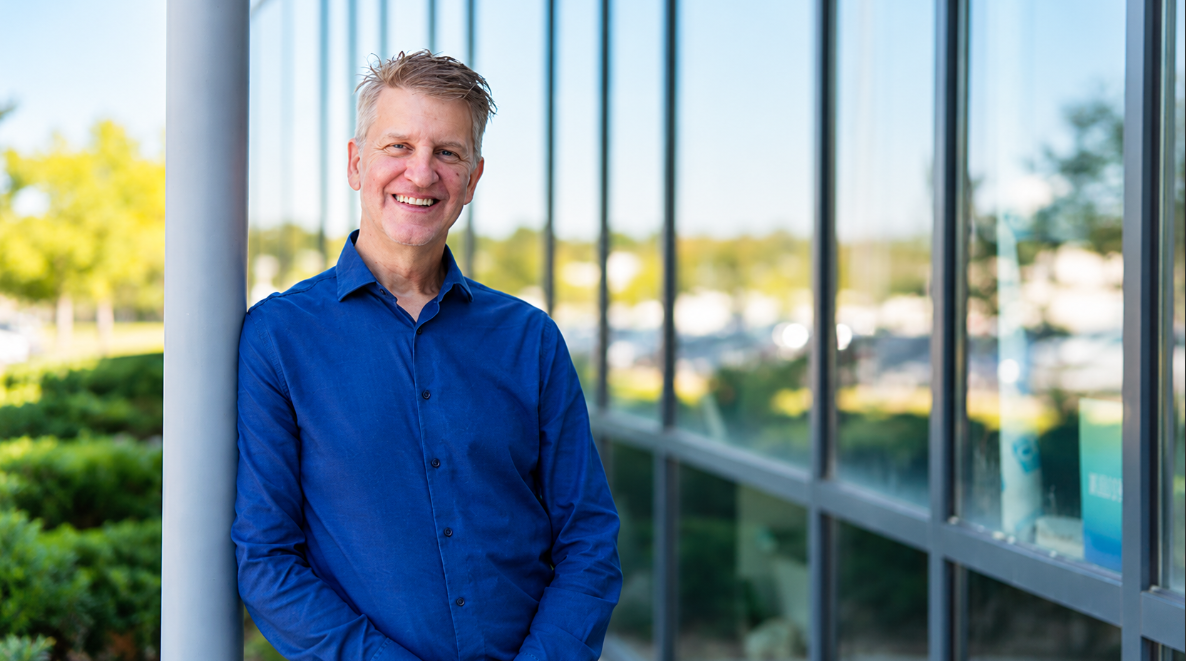
Charles Black is the director of Brookhaven National Laboratory’s Co-design Center for Quantum Advantage (C2QA), where he applies decades of materials science and semiconductor research to quantum computing.
- C2QA researchers are exploring superconducting materials, such as tantalum, to enhance qubit performance and develop quantum hardware suitable for scalable manufacturing.
- Black’s efforts at C2QA build on his previous research at Brookhaven and IBM, focusing on nanoscale materials, semiconductor devices, and manufacturing.
PRESS RELEASE
When Charles (Chuck) Black was a doctoral student at Harvard University, he initially explored superconducting materials for fundamental physics inquiries. These materials, which provide lossless electricity conduction at low temperatures, had limited technological applications back then. However, 30 years later, they are pivotal for quantum computing, with Black now leading a national research center dedicated to their advancement for practical quantum computers.
“I feel like I’ve come full circle,” remarked Black, who became the director of C2QA in June 2025.
C2QA, a National Quantum Information Science Research Center under the U.S. Department of Energy (DOE), collaborates with 28 institutions including National Labs, academia, and industry. The center focuses on breakthroughs in materials science and system architectures to create scalable, fault-tolerant quantum systems.
“Leading a center addressing the scientific challenges in quantum technologies is thrilling. It draws on my diverse career perspectives,” noted Black, who also serves as deputy associate laboratory director for the Energy and Photon Sciences Directorate at Brookhaven.
Materials-Driven Innovation
Black’s career trajectory reflects the evolution of quantum computing, merging fundamental physics foundations with extensive nanoscale materials research and semiconductor technology experience. Prior to his C2QA role, he spent nearly 20 years at the Center for Functional Nanomaterials (CFN), a DOE Office of Science user facility. Serving as CFN’s director from 2016 to 2025, Black witnessed how materials science advances catalyze discoveries across scientific fields, a core mission of C2QA.
During Black’s tenure at Brookhaven, physicists at Yale developed the superconducting transmon qubit, the basic element of quantum computing. However, performance improvements stalled after a decade with aluminum and niobium. Hence, C2QA assembled leading physicists and materials scientists to assess if these materials were limiting qubit performance.
Researchers began fabricating qubits using tantalum—an alternative with fewer oxidation states—to enhance performance. Their investigations, supported by tools at CFN and the National Synchrotron Light Source II, led to the world’s best-performing superconducting transmon qubits, achieving lifetimes exceeding one millisecond—the longest recorded.
“I like remembering the early microelectronics were based on germanium semiconductors, not silicon. Whether tantalum might be the ‘germanium’ of quantum computing is a thought-provoking question,” stated Black.
Yet, enhancing qubit performance alone isn’t sufficient for scalable, fault-tolerant quantum computers; manufacturing at scale poses another important challenge. Black’s earlier experiences at the IBM Thomas J. Watson Research Center provided insights into these manufacturing challenges, guiding C2QA’s efforts toward quantum devices using silicon-compatible materials that align with current manufacturing capabilities, facilitating future large-scale production.
A Collaborative Philosophy
Black’s scientific prowess and leadership position him well for C2QA’s ambitious aspirations. His emphasis on teamwork and collaborative efforts strongly contribute to the center’s success.
“I’ve always enjoyed being part of teams,” Black affirmed. He recalls advice from his high school orchestra teacher, urging students to “play their parts,” a principle he applies in addressing grand scientific challenges.
In Black’s words, “Quantum computing represents one of the significant scientific challenges and opportunities of our time. Its realization depends on scientists like us. We each have roles to play, so let’s unite and perform them to the best of our abilities.”
C2QA is supported by the DOE Office of Science.
Brookhaven National Laboratory is backed by the Office of Science of the U.S. Department of Energy, which supports fundamental research in physical sciences to tackle pressing challenges. More information is available at science.energy.gov.


