New Insights into Neutron Star Mergers: X-Ray Flashes
Astronomers have identified a new phenomenon involving neutron star mergers. Traditionally, these events were known for their short gamma-ray bursts, lasting less than two seconds. Recent research shows some mergers may also produce longer-lasting X-ray flashes that can persist for several minutes.
Key Findings
A study published in Science Bulletin presents compelling evidence connecting these mysterious cosmic flashes to neutron star mergers. The findings open new avenues for understanding unexplained cosmic events detected by the Einstein Probe satellite.
Astronomers have discovered hundreds of fast X-ray transients from distant galaxies since the satellite’s launch in January 2024. While some are linked to immense stars’ deaths, others remain enigmatic. The challenge lies in determining the origins of these events, as distance and energy levels are often unknown.
Magnetar Formation
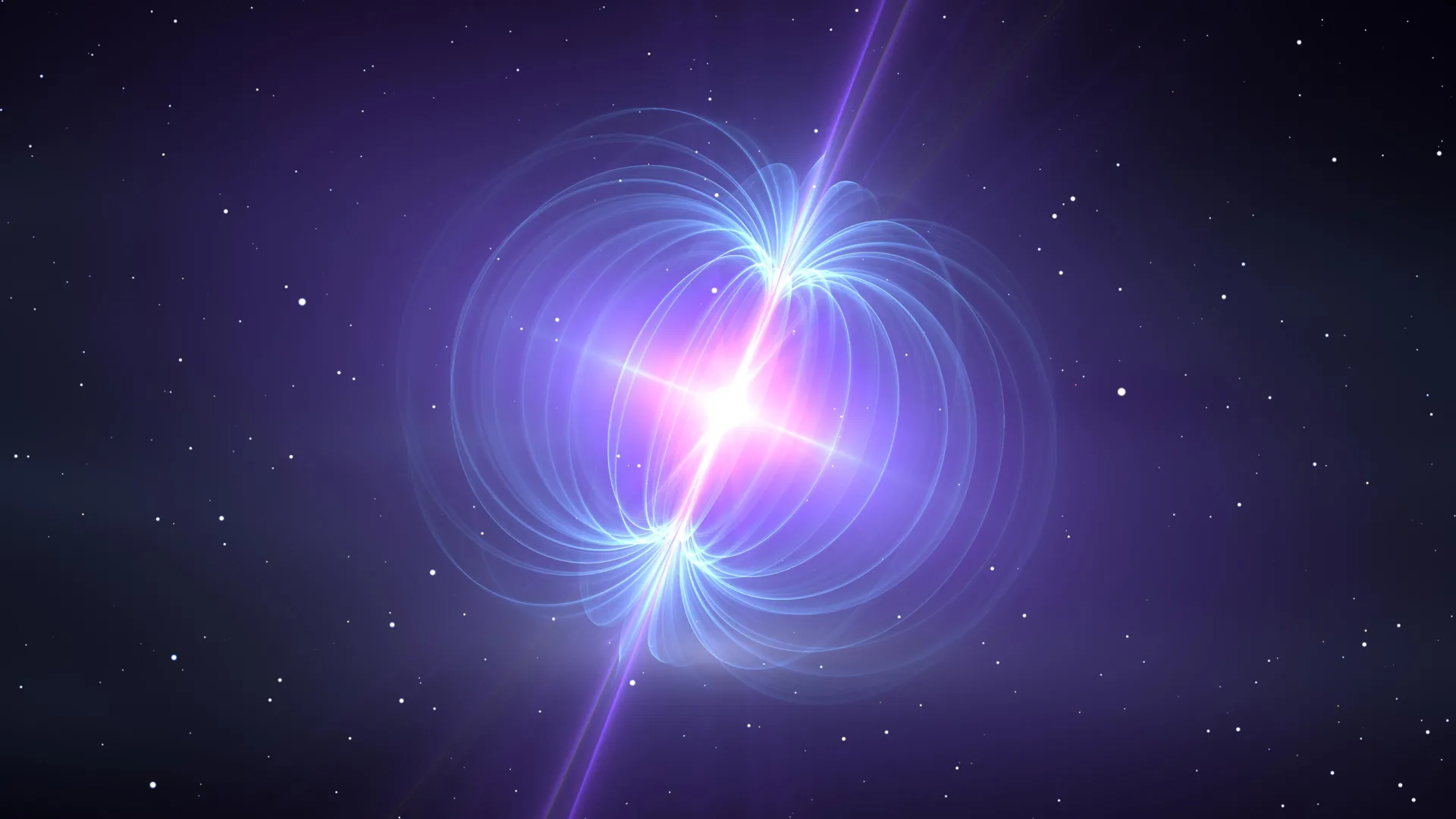
Research from Professor Eleonora Troja’s group suggests that some X-ray transients may indicate the birth of a magnetar—a rapidly spinning neutron star with strong magnetic fields—formed by the collision of two neutron stars. Utilizing alerts from the Einstein Probe, the team conducted follow-up observations with advanced instruments like the European Southern Observatory’s Very Large Telescope (VLT).
Prof. Troja noted that if a neutron star remnant becomes a magnetar, it could lead to longer and brighter bursts, providing insights into these extreme celestial events.
A Record-Breaking X-Ray Flash
On July 4, 2025, an event designated EP250704a/GRB 250704B was detected by several satellites. While the accompanying gamma-ray burst lasted only about half a second, the Einstein Probe recorded X-ray emissions for nearly ten minutes—marking the longest-lasting prompt X-ray flash observed from a neutron star merger.
Graduate student Niccolò Passaleva, who led the follow-up observations, emphasized the significance of capturing this event, likening it to having a front-row seat to cosmic phenomena.
Measuring Distances and Absence of Supernovae
Using the VLT’s X-Shooter instrument, the team analyzed the event’s light, measuring a redshift of z=0.6610, indicating the explosion occurred over six billion years ago. Notably, they found no associated supernova, typically expected from a massive star’s collapse, bolstering the case for a neutron star merger.
Future Directions
This research could revolutionize how astronomers identify and understand neutron star mergers. By continuing to find similar X-ray flashes, researchers aim to establish how frequently these mergers create magnetars.
Passaleva expressed excitement for future gravitational wave observations, envisioning the potential to pair X-ray bursts with gravitational waves from the same source, thus offering a clearer picture of these dramatic cosmic events.
Collaboration and Acknowledgments
The study involved an international team of astronomers, with lead authors including An Li, Chen-Wei Wang, Niccolò Passaleva, and Jie An. The research utilized extensive observations from the VLT, part of a larger program titled “QUEENB: a QUEst for Elusive Neutron star and Black hole mergers,” led by Prof. Troja.
This groundbreaking work represents a significant leap in our understanding of stellar phenomena in the universe.


