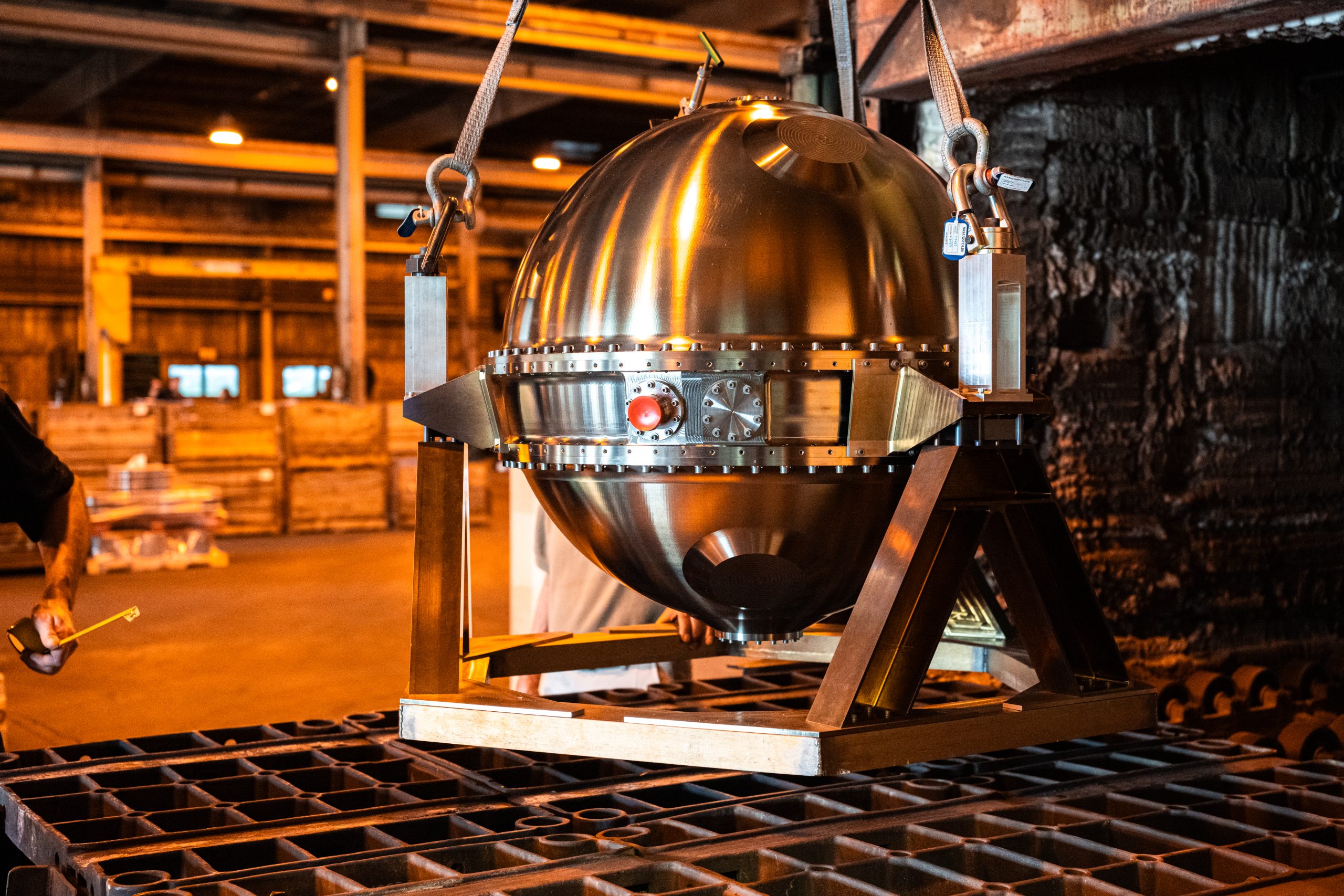
NASA’s DAVINCI (Deep Atmosphere Venus Investigation of Noble gases, Chemistry, and Imaging) descent probe successfully passed a critical thermal test that ran from August 28 to September 10. This test demonstrated the probe’s ability to endure Venus’s extreme temperatures.
The engineering model of the probe was subjected to rigorous testing at Rex Heat Treat in Pennsylvania, one of the few facilities capable of simulating Venus-like conditions. The probe, about the size of a yoga ball, was heated to a staggering 869°F (465°C) within an hour, replicating the rapid temperature increase the probe will encounter during its descent. This thermal cycling was repeated six times, and the model endured without damage, validating its capability to protect sensitive scientific instruments from Venus’s harsh atmospheric conditions.
Jim Garvin, the mission’s principal investigator, emphasized the success of the experiment, stating that it provided a comprehensive evaluation of spacecraft hardware at Venus temperatures—something not done in the U.S. since the mid-1970s.
The DAVINCI spacecraft aims to explore key scientific questions about Venus, including past habitability and the existence of oceans. The descent probe will collect data on Venus’s atmosphere and its composition during a challenging descent lasting nearly an hour.
Kristen Brown, the probe manager, highlighted the engineering hurdles posed by the intense Venusian environment. The probe is designed with a titanium shell that can withstand corrosion while facilitating the study of high-temperature gases.
In addition to its scientific instruments, the probe will capture high-resolution images of Venus’s surface to aid in the creation of a 3D map, while also transmitting data back to the orbiting spacecraft above.
This testing follows a successful campaign earlier in the summer to validate the probe’s imaging system. The DAVINCI mission is now progressing toward final design and fabrication phases, having met major milestones within an accelerated timeline, bringing scientists closer to understanding the differences between Earth and its “twin.”


