Observations of Stellar Winds and X-Ray Flares
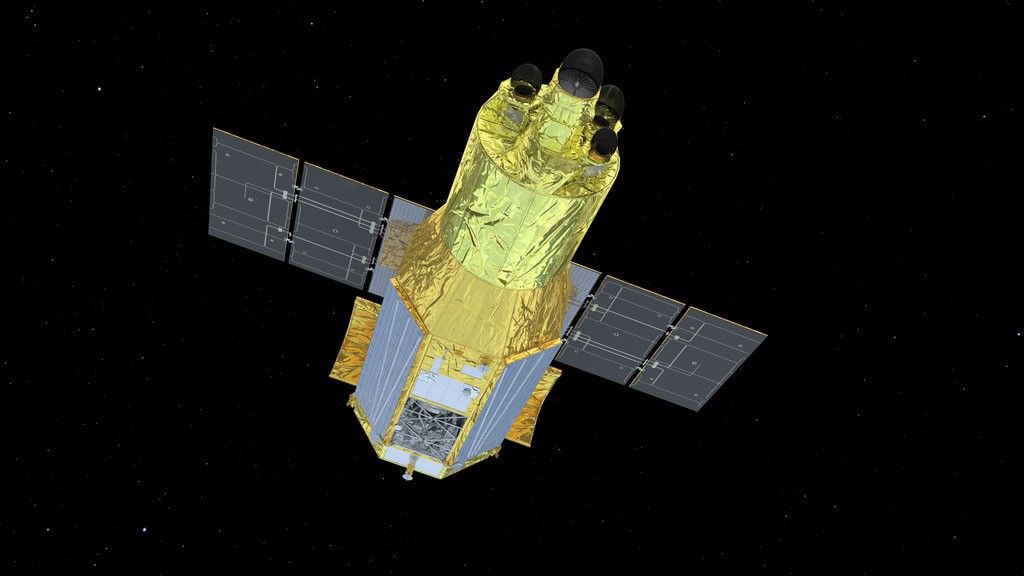
Astronomers utilizing data from the Japan-led XRISM (X-ray Imaging and Spectroscopy Mission) observatory have made a groundbreaking observation of a giant star’s stellar wind impacting its compact companion. This phenomenon is responsible for the strong X-ray flares observed in the system, enhancing our understanding of the extreme universe.
Key Findings:
- Discovery: For the first time, researchers have confirmed the capture of wind plasma by a compact object (a neutron star) from its massive companion, a blue hypergiant.
- Research Context: This research is a part of NASA’s initiatives to explore and understand cosmic phenomena.
- Primary Star: The secondary star, known as Wray 977, is a blue hypergiant, approximately 40 times the mass and 60 times the size of the Sun. Its intense heat generates a stellar wind—a continuous stream of ionized gas flowing outward.
The System: BP Crucis
Located 13,000 light-years away in the southern constellation Crux, BP Crucis contains:
- Wray 977: The massive blue hypergiant extensively loses mass through stellar winds.
- GX 301-2: A neutron star (or pulsar) that spins every 11 minutes. This neutron star exhibits strong X-ray emissions as it moves through the dense plasma stream created by its hypergiant companion.
Observational Details:
- Flares occur during the pulsar’s 41.5-day orbit around Wray 977. The most intense flares are detected when the pulsar travels through regions of especially dense plasma.
- The XRISM observatory captured 16 hours of X-ray spectra from this dynamic system, revealing rapid fluctuations in emission and absorption lines, particularly from ionized iron—a critical finding as it indicates the speed and movement direction of the inflowing plasma.
Innovative Insights:
- Researchers observed a redshift in absorption lines, indicating gas moving toward the pulsar at around 335,000 mph (540,000 kph).
- The analysis suggests that when the pulsar enters the stellar wind stream, it forms an unstable accretion disk that later dissipates and allows plasma to flow directly onto the pulsar.
Conclusion:
The BP Crucis system serves as an exceptional laboratory for studying pulsar accretion influenced by stellar winds, propelled by findings from the XRISM mission’s Resolve spectrometer.
For more information about the XRISM mission, visit: XRISM.
This summary captures the essence of the research findings, highlighting the discovery of stellar wind interactions and their implications for the understanding of pulsar environments.


