By Marcia Dunn
AP Aerospace Writer
Published: Sept. 13, 2026, 3:16 PM PT
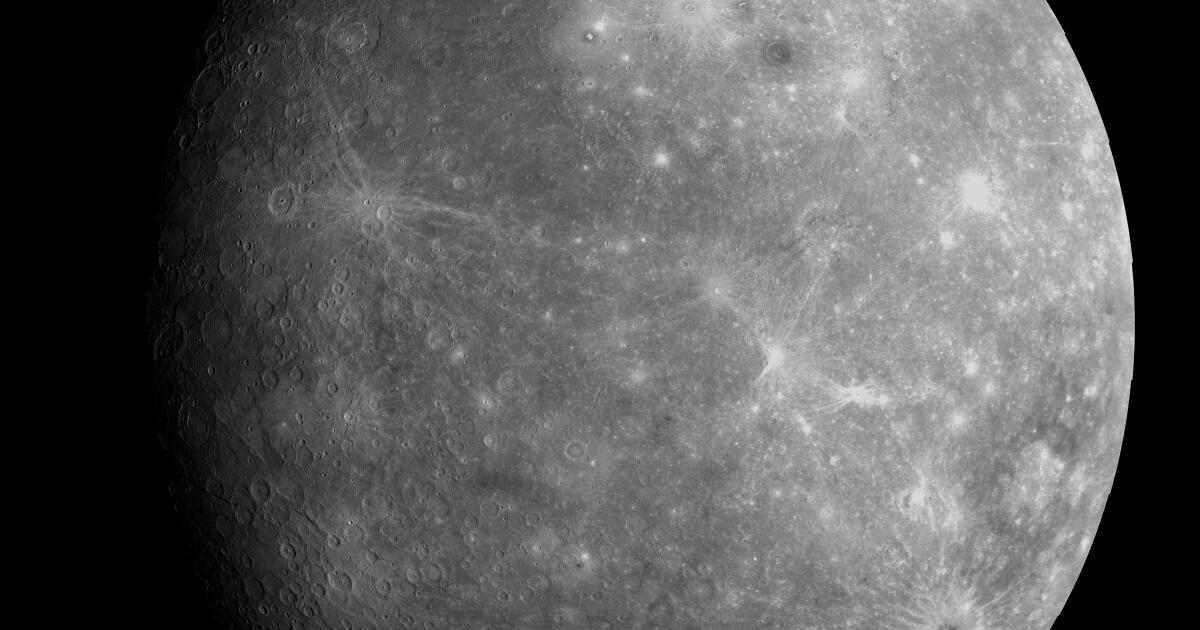
CAPE CANAVERAL, Fla. — A new study reveals that Mercury, the smallest planet in our solar system, is shrinking faster than previously thought, akin to a grape shriveling into a raisin. Researchers from the German Aerospace Center’s Institute of Space Research announced that Mercury’s diameter has decreased by as much as 14 miles, about 30% more than earlier estimates.
This shrinkage may have been obscured by Mercury’s rough surface, which is constantly reshaped by debris from impact craters, according to findings in the journal Geophysical Research Letters. The news comes as the BepiColombo spacecraft, a joint mission by Europe and Japan, approaches Mercury and is set to enter orbit in November for further study.
BepiColombo’s laser instrument will measure Mercury’s ongoing contraction, according to lead author Gaku Nishiyama, who is involved in the mission. Prior measurements from NASA’s Messenger spacecraft in the 2010s indicate that the shrinkage could be even more significant.
Mercury has been contracting since its formation 4.5 billion years ago, as its hot iron core cools and its mantle and crust tighten. Nishiyama’s research, which involves comparing geological maps of Mercury’s contraction with surface roughness, found that areas with more roughness showed fewer signs of shrinkage. This could mean many shrinkage indicators are hidden under layers of impact debris.
The insights gained could enhance our understanding of other contracting celestial bodies. “We are quite excited,” Nishiyama shared, stating they feel as if they are getting closer to grasping Mercury’s evolutionary history.
Dunn writes for the Associated Press.


