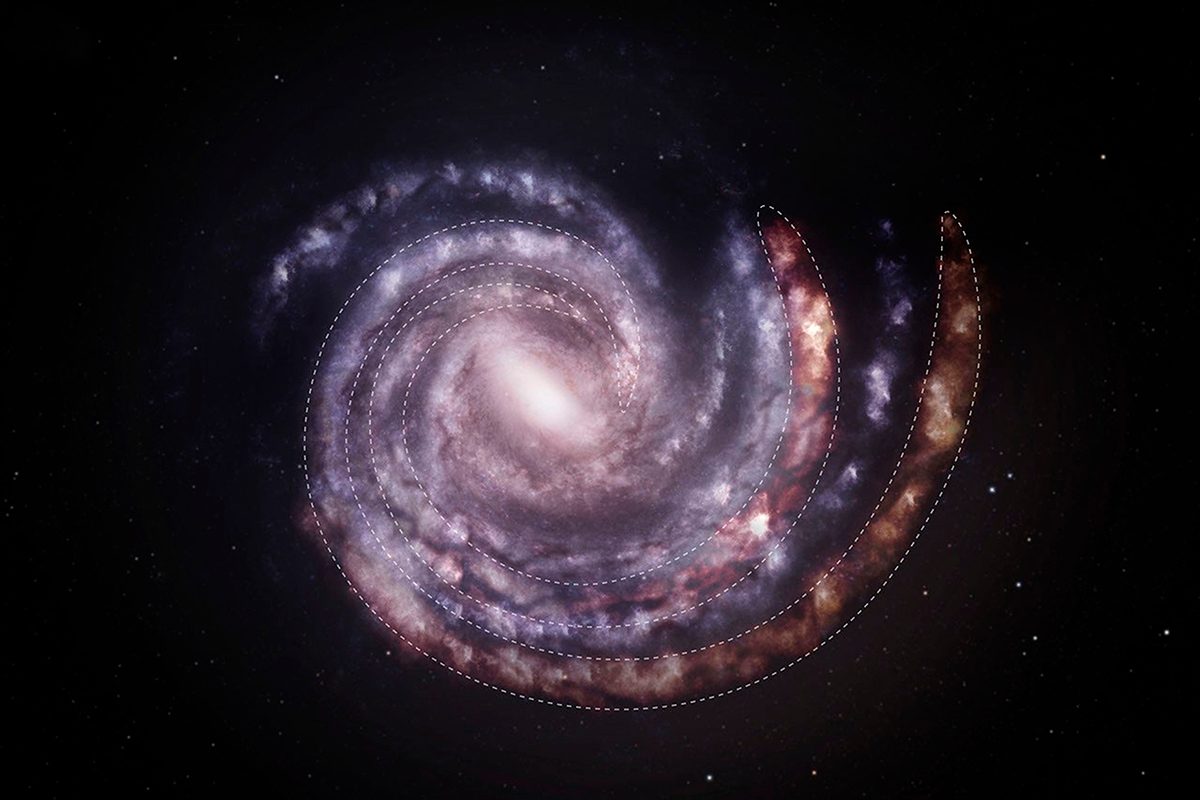
The Milky Way’s outer spiral arms might extend further into space than previously thought, prompting a potential revision of fundamental models of our galaxy.
Astronomers employed a novel measurement technique involving X-ray echoes from gamma-ray bursts detected by NASA’s Chandra X-ray Observatory and ESA’s XMM-Newton. By analyzing these echoes, they could measure the distances to dust clouds within the Milky Way’s spiral arms.
The method involves examining expanding X-ray rings created by gamma-ray bursts in distant galaxies. As X-rays traveled toward Earth, some scattered off dust clouds, forming ‘light echoes’ that illuminated the clouds and allowed researchers to determine their distances from Earth. The results showed that while the Perseus Arm’s distance aligns with accepted values, the Outer Arm and Outer Scutum-Centaurus Arm are up to 10% farther than previously estimated.
Beatrice Vaia, the lead author, emphasized the accuracy of this direct geometric method, which contrasts with traditional approaches that rely on assumptions about the Milky Way’s rotation, especially in its outer regions. However, this technique may not see widespread application soon, as suitable gamma-ray bursts are exceedingly rare, with only a handful identified over the last 25 years. Andrea Tiengo noted that the researchers are dependent on the universe to provide these events.