Breakthrough in Quantum Technology: Preserving Quantum Coherence on Crystal Surfaces
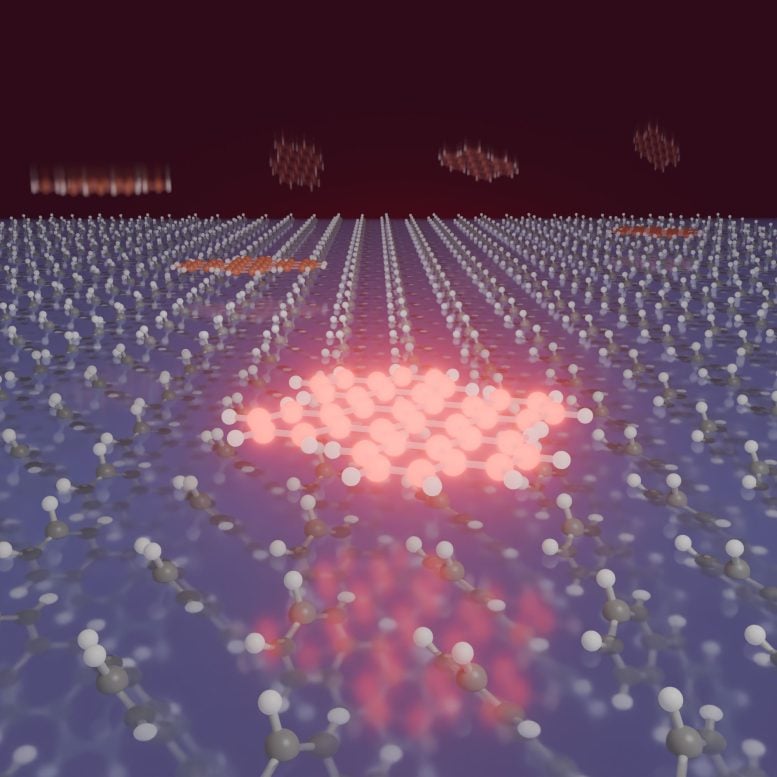
Artistic Illustration of an Optically Excited Molecule
Credit: MPL, Alexey Shkarin
Researchers at the Max Planck Institute for the Science of Light (MPL) have developed a groundbreaking technique that enables individual molecules on ultra-clean crystal surfaces to maintain their quantum coherence at the fundamental Fourier limit. Traditionally, probing molecules on a surface is challenging due to contamination that creates a noisy environment, destabilizing quantum properties.
Key Advances
-
Surface Examined with Spectroscopic Precision: The new method allows for precise examination of molecules on a surface while reaching unprecedented coherence limits, a feat not previously accomplished.
-
Quantum Emitters and Their Applications: The findings are crucial for optical quantum technologies, which rely on atoms and molecules that interact strongly with light. Such quantum emitters can generate single photons and distribute entangled states, vital for quantum computing and communication.
Innovative Cleaning Technique
Prof. Vahid Sandoghdar and his team addressed contamination issues by using organic crystals that naturally evaporate at room temperature. They placed these crystals in a cryostat under vacuum, allowing surface contaminants to be removed as the crystal’s upper layers sublimated. This was followed by cooling the crystal to just above absolute zero, after which molecules were deposited using a microfabricated oven.
Results and Implications
By employing this method, the researchers created a remarkably stable environment for quantum emitters, achieving coherence times that meet the Fourier limit. This stability indicates that the molecules experienced minimal noise, a critical factor for ensuring reliable quantum operations.
Moreover, the presence of the surface altered the behavior of the adsorbed molecules, affecting their orientation and energy states, hinting at new possibilities in how surfaces interact with molecular behavior.
Future Directions
Moving forward, the team aims to combine this innovative surface cleaning technique with atomic force microscopy (AFM) and scanning tunneling microscopy (STM) to gain nanoscale control over individual quantum emitters. This integration could provide valuable insights into surface properties and facilitate the engineering of novel quantum states of matter.
For further reading, see the full study published in Science:
“Nano–electron volt Fourier-limited transition of a single surface-adsorbed molecule”
DOI: 10.1126/science.aeg5014
Stay Updated: Subscribe to the SciTechDaily newsletter for the latest breakthroughs and innovations.