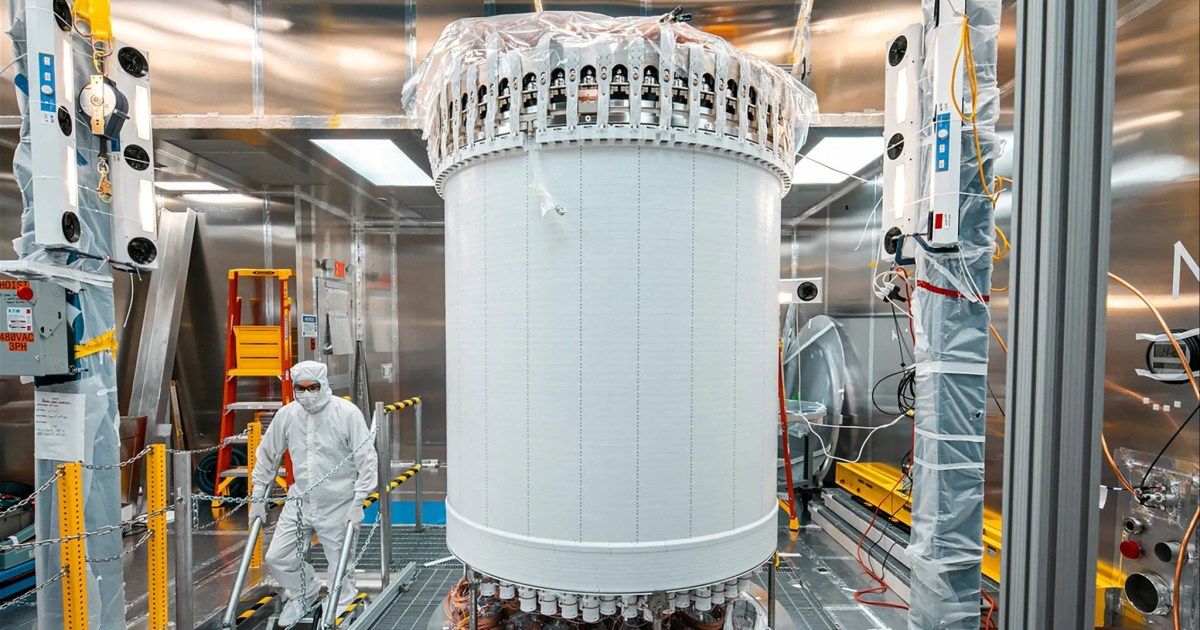
Deep within the Black Hills of South Dakota, researchers have observed an unusual particle interaction in an old gold mine using a tank of liquid xenon, potentially linked to dark matter. While they found a single interaction resembling a dark matter particle, they emphasize that this is not a confirmed detection.
### Understanding Dark Matter
Dark matter is an invisible substance constituting about 27% of the universe, while dark energy, which propels galaxies apart, accounts for 68%. Ordinary matter makes up just 5%. Scientists have inferred dark matter’s existence through its gravitational effects on galaxy movement and light behavior around massive clusters, first hinted at by astronomer Fritz Zwicky in the 1930s.
### Recent Findings from the LUX-ZEPLIN Experiment
The LUX-ZEPLIN (LZ) experiment, involving 250 scientists from 38 institutions, was conducted at the Sanford Underground Research Facility. Its purpose was to test the theory that a hypothetical dark matter particle, known as a WIMP (weakly interacting massive particle), would produce detectable flashes of light upon interacting with xenon atoms.
After analyzing 220 days of data, the LZ team reported a significant event occurring on June 16, 2023. While this finding is not a direct confirmation of dark matter, it is the most compelling signal produced by the LZ experiment to date.
### Significance of the Discovery
Researchers are cautious, refraining from prematurely asserting they’ve discovered dark matter. However, they consider the finding significant, particularly because it has survived multiple checks and remains a viable signal amidst rigorous scrutiny. Physicists like Theresa Fruth express enthusiasm, noting the persistence and reliability of the event, which might guide future investigations into particles beyond current physics models.
### Ongoing Research
In a parallel effort, NASA announced a $4 billion project for the Nancy Grace Roman Space Telescope, aimed at exploring both dark matter and dark energy, which may shed further light on these enigmatic components of our universe.