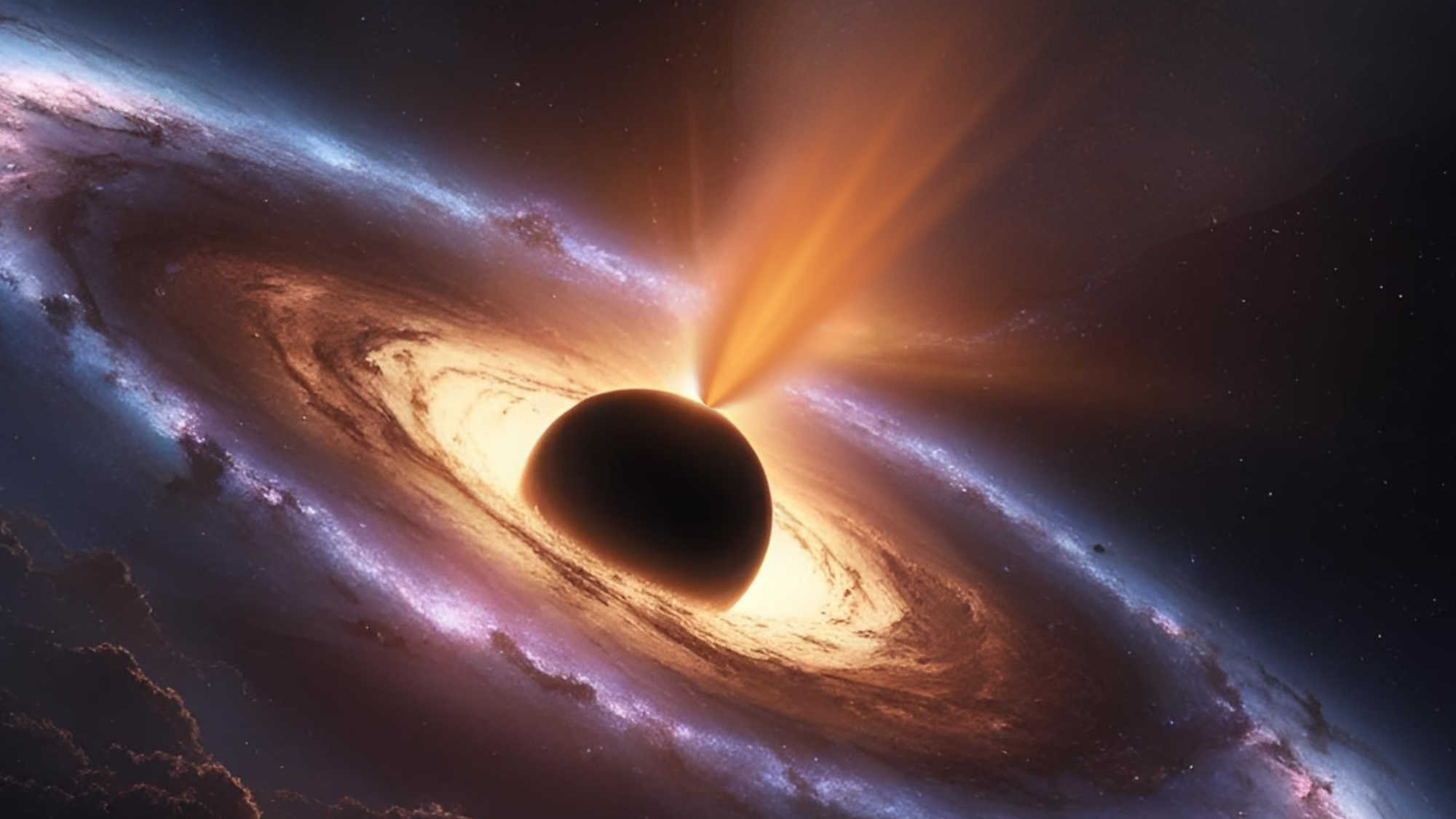
The James Webb Space Telescope (JWST) has been uncovering supermassive black holes in the early universe, revealing that many of these black holes are much less massive than previously estimated, ranging from one to ten million solar masses, compared to earlier estimates of hundreds of millions. This new perspective indicates that these black holes are not as monstrous as once thought, aligning them better with the small galaxies that host them.
One intriguing aspect is that these black holes are often silent in X-rays, which is unusual since feeding black holes typically emit X-rays as they consume surrounding gas and dust. Researchers led by Alessandro Trinca propose that the lack of X-ray emission is not a problem, but rather a clue that the black holes could be feeding rapidly in a manner that prevents X-ray production from escaping.
The researchers suggest these black holes might be undergoing “super-Eddington” feeding phases, allowing them to grow quickly while still being less massive overall. This model proposes shorter, intense periods of accretion instead of continuous growth, which aligns better with the dynamic environments of early galaxies.
To validate this theory, further observations, especially with next-generation X-ray telescopes, will be crucial, along with measurements of black hole masses in earlier cosmic epochs. The team’s research, which emphasizes the importance of non-detections in scientific discovery, was published in a recent edition of Astronomy & Astrophysics.