Yves here. Current global conflicts are heated, and critical developments often lack the attention they deserve. John Helmer sheds light on one such instance: NATO’s heightened surveillance over the southern Black Sea following drone attacks on two commercial vessels off Bulgaria’s coast. Russia has denied any involvement, stating the ships were not on its target list, while EU officials are blaming Russia. Bulgaria finds itself in a precarious position, claiming a lack of evidence but suggesting logic points to Russia’s culpability.
By John Helmer, the longest continuously serving foreign correspondent in Russia and the only Western journalist with an independent bureau. Helmer has also served as a professor of political science and adviser to government leaders in Greece, the U.S., and Asia. He is notably the first and only member of a U.S. presidential administration (Jimmy Carter) to establish himself in Russia. Originally published at Dances with Bears
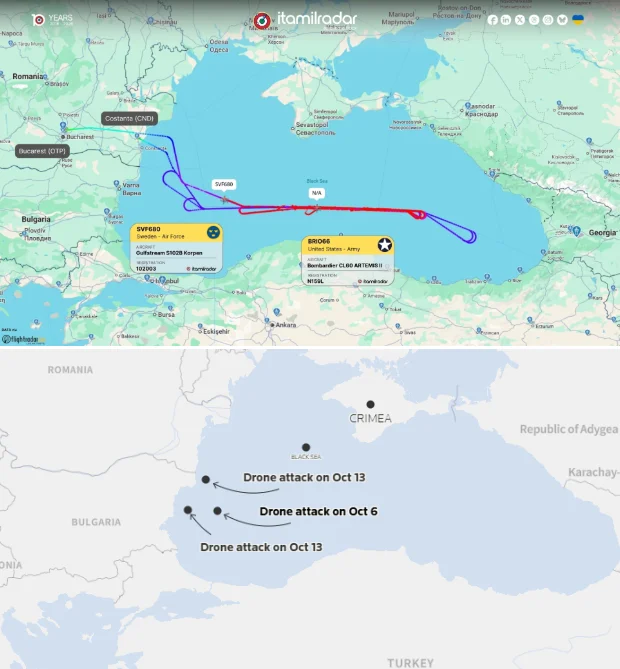
From October 5-7, Swedish Air Force and U.S. Army intelligence aircraft conducted multiple missions over the southern Black Sea, launching from bases in Bucharest and Constanta, Romania. The focus was on the Bulgarian coastline and territorial waters to the east, as well as the northern Turkish shores and Georgia (lead image, top map).
Itamilradar.com, an Italian military monitoring site, reported that this marked a significant change in NATO operations in the region.
“Today’s operations are particularly interesting not because of individual missions, but their simultaneous execution. The two aircraft are operating in the same strategic area while approaching from different bases and with varied sensor configurations. This layered intelligence picture allows the Korpen [Swedish Air Force] to contribute specialized SIGINT collection, while ARTEMIS II [U.S. Army] offers another U.S.-run source of electronic and communications intelligence. Thus, their presence is more remarkable than merely counting two reconnaissance aircraft. This pattern emphasizes Romania’s role as an ISR [Intelligence, Surveillance, Reconnaissance] hub, permitting allied aircraft to reach the Black Sea efficiently, maintaining a constant surveillance presence over international waters,” it stated.
“Today’s simultaneous operations suggest that Black Sea ISR is being pursued as an ongoing NATO initiative, rather than isolated missions. After three consecutive days of Korpen operations, the Swedish contribution is notably significant, while the concurrent ARTEMIS II mission adds another dimension to the situation.”
On October 6, two merchant vessels were targeted in Bulgaria’s economic zone of the Black Sea. The first attack occurred 70 nautical miles off the Bulgarian coastal town of Byala, with the second 140 nautical miles to the east (lead image, bottom map). Reuters reported that this marked the first such assault in Bulgaria’s exclusive economic zone. Initial blame was placed on Russia, while Ukraine denied any involvement.
The first ship was independently identified as the Alfa Watan, flagged under Togo and Turkish-owned, which reportedly sank; the second vessel was the Able, flagged under Palau and Turkish-owned, which later reached the port of Varna. The Alfa Watan had been sailing north, while the Able was sailing south.
Sea and aerial drones were reported as the weapons used in the attacks. There has been no recovery of drone fragments; if the Bulgarians and their NATO allies have found evidence regarding the launch points and trajectory, it remains undisclosed.
Bulgarian territorial waters extend eastward into the Black Sea by 12 nautical miles, while the exclusive economic zone (EEZ) extends from 12 nautical miles to 200 nautical miles. In the EEZ, Bulgaria possesses exclusive rights to explore and manage natural resources (like fish, oil, and gas) in the water and seabed, although the area of the attack is classified as international waters for free navigation and flight.
Was NATO intelligence utilized by the drone operators to target the two ships? Was Russia involved?
Maritime Executive, a U.S.-based publication, reported that Russia’s embassy in Bulgaria informed Reuters that the two vessels were not on the Ministry of Defense’s target list. They indicated that an investigation is necessary to ascertain the source of the drones that struck the ships. Meanwhile, Bulgaria’s Maritime Administrator stated that since the incident occurred outside the country’s direct responsibilities, they would not be organizing an underwater search. There was no indication as to whether any drone debris was recovered.
A week later, on October 13, two drone assaults occurred again against vessels in the Bulgarian EEZ, just outside the territorial limit.
The Bulgarian press reported: “On October 13, two merchant ships in Bulgaria’s Black Sea exclusive economic zone were attacked by drones, one of which sank, Prime Minister Roumen Radev announced. The Turkish-owned, St Vincent and Grenadines-flagged Azov Concorde was struck 17 nautical miles from Krapets and subsequently sank, with one crew member rescued. The Ukrainian-owned Maltese-flagged Chelsea 3 was hit 15 nautical miles from Byala, with fifteen crew members rescued.”
The Bulgarian government publicly assigned blame for these attacks to Russia. According to Prime Minister Roumen Radev, “While we lack clear evidence to implicate any party, the logic suggests that Russia benefited from these results. Therefore, I will be summoning Ambassador Mitrofanova for a discussion today.”
During this time, the Bulgarian and maritime media reported no mention of NATO’s reconnaissance missions; the Italian military monitor was unaware of the drone attacks. This connection was discussed in a podcast with Nima Alkhorshid on October 13; click to view. An extended report regarding these incidents appeared in Vzglyad, a Kremlin-supported platform for military and security analysis, on October 14.
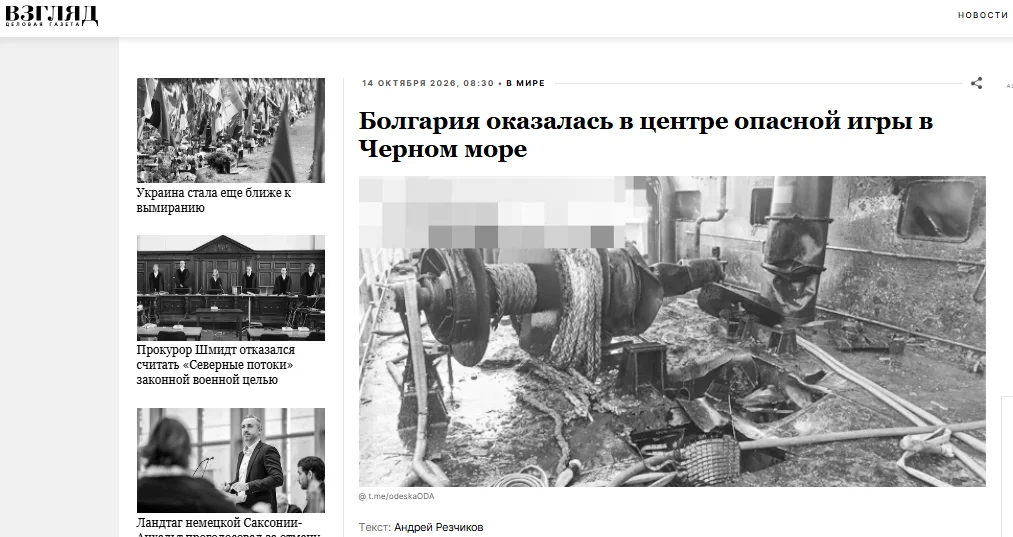
Click to view original: https://vz.ru/world/2026/10/14/1462518.html
 October 14, 2026
Bulgaria finds itself in the middle of a dangerous game in the
Black Sea
By Andrei Rezchikov
Drone strikes on merchant vessels near Bulgaria’s coast have intensified tensions in the Black Sea. While Sofia calls for patience during the investigation, EU and NATO officials swiftly point fingers at Moscow and discuss bolstering military presence in the region. Analysts raise concerns that these events may be attempts to involve the Alliance in the Black Sea conflict. Who stands to gain from this escalation, and what should be Russia’s response?
This past Tuesday, Bulgarian Prime Minister Roumen Radev engaged in discussions with Russian Ambassador Eleonora Mitrofanova regarding the drone strikes on merchant vessels in the nation’s exclusive economic zone. Following their meeting, Radev indicated that Sofia would continue its investigation alongside EU and NATO allies to uncover the truth while noting that definitive evidence regarding the drones’ origin is still lacking.
Mitrofanova responded by stating that the Russian Ministry of Defense has no information regarding the attacks. When Radev mentioned that “Ukraine has no rationale for destroying its own vessels, whereas the Russian Federation could benefit from the strikes,” the Russian diplomat encouraged Bulgaria to “consider alternative logics.” She suggested that night-time attacks near Bulgarian territorial waters might be orchestrated provocations from a third party.
The first incident came during the night of October 6, approximately 80 nautical miles from the Bulgarian coastline. Drones targeted two civilian vessels: the Alfa Watan, a Togo-flagged ship that ultimately sank, and the Able, under the flag of Palau, which caught fire on board. Around this time, Sofia requested technical support from NATO for the investigation, refraining from making high-profile political remarks.
The second attack unfolded just a week later, affecting vessels closer to the Bulgarian shore. Three aerial drones struck the dry cargo vessel Chelsea 3, owned by a Ukrainian entity and sailing under a Maltese flag. Although it sustained damage, it remained afloat and reached Varna’s port. Meanwhile, 17 nautical miles from Krapets, drones attacked the merchant ship HS Dignity, also known in the media as Azov Concorde, which sank. This vessel was flying the Guinean flag and allegedly served Russia’s economic interests.
After this second incident, Radev convened the National Security Council once more, emphasizing that the investigation had yet to yield conclusive evidence.
In Brussels and NATO headquarters, responses to the frequent attacks included strong statements. European Commission President Ursula von der Leyen condemned the air raids, declaring, “The Black Sea has become another front in the war’s escalation.” Additionally, the head of the European Council, António Costa, attributed the escalation to Russia, stating that the growing “hybrid activities by Russia” would be discussed at the forthcoming EU summit in Brussels.
NATO Secretary General Mark Rutte held an emergency call with Radev following the nighttime incident, stressing that the alliance would maintain close cooperation with Black Sea allies and meticulously monitor the situation. He noted that NATO has already bolstered its positions on the eastern border and is contemplating further measures to adapt its defense strategy in the Black Sea to address new shipping threats.
Despite this backdrop, Radev has remained cautious in his assessments and has refrained from assigning blame for the attacks to any specific party. This aligns with his historically pragmatic approach toward Moscow. Analysts argue that the incidents could either be part of a strategic provocation by Kiev, aimed at directly involving NATO in the emergent Black Sea conflict. Some suggest, “Radev’s stance should not be seen as mere situational balancing, but rather as longstanding pragmatism. He must possess enough resolve to withstand external pressures,” military expert Vasily Dandykin elaborated. Dandykin further contends that Bulgaria’s restrained reaction signals that NATO’s eastern flank lacks cohesion. “Russia maintains historical ties with Bulgaria, Romania, and other regional countries. There is a growing awareness that these nations are being pulled into external conflicts, making them less inclined to endorse escalations or sever ties with Moscow. Hopefully, this understanding will only strengthen,” he added.
According to Dandykin, the assaults on merchant vessels within Bulgaria’s exclusive economic zone are provocations that primarily serve Kiev’s interests. He links them to the ongoing military setbacks for Ukraine on the front, suggesting that the intention is to drag NATO into a Black Sea conflict. “In addition, the Ukrainian side could leverage intelligence data from its allies for these strikes. Western intelligence is active in supporting Ukraine; they monitor everything, transmitting coordinates to Kiev. This resembles the situation with the Zaporozhye Nuclear Power Plant: Russia identifies who is firing, but Western countries usually disregard this,” Dandykin opines.
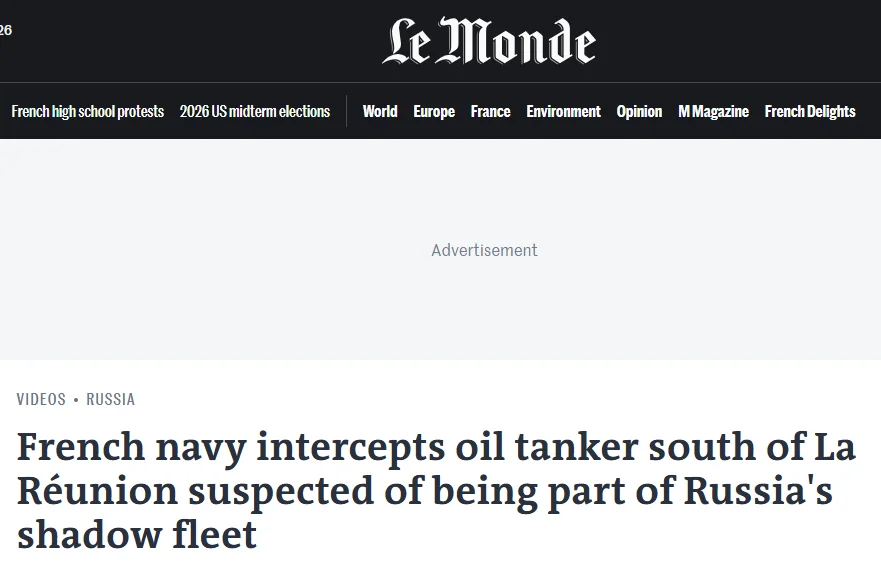
Military expert Andrei Kolesnik, previously a naval officer, also believes that the attacks aim to involve NATO in this conflict, viewing them as part of a broader operation. “This is not merely a Ukrainian provocation, but part of a complex operation orchestrated by NATO and the EU. Kiev acts in the interests of its Western backers, seeking to stir tensions in the Black Sea to lure NATO countries into the conflict. This is just one instance, while similar pirate attacks have been reported in the Indian Ocean and provocations in the Baltic Sea, which collectively form a coherent strategy,” he suggests.
Kolesnik supports his theory with the timing of NATO reconnaissance aircraft deployment over Romania, coinciding with the Black Sea attacks. “There is a clear pattern; they are not even concealing it. American, British, and French aircraft and drones survey the area and provide coordinates, followed closely by the strikes. Western intelligence assists Kiev, which is why they do not publish any evidence—it simply isn’t in their interests,” Kolesnik critiques.
Against this backdrop, he interprets EU and NATO statements about enhancing defense in the Black Sea as efforts to legitimize further militarization of Europe. “International maritime law is being disregarded: ships are seized and subjected to piracy, exemplifying the approach parallel to that of the French in the Indian Ocean. This behavior fuels the EU’s war machine while other sectors—like automotive, engineering, and machine-tool manufacturing—face crises; the defense sector, however, is thriving,” Kolesnik concludes.
October 15, 2026 -- https://www.lemonde.fr/en/videos/video/2026/10/13/french-navy-intercepts-oil-tanker-south-of-la-reunion-suspected-of-being-part-of-russia-s-shadow-fleet_6758563_108.html
In reflecting on these accusations and threats, Dandykin advises Russia to exercise restraint, monitor the evolving scenario, and fortify its military capabilities instead. “With a vast expanse of territory, we control the Northern Sea Route and can conduct exercises in the Arctic, expanding our reach toward Indonesia. The Ukrainian predicament is merely proxy support for the West. Russia possesses broader capabilities. Hence, our Navy and Aerospace Forces can efficiently counter increased reconnaissance activity and potential provocations in neutral waters without descending into a direct confrontation,” he concluded.