Astronomers Detect Most Distant Fast Radio Burst Yet
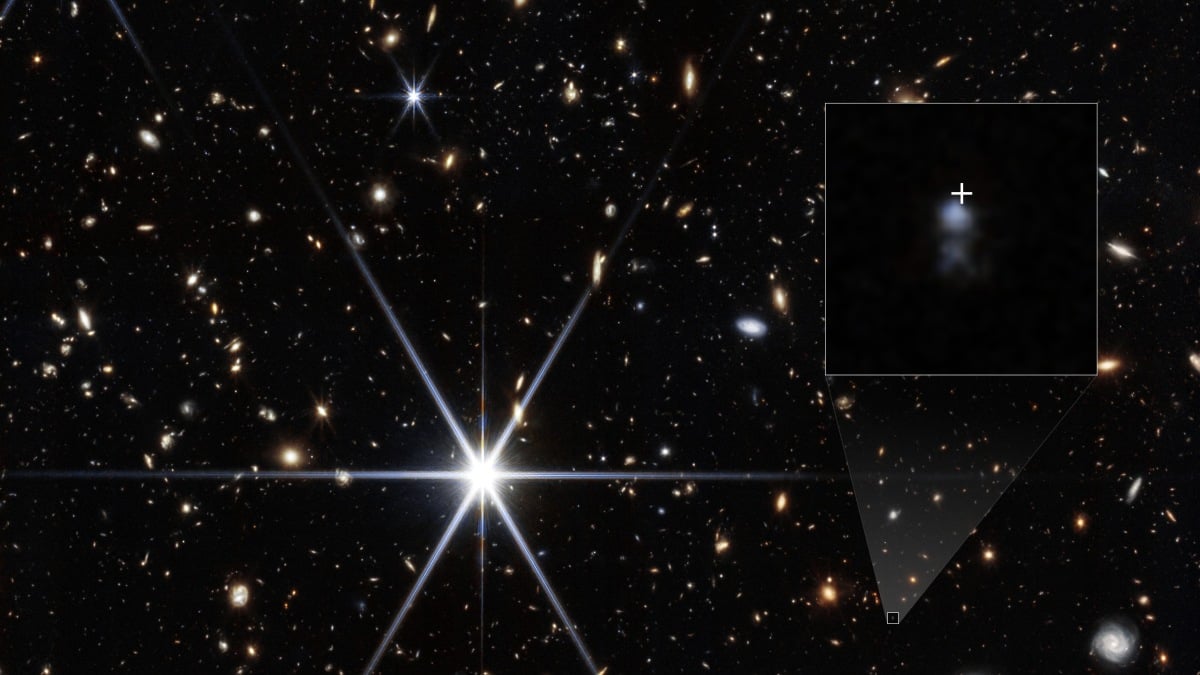
A remarkable discovery in the field of astrophysics was made when South Africa’s MeerKAT radio telescope detected a fast radio burst (FRB) designated as FRB 20240304B, which traveled through space for over 10 billion years before reaching Earth. This detection marks it as the farthest FRB ever confirmed.
Understanding Fast Radio Bursts
Fast radio bursts are intense bursts of radio waves that last mere milliseconds but emit a tremendous amount of energy. The first FRB was discovered in 2007, and despite various theories, the exact causes remain largely unknown. Most FRBs are single occurrences, making them difficult to locate and study.
Key Findings
On March 4, 2024, after unsuccessfully searching for the burst’s origin using the world’s largest ground-based telescopes, researchers from the University of Sydney, led by Manisha Caleb and Themiya Nanayakkara, employed NASA’s James Webb Space Telescope, which ultimately identified a faint galaxy from a time when the universe was approximately 3 billion years old—double the distance of the previous record.
The findings indicate that this burst originated from a smaller galaxy, approximately 1,000 times less massive than those typically associated with FRBs, which typically emerge from larger, mature galaxies. The galaxy was keenly identified during a period known as “cosmic noon,” when star formation rates were at their peak, providing insights into the potential causes of FRBs.
Exploring Theories Behind FRBs
Two primary theories exist regarding the origins of FRBs, both involving neutron stars:
-
Neutron Star Mergers: This theory suggests that FRBs occur as two neutron stars orbit each other and eventually collide. However, such collisions are expected to happen in mature galaxies due to their lengthy time scales.
-
Magnetars: The other theory focuses on magnetars, which are young neutron stars with powerful magnetic fields. The strain in a magnetar’s crust can cause abrupt fractures (starquakes), potentially leading to the release of FRBs.
Given that the host galaxy of FRB 20240304B contains few heavy elements, a characteristic of its early age, the research team posits that magnetars could be responsible for many fast radio bursts, especially this particular one.
Significant Implications
The detection of FRB 20240304B not only enhances our understanding of fast radio bursts but also demonstrates the capabilities of radio telescopes like MeerKAT in identifying cosmic phenomena. The burst provided insights into previously unknown galaxy clusters along its path, revealing a cluster 3.5 billion light-years away and also including the closer Virgo cluster.
As co-author J. Xavier Prochaska stated, “A fast radio burst is almost like a cosmic flashlight. It lights up everything along the path.” The implications of this discovery could help astronomers use FRBs as tools to explore the universe more deeply.
For further information, you can refer to the researchers’ findings published in the journal Science.


