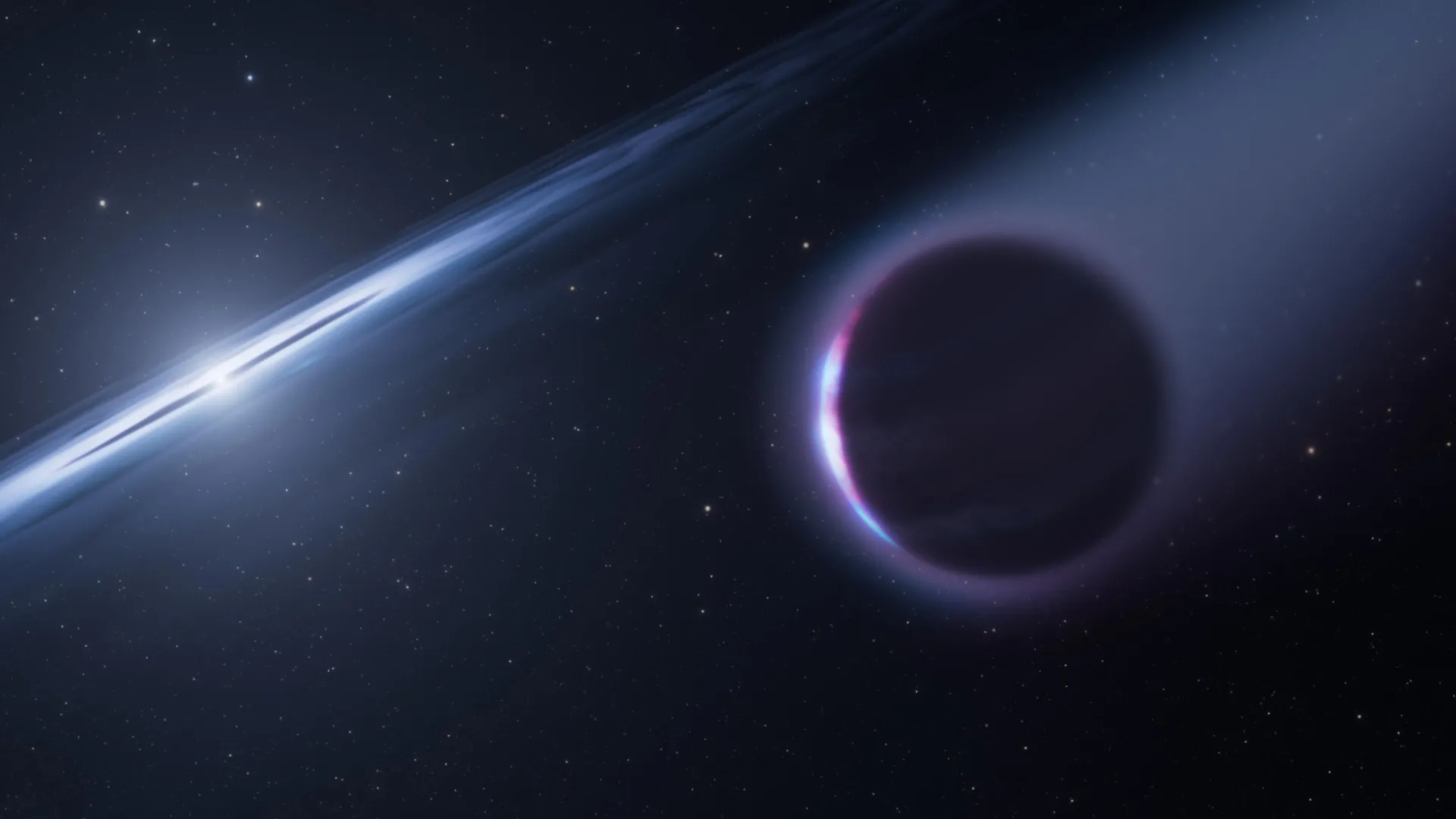
Astronomical Discovery: A Potential Second-Generation Planet
Recent findings from astronomers revisiting NASA’s Hubble Space Telescope data have shed light on a long-standing mystery involving the white dwarf star HS 0209+0832. A study published on October 5 in Nature Astronomy reveals an unusual chemical signature that hints at the possibility of a second-generation planet forming from material expelled by the star.
Understanding White Dwarfs
A white dwarf, the remnant core of a low-mass star, emerges after the star has exhausted its nuclear fuel and ejected its outer layers. While first-generation planets, such as those in our solar system, form alongside young stars, second-generation planets arise later from materials released during a star’s death.
Exciting New Findings
Jamie Williams, a doctoral candidate at the University of Warwick and the study’s lead author, expressed excitement about this revelation: “Rather than seeing the white dwarf stage as the end of a stellar story, we see it as possibly the beginning of a longer narrative with new celestial bodies.”
The Niobium Mystery
Williams uncovered a significant abundance of niobium in the white dwarf system, a signature related to the star’s death rather than its birth. While niobium exists within our solar system and has applications on Earth, its significant presence in this white dwarf suggests it originated from material expelled during the star’s demise.
Nicholas Stone, a theoretical astrophysicist involved in the research, noted the unique nature of heavier elements like niobium: “They aren’t formed through standard stellar processes but in the extreme conditions during a star’s death, marking the expulsion of its inner materials.”
The Birth of a Gas Giant
The research suggests that, after the star released its chemically enriched material, this material coalesced to eventually form a gas giant planet. While much of the remaining material has likely drifted into space, the planet may still be in orbit.
Supporting Evidence
To bolster their findings, the research team compared Hubble’s observations with data from NASA’s retired FUSE mission, which also indicated a strong niobium presence. Additionally, NASA’s TESS monitored the white dwarf, noting variations in brightness that imply a planet is orbiting the star about 3.7 million miles away—closer than Mercury is to the Sun. The candidate world is estimated to be a gas giant, potentially comparable in size to Jupiter, and is rapidly losing its atmosphere.
Future Investigations
Despite the planet’s atmospheric loss, Williams is optimistic about its longevity: “If the second-generation planet exists, it likely will survive over time, eventually residing in its stable habitable zone.”
Outstanding questions remain about the mechanisms of second-generation planet formation and their prevalence. Williams intends to leverage Hubble for further observations over the upcoming years to deepen our understanding of these phenomena and gather substantial data on this intriguing class of celestial objects.
In conclusion, this research exemplifies the unpredictable path of scientific discovery, revealing unexpected insights into the cosmos and opening new avenues for exploration.


