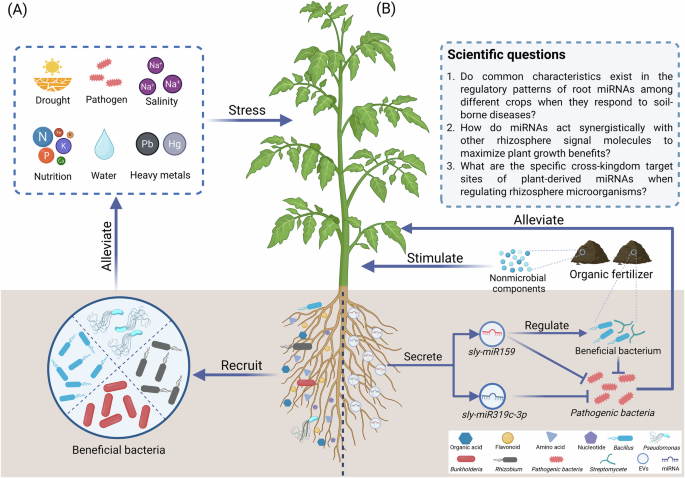
The discovery that organic fertilizer triggers tomato roots to release microRNAs (miRNAs) for regulating rhizosphere microorganisms offers a new avenue for managing soil-borne diseases in sustainable agriculture. Traditionally, farmers have relied on chemical pesticides, which can disrupt the soil’s ecological balance and enhance pathogen resistance. In contrast, the use of plant-secreted miRNAs (like sly-miR159 and sly-miR319c-3p) could provide a more environmentally friendly method for improving crop disease resistance and soil health by simultaneously inhibiting pathogen growth and promoting beneficial bacteria.
This research highlights the potential for microbiome engineering in agriculture. If the components in organic fertilizers that stimulate miRNA release can be identified, and their stability in soil enhanced (possibly using carriers like exosome-like vesicles), it could pave the way for developing targeted biological agents that restore beneficial microbial populations in soils affected by diseases or nutrient deficiencies. Additionally, the precise role of miRNAs in shaping rhizosphere microbiomes could allow for selective resistance to pathogens and improved soil nutrient cycling.
Several interdisciplinary questions arise from this study, such as whether different crops exhibit similar patterns of root miRNA responses to soil-borne diseases, and how miRNAs interact with other rhizosphere signals to maximize plant growth benefits. These inquiries lay the groundwork for innovative research at the crossroads of microbiology, plant molecular biology, and nanotechnology.
Despite the promising findings, there are challenges to overcome. Current research mainly shows that miRNAs can influence microbial growth, but prokaryotes lack the RNA interference machinery that could facilitate this process. Proposed mechanisms for miRNA action include direct pairing with bacterial mRNAs to block translation or induce degradation, modulation of bacterial small RNAs, and interaction with bacterial receptors to trigger signaling pathways. However, the specific target genes involved in these interactions are not yet identified.
Moreover, the identification of active components in organic fertilizer that induce miRNA secretion remains unclear, raising uncertainties about their chemical identity and the mechanisms by which tomato roots perceive and respond to these components. Understanding these processes could lead to the artificial simulation of organic fertilizer benefits, thus simplifying its application.
Future research should focus on verifying the stability of miRNAs in various soil types, exploring the universality of the miRNA regulatory mechanism across different crops, and optimizing the application of organic fertilizers for better field outcomes. Environmental risk assessments will also be vital to ensure that long-term miRNA induction does not negatively impact non-target microorganisms that play crucial roles in soil ecology.
Overall, Liu et al.’s study significantly advances our understanding of the interactions between organic fertilizers, root miRNAs, and rhizosphere microorganisms. It enhances the theoretical framework for plant-microbe relationships and provides practical strategies for reducing chemical pesticide use while promoting sustainable agricultural practices. With advancements in molecular biology and synthetic biology, there is potential for precise manipulation of rhizosphere dynamics, ultimately fostering a healthier agricultural ecosystem.


