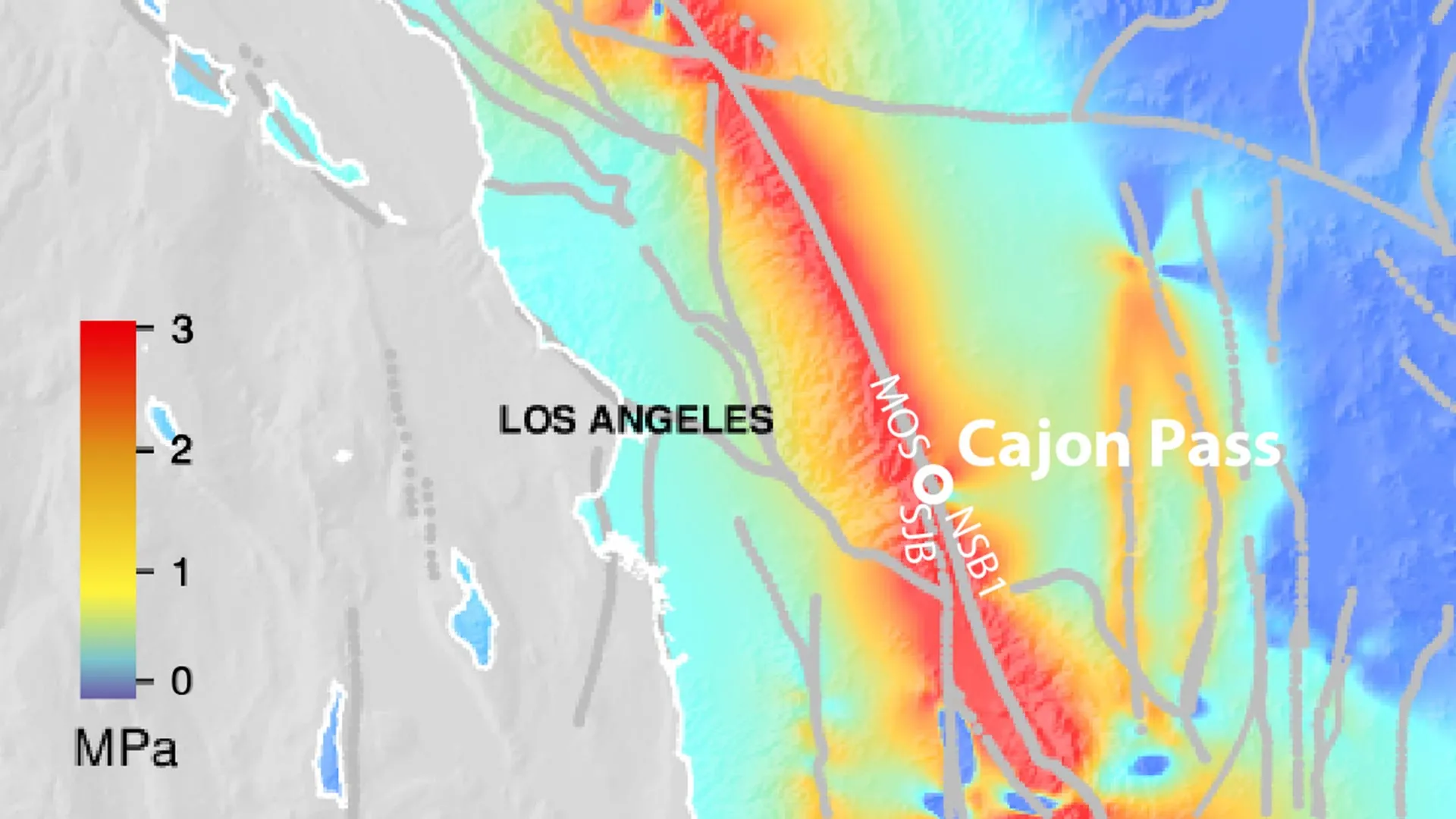
The article discusses the earthquake risks in Southern California, focusing on the San Andreas and San Jacinto fault systems, particularly at Cajon Pass. Here are the key points summarized:
Earthquake Mechanics
- Fault Movement: Earthquakes occur when sections of Earth’s crust move against each other, becoming stuck and accumulating stress over time.
- Energy Release: When the stored energy is released, an earthquake happens.
Fault Systems
- The San Andreas and San Jacinto faults are significant in Southern California for accommodating tectonic motion.
- Cajon Pass serves as a key area where these fault systems intersect, acting as an “earthquake gate.”
Recent Research Findings
- A study led by Dr. Liliane Burkhard modeled 1,000 years of earthquake activity along these fault systems.
- Current tectonic stress levels in some areas around Cajon Pass are reported to be the highest in the last millennium.
Cajon Pass as an “Earthquake Gate”
- The junction has a dual role: it can either stop or allow a rupture to continue from one fault system to another.
- Historical events (like the Fort Tejon and Wrightwood earthquakes) demonstrate both scenarios.
Stress Levels and Earthquake Risk
- The study found that if both fault systems reach high stress levels simultaneously, the likelihood of a significant rupture increases.
- Current stress levels are notably high (3.6 MPa for San Jacinto-Bernardino and 2.8 MPa for Mojave South of San Andreas), which could indicate potential for a major earthquake affecting both faults.
Broader Impact
- A rupture crossing Cajon Pass could impact densely populated areas including greater Los Angeles, San Bernardino, and Riverside.
- Cajon Pass also houses critical infrastructure like highways and rail lines, making it vital for emergency planning.
Key Takeaway
- The study provides a clearer understanding of the stress state in the fault system but does not predict when an earthquake will occur. It emphasizes the need for preparedness based on stress conditions and the potential for significant seismic events in the region.


