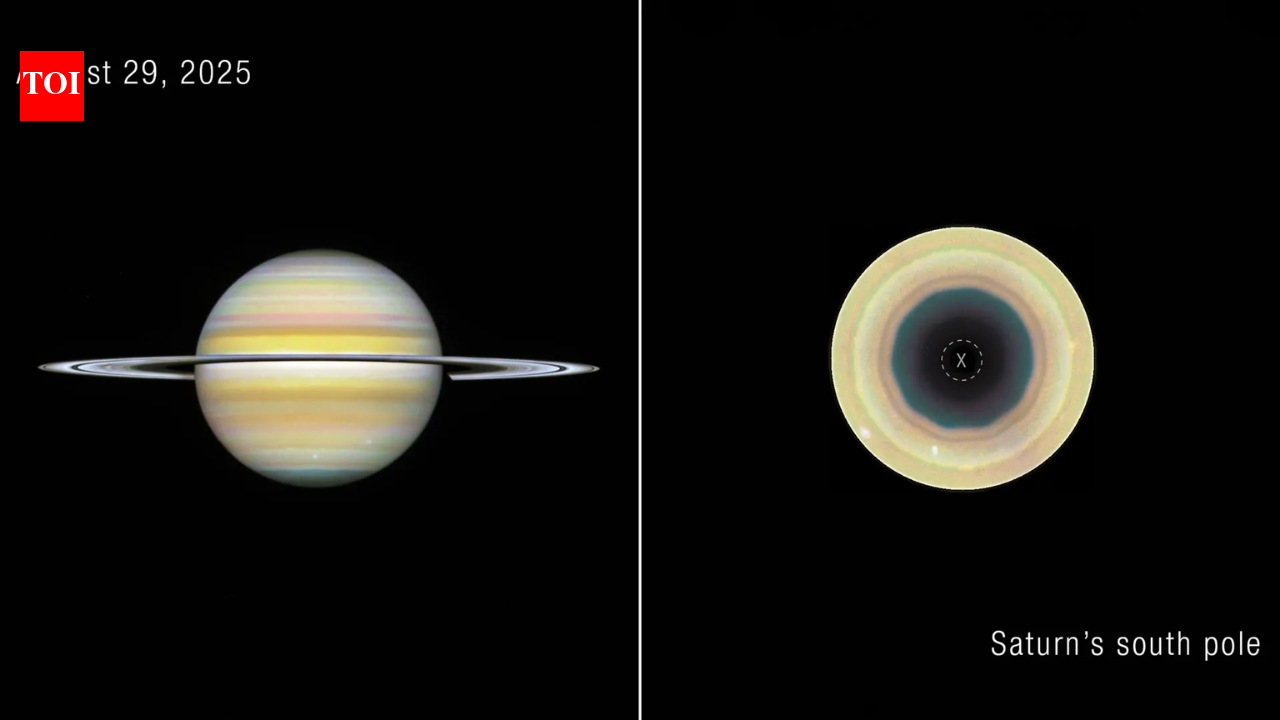
Recent Discovery of a 10-Sided Atmospheric Wave on Saturn
A significant discovery in planetary science has surfaced thanks to an observant amateur astronomer from Australia, Trevor Barry. Using a homemade telescope, Barry detected a subtle ripple on Saturn during his backyard observations in 2024. This initial sighting eventually contributed to the identification of a striking 10-sided atmospheric wave, or “decagon,” located around Saturn’s south pole.
The Journey to Discovery
Barry, who has been observing the night sky since the early 2000s, initially noted this peculiar feature and reported it to Agustín Sánchez-Lavega, a researcher at the University of the Basque Country in Spain. Barry’s observations, combined with those from other amateur astronomers, formed part of an international research effort that validated the presence of this previously unrecognized atmospheric structure. The findings were later published in the journal Science Advances.
Hubble Space Telescope’s Contribution
NASA’s Hubble Space Telescope played a crucial role in confirming the decagon. Observations made over years revealed that this geometric pattern extends through multiple layers of Saturn’s atmosphere, showcasing its complexity beyond a single cloud layer. Initially detectable in early Hubble data from 2023, the structure became increasingly pronounced in subsequent observations.
Comparison with Saturn’s Northern Hexagon
The newly found decagon is particularly fascinating because it contrasts with Saturn’s well-documented hexagon at the north pole, spotted during the Voyager flybys in the early 1980s. Researchers had been searching for a southern equivalent since 1990, making this discovery noteworthy as it highlights unique atmospheric phenomena on Saturn.
Importance of the Decagon
The atmospheric decagon is not merely a visual spectacle; it is intricately linked to Saturn’s atmospheric circulation and jet streams. NASA scientists believe it is evolving and may offer insights into the dynamics of atmospheric wave formation on giant planets. However, questions remain regarding its origins and lifespan, emphasizing the need for continued observation.
Role of Amateur Astronomers
Trevor Barry’s contributions underline the valuable role that amateur astronomers can play in scientific research, using accessible technology to make observations that can lead to significant discoveries. His persistence in observing Saturn has forged a connection between grassroots astronomy and major scientific institutions.
Future Observations
As researchers strive to unravel the mysteries of Saturn’s atmosphere, further studies will utilize Hubble, the James Webb Space Telescope, and simulation models to explore the atmospheric conditions that gave rise to the decagon. The ongoing observations aim to understand its development, stability, and any potential similarities with the northern hexagon.
In summary, Saturn’s 10-sided atmospheric wave not only adds to our knowledge of the gas giant but also exemplifies the exciting intersection of amateur and professional science in the exploration of our solar system.


