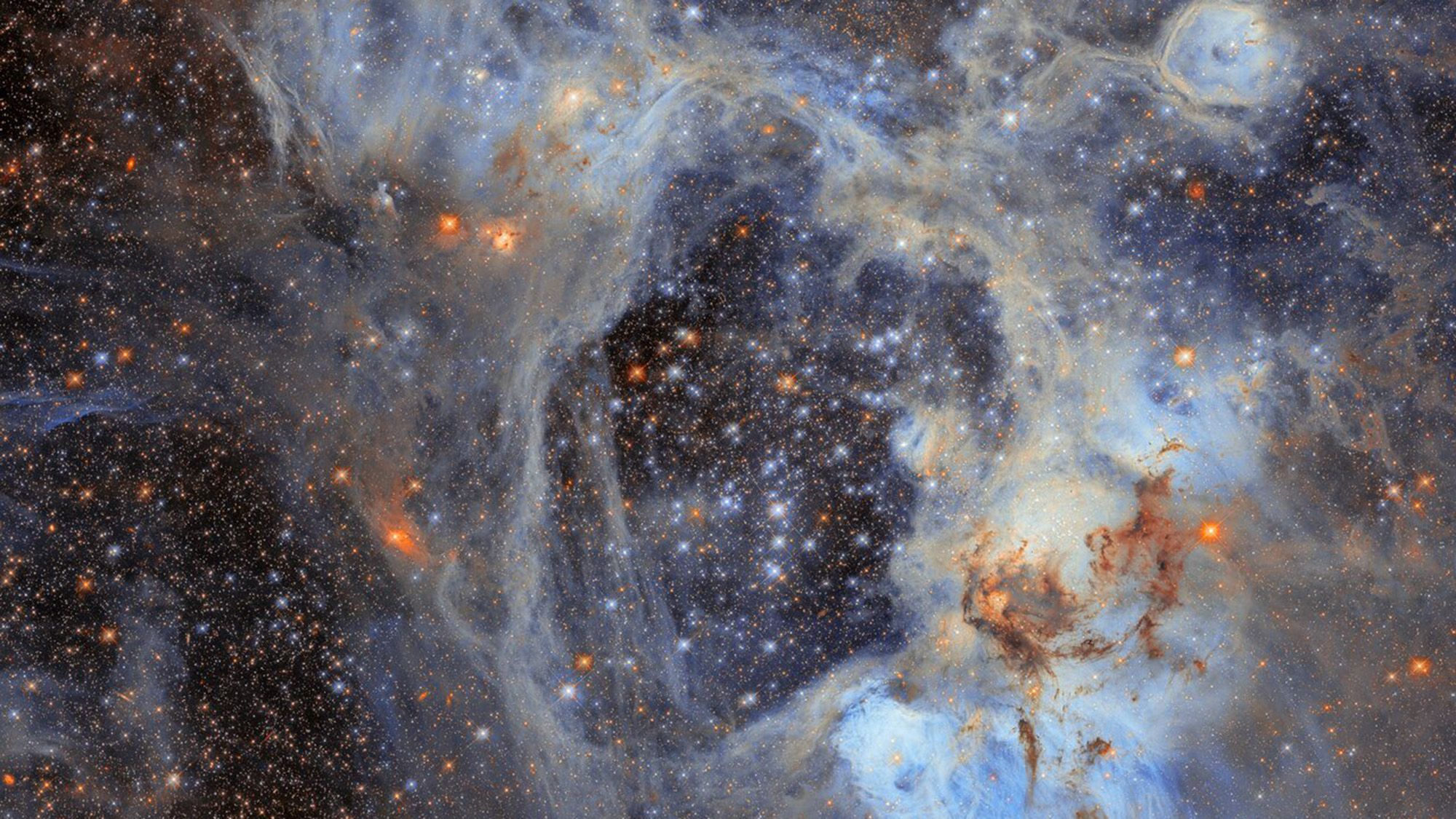
Quick Facts about Nebula LHA 120-N44
- What it is: The nebula LHA 120-N44
- Where it is: 160,000 light-years away, in the constellation Dorado
- When it was shared: September 3, 2026
The LHA 120-N44 nebula presents a fascinating cosmic cycle of destruction and creation. Captured by the Hubble Space Telescope, its spectacular image showcases vast areas that resemble gigantic holes in a cloud. Instead of mere emptiness, this nebula represents a complex interplay where a generation of stars dismantles its birthplace while simultaneously fostering new star formation.
Location and Size
N44 is situated approximately 160,000 light-years away in the Large Magellanic Cloud, a satellite galaxy to our own Milky Way. The nebula spans a remarkable 210 by 140 light-years. For context, the closest star system, Alpha Centauri, is only 4.4 light-years away.
Characteristics
Due to its massive size and appearance, it is referred to as a superbubble, a cavity shaped by a cluster of hot, massive stars located near its center. These stars function destructively, emitting powerful stellar winds that push material into space. The most massive stars eventually explode as supernovas, further clearing gas and dust.
Stellar Feedback
The expelled gas creates a dense shell surrounding the superbubble, within which new stars are born. This intriguing phenomenon, known as stellar feedback, highlights how massive stars both destroy and potentially give rise to new stars by compressing neighboring gas clouds.
Observations and Opportunities
The Hubble image of N44 reveals nearly 500,000 stars, including around 30,000 young stars that have not yet begun hydrogen fusion. This stellar population provides astronomers with a unique opportunity to investigate the time it takes for stars to form, contributing to our understanding of stellar evolution.
This captivating cycle of creation and destruction within LHA 120-N44 not only enriches our knowledge of cosmic events but also illustrates the dynamic nature of the universe.


