Overview of Mount Michael and Its Activity
Location and Significance
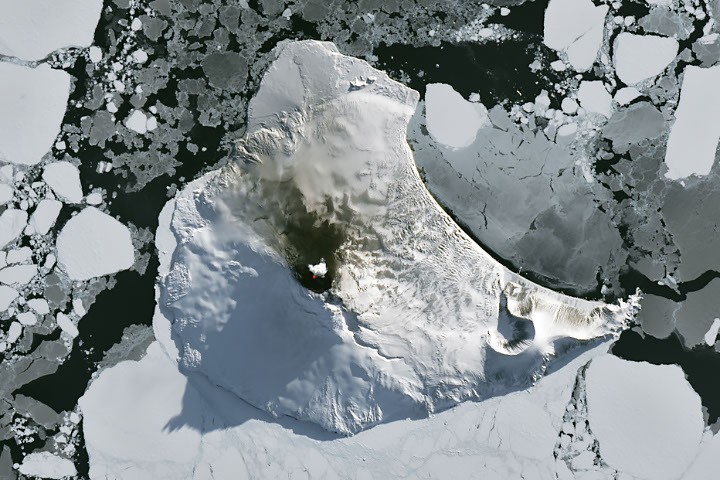
Mount Michael, a stratovolcano at the heart of Saunders Island, is part of the South Sandwich Islands in the South Atlantic Ocean. It’s located near the Antarctic Circle, an area known for its extreme winter conditions, characterized by prolonged darkness and heavy sea ice.
Volcanic Activity
Recent satellite imagery captured by NASA’s Landsat 8 on August 24, 2026, has highlighted that Mount Michael remains active volcanically. The image, enhanced with infrared data, reveals a persistent lava lake within the volcano’s summit crater, indicated by a thermal signature. Additionally, a volcanic plume and darkened snow slopes hint at ongoing eruptions.
The South Sandwich Islands, formed by the subduction of the South American plate beneath the South Sandwich plate, have seen regular volcanic activity in recent centuries. Mount Michael’s lava lake is one of the few such features globally, comparable to those at Kīlauea, Nyamulagira, and Erta Ale.
Monitoring and Research
Due to the remote nature of Mount Michael, scientists rely heavily on satellite data for monitoring its activity. Instruments like MODIS and VIIRS support ongoing observations, while systems like MIROVA provide near-real-time volcanic hot spot detection. Recent findings indicate low-intensity activity at Mount Michael and a consistent emission of gases like sulfur dioxide.
Weather Patterns
The clear visibility of Mount Michael’s activity was brief. Just a week after the satellite image was taken, cloud cover returned, obscuring the volcano. However, this atmospheric disturbance created striking wave clouds over the ocean, adding to the uniqueness of the region.
Key Points
- Mount Michael is located in a harsh Antarctic environment but remains volcanically active.
- Satellite observations have confirmed the presence of a lava lake and volcanic gas emissions.
- Scientists use advanced technology to monitor the volcano due to its isolated location.
- Weather phenomena like wave clouds can also be observed in the area due to the island’s geographical effects.
References
- Global Volcanism Program (2026), Saunders.
- Gray, D.M., et al. (2019), Journal of Volcanology and Geothermal Research.
- MIROVA (2026), Michael.
- NASA Earth Observatory resources on volcanic phenomena and cloud interactions.
For detailed images and further information about Mount Michael, you can explore NASA resources.