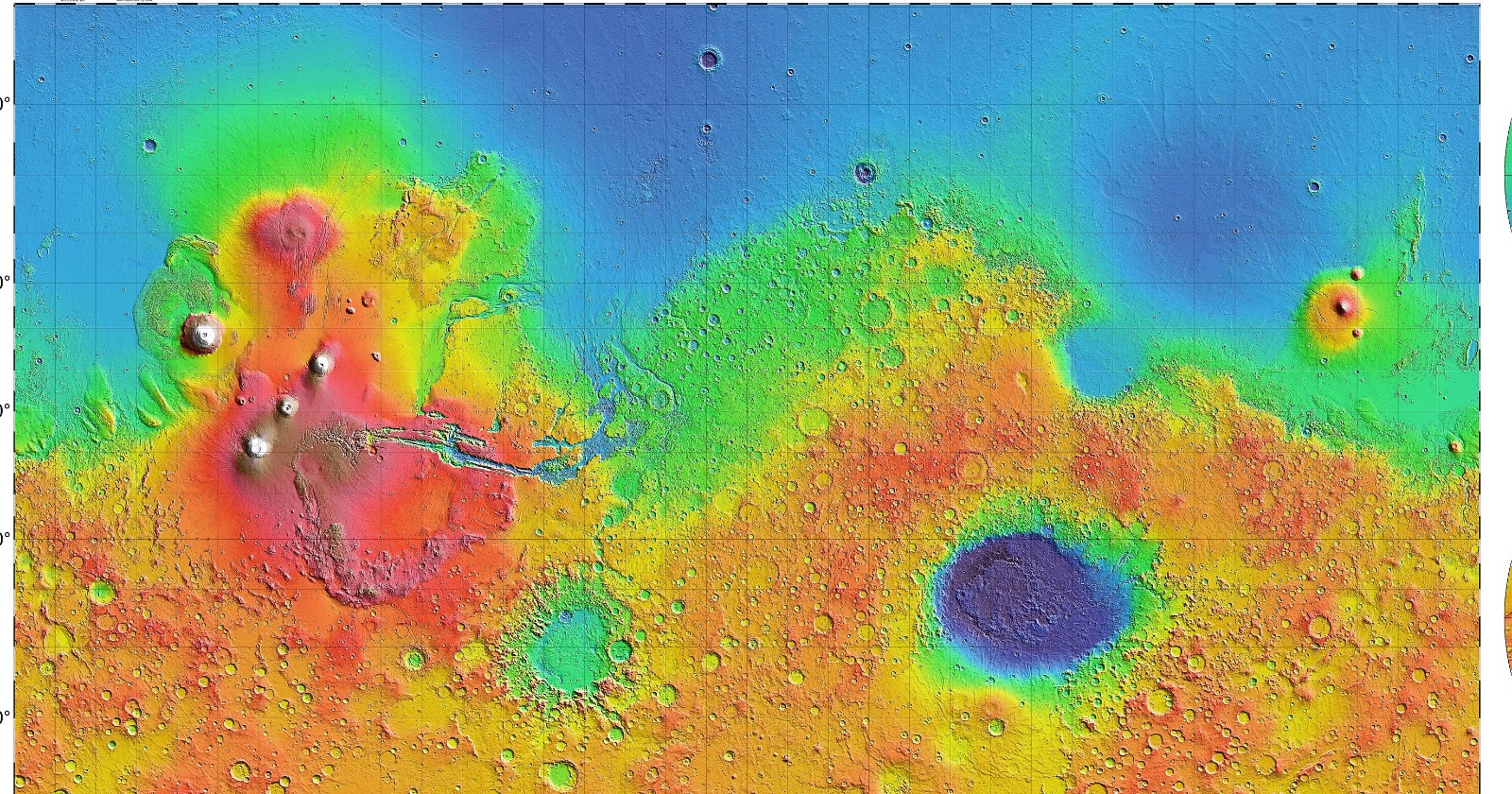
The article discusses the application of tidal tomography, a technique originating on Earth, to analyze the interior of Mars, focusing on its mantle and crust density variations. Following successful applications on Earth and the Moon, researchers led by Alexander Berne at the University of Arizona analyzed Martian spacecraft data over 16 years to understand why Mars has two distinct hemispheres—the low, smooth Northern Hemisphere and the rough, cratered Southern Hemisphere.
Key Findings:
-
Asymmetric Flexing: Mars responds asymmetrically to seasonal tidal forces due to its solar pull. The study deduces that the mantle under the southern highlands is approximately 200 to 400 degrees Celsius warmer than that under the northern lowlands.
-
Crustal Thickness and Density: The paper estimates a 25-kilometer average difference in crustal thickness between the hemispheres or a 200 kg/m³ difference in crustal density. The crust’s composition couldn’t solely account for these differences, suggesting the need for a hybrid explanation involving thermal modeling and historical impacts.
-
Surface and Interior Correlation: The stiffness differences in Mars’ mantle correspond to the well-mapped surface dichotomy, linking geological features with inferred interior structures.
-
Temperature Estimates: The study proposes a temperature difference of up to 400°C based on the mantle’s stiffness. However, this inference carries assumptions, and the authors highlighted that their findings do not necessitate a fully molten mantle but leave open the possibility of localized melting.
-
Volcanic Activity: Surprisingly, Mars’s recent volcanic activity is located in the northern hemisphere, despite predictions that a warmer southern mantle would lead to increased magma production. The authors suggest crust thickness might inhibit magma ascent or that tectonic conditions favor volcanism in the northern plains.
Wider Implications:
The research offers new insights into the geological and thermal evolution of Mars while demonstrating that tidal tomography can effectively explore the interiors of other celestial bodies, such as Ganymede and Enceladus, with further missions potentially refining our understanding without the long wait for extensive data collection.
In summary, this study advances our understanding of planetary interiors, the mechanics of Mars’ dichotomous structure, and the potential for future exploration of similar bodies in space using innovative remote sensing techniques.