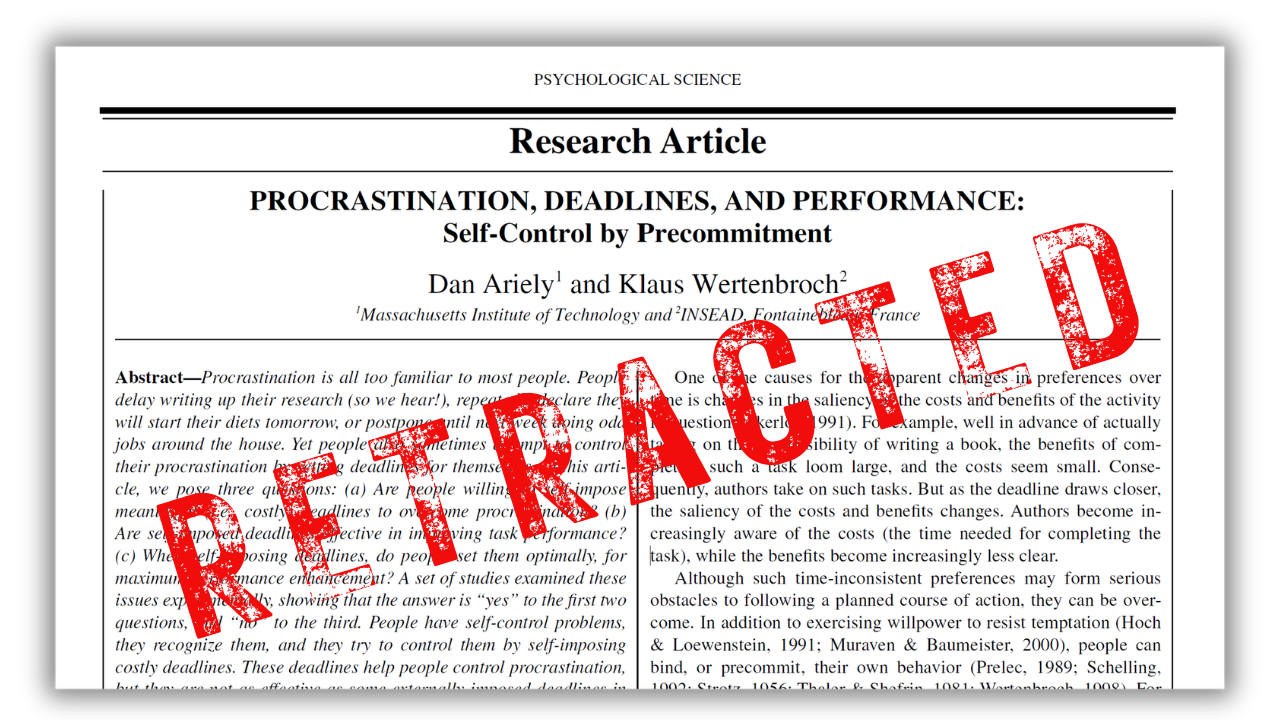
Summary of the Retraction of Ariely and Wertenbroch’s Paper on Procrastination
A psychology journal retracted a seminal 2002 paper by Dan Ariely and Klaus Wertenbroch on procrastination and deadlines. The retraction occurred shortly after analysis from the Data Colada blog raised concerns about data manipulation in the study’s experiments, spurred by a recent replication attempt that failed to confirm the original findings.
Key Details:
-
Background and Publication: The original paper, published in Psychological Science, explored the effects of deadlines on procrastination and has been cited nearly 1,000 times.
-
Research and Findings: The retraction was prompted by a replication study published on July 15, which raised questions about the original data. The Data Colada team analyzed the datasets, uncovering signs of tampering, such as implausibly large effects and duplicated values.
-
Response and Action: Ariely’s co-author, Wertenbroch, initiated the retraction process after reviewing the Data Colada findings. The editor-in-chief of Psychological Science confirmed the integrity concerns were previously unknown.
-
Ariely’s Comment: In response to the controversy, Ariely acknowledged the findings and expressed his commitment to ensuring accuracy moving forward.
-
Significance and Impact: The retraction marks Ariely’s second, following a prior paper on dishonesty that also faced integrity issues. The outcomes of this retraction stress the importance of maintaining accuracy in research and the role of replication studies in the scientific process.
This incident highlights the ongoing challenges in research integrity and the efforts within the academic community to correct the scientific record.