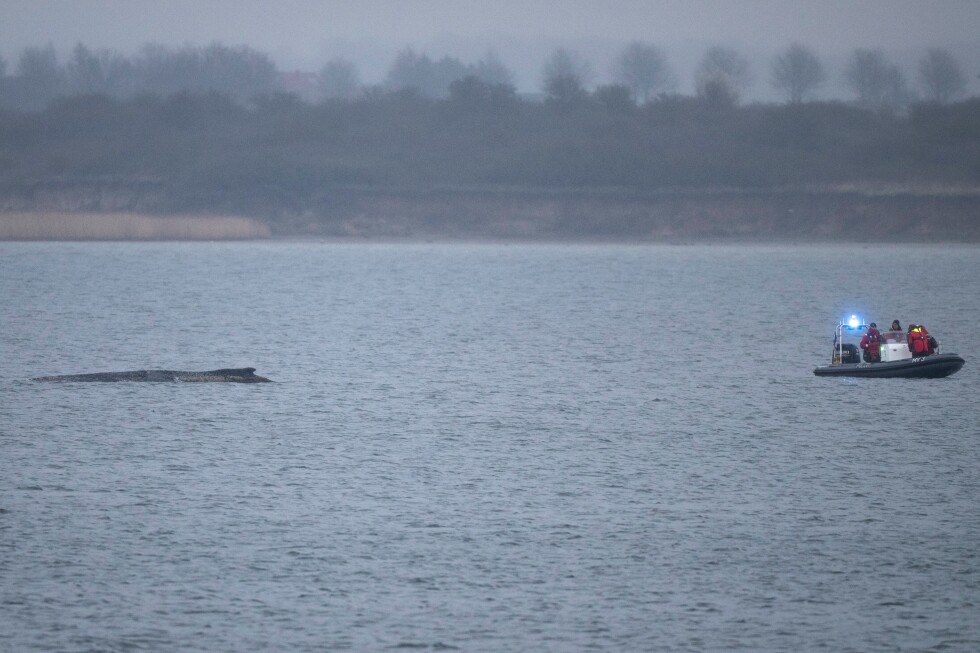
The situation surrounding a humpback whale stranded off the coast of Germany’s Baltic Sea has captured the attention of many. This magnificent creature has faced multiple challenges since first being spotted in the area, raising concerns for its wellbeing and the efforts to guide it back to safer waters.
Rescue Efforts Continue
BERLIN (AP) — A humpback whale that has become stranded repeatedly off Germany’s Baltic Sea coast in recent days got stuck again on Tuesday, authorities said, less than a day after swimming free. But rescuers remain optimistic that it can navigate its way back into open waters.
The whale, measuring 12 to 15 meters (39 to 49 feet) long, swam free late Monday from a location near the German port of Wismar, where it had been trapped since the weekend. After a brief disappearance, it was spotted Tuesday morning near an island called Walfisch—a fitting name, as “Walfisch” translates to “whale” in old German.
Authorities, including the police and the environmental organization Greenpeace, dispatched rubber boats to guide the whale. However, the whale veered off a course intended to lead it out of Wismar Bay, instead entering an inlet and becoming stranded once again, according to Till Backhaus, the environment minister of Mecklenburg-Western Pomerania state.
While rescuers were able to prevent the whale from drifting too far into the inlet, it remains in deeper water, where it could potentially swim away on its own, shared Thilo Maack, a marine biologist with Greenpeace, during a news conference.
The Journey So Far
Last week, efforts to rescue the whale from a shallow underwater sandbank near Timmendorfer Strand, a resort town approximately 50 kilometers (over 30 miles) from its current position, were ultimately successful with the help of an excavator. However, the whale soon found itself in distress again, albeit in deeper water. Officials are currently hoping to provide it some tranquility and perhaps motivate it to swim away by approaching with boats.
The ongoing drama has captivated many in Germany, with the media providing continuous updates on its condition. However, even if the whale manages to swim away again, it is still a considerable distance from its natural environment.
“Our aim is for it to get out of Wismar Bay, into the Baltic Sea, through Danish waters into the North Sea, and then into the Atlantic where the whale belongs,” Maack stated. “These animals are designed for depths that far exceed those found anywhere in the Baltic Sea.”
The whale first made its appearance in the region on March 3. The reasons behind its entry into the Baltic Sea remain unclear, although some experts suggest it may have lost its way while pursuing a shoal of herring or during its migratory path.
No tracking device has been affixed to the whale due to its skin condition, which has deteriorated from prolonged exposure to the relatively low salinity of the Baltic Sea. In order to reach the North Sea, the whale would need to cover several hundred kilometers.
Backhaus mentioned that a health assessment of the whale conducted on Monday revealed it “has potential.” He acknowledged that the whale is ill, and essential internal issues remain unknown. Nonetheless, he expressed hope for a positive outcome, stating, “I am still keeping my fingers crossed and I hope that we will still have a good ending.”
Key Takeaways
- A humpback whale off Germany’s Baltic Sea has faced repeated stranding attempts.
- Rescue efforts have involved both authorities and environmental groups like Greenpeace.
- The whale is believed to be exhausted but remains biologically capable of returning to the sea.
- It was first sighted in the region on March 3, and the reasons for its stranding are still being investigated.
- Continuous monitoring and supportive measures aim to guide the whale back to its natural habitat.
FAQ
Why is the whale stranded in the Baltic Sea?
The whale may have lost its way while pursuing food or during migration, although the exact reasons remain unclear.
What are the rescue efforts involved?
Rescuers, including the police and Greenpeace, are attempting to guide the whale back to open waters using boats.
How long has the whale been in the area?
The whale was first spotted in the Baltic Sea on March 3.
Can the whale survive in the Baltic Sea?
While the whale is currently considered ill, efforts are focused on providing it with the best chance to recover and return to its natural habitat.
In conclusion, the story of the humpback whale is one of hope and determination. As rescue efforts continue, many will be watching closely, longing for a successful departure back to the depths of the ocean it calls home.