Summary of Research on Nanoerythrosomes and Gallium-68 Radiolabeling
Objective:
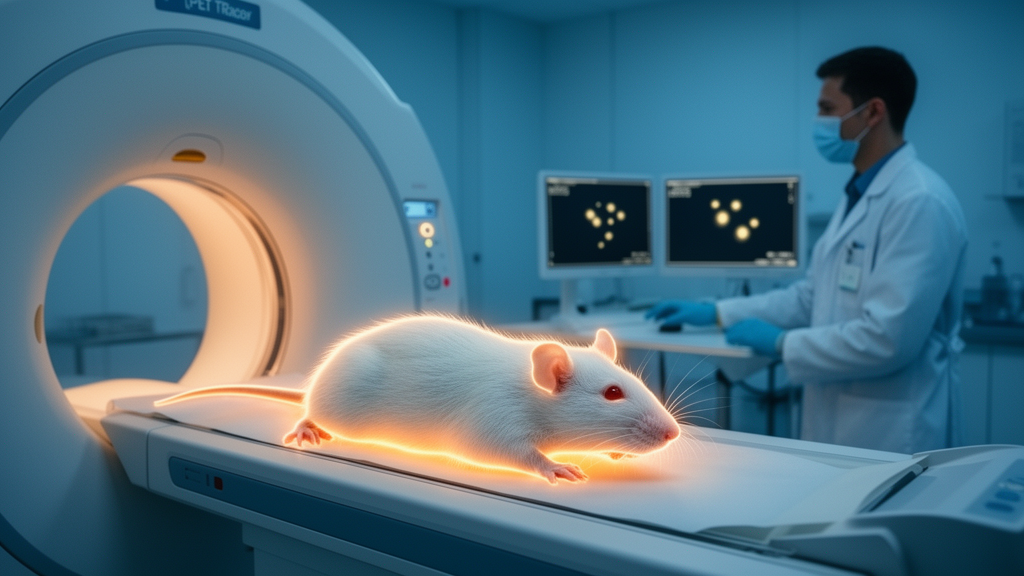
To investigate the biodistribution of nanoerythrosomes (NanoEs), mimics of extracellular vesicles made from donated human blood, using gallium-68 (Ga-68) for positron emission tomography (PET) imaging in healthy rats.
Key Findings:
-
Radiolabeling Method:
- NanoEs were radiolabeled with the [68Ga]Ga-tris(8-hydroxyquinoline) complex.
- The labeling process took approximately 77 minutes, yielding a decay-corrected radiochemical yield of 35%.
-
Biodistribution Analysis:
- The study involved administering the labeled NanoEs to Sprague-Dawley rats and conducting PET scans for 60 minutes.
- Tissue collection post-imaging allowed for quantification of radioactivity.
- Higher uptake of [68Ga]Ga-tris(8-hydroxyquinoline)-NanoEs was observed in the liver, pancreas, and blood cells compared to control groups.
-
Comparison with Controls:
- Control groups included rats given [68Ga]GaCl3, the free [68Ga]Ga-tris(8-hydroxyquinoline) complex, and NanoEs labeled with [68Ga]GaCl3.
- The distinct uptake patterns demonstrated that the tris(8-hydroxyquinoline) labeling method provides unique information about the biodistribution of NanoEs.
-
Significance:
- The results suggest that nanoerythrosomes could be effective as biocompatible nanocarriers for drug delivery and diagnostics.
- The study lays groundwork for future research on the therapeutic applications of NanoEs.
Conclusion:
The research indicates a viable strategy for using gallium-68 to track the biodistribution of nanoerythrosomes, which holds promise for clinical applications in drug delivery and imaging.
Reference:
Kunnas, J., et al. (2026). In vivo tracking of nanoerythrosomes with gallium-68 labeling strategies. EJNMMI Radiopharmacy and Chemistry. Find the full article here.