Climate change poses numerous threats to public health, and recent research has illuminated its profound impact on mortality rates. This study delves into how the rising temperatures associated with climate change influence lifespans beyond the immediate effects of heat exposure. The ramifications of extreme weather events, which disrupt traditional farming cycles and threaten both lives and livelihoods, underscore the urgency of understanding these connections.
By Adrien Bilal, Assistant Professor of Economics at Stanford University; Diego Känzig, Faculty Research Fellow at the National Bureau of Economic Research and Assistant Professor at Northwestern University; and Krzysztof Lisiecki, Predoctoral Research Fellow at the Stanford Institute for Economic Policy Research at Stanford University. Originally published at VoxEU
Mortality stands out as one of the most significant consequences of climate change. Previous studies primarily focused on the direct effects of local heat exposure. This perspective, however, may overlook crucial aspects of the overall health burden. New findings point to the indirect ways in which climate change influences mortality, primarily through its effects on economic activity and living standards. By broadening our scope to include these factors, we find that the estimated mortality damages rise significantly, highlighting the importance of economic resilience in mitigating the health impacts of climate change.
Western Europe recently recorded its hottest summer, with August 2026 marking the hottest globally. These extreme conditions have drawn attention to the health risks linked to heat. The World Health Organization (WHO) reported over 200,000 deaths in Europe due to rising temperatures in the past four years (WHO Europe 2026). While the effects of local heat exposure, adaptation potential, and healthcare pressures are well-documented (Barreca et al. 2016; Carleton et al. 2022, 2025; Aguilar-Gomez et al. 2025), they may only scratch the surface of climate change’s mortality impact.
Rising temperatures also influence economic dynamics. Lower incomes and disrupted healthcare services in a warming world can lead to increased mortality. This raises an essential question: To what extent does global warming affect mortality when accounting for these wider economic repercussions?
In our latest research, we estimate the effects of changes in global average temperature on mortality rates worldwide (Bilal et al. 2026a). Our findings indicate that the mortality effects of climate change are significantly more substantial than those captured by local heat exposure data alone. We attribute much of this discrepancy to the macroeconomic repercussions of rising global temperatures.
From Local Heat to Global Temperature
Most empirical studies on climate and mortality analyze local weather variations. Researchers typically assess mortality rates during years of extreme heat against years with normal temperatures while controlling for common factors across countries.
Local heat exposure, however, reflects merely one aspect of a warming climate. Climate change should be understood as a rise in global average temperature, which correlates with broader changes in the climate system—manifesting as rising land temperatures, altered ocean temperatures, rainfall patterns, droughts, and other extreme weather events. Consequently, estimates grounded in local temperature variations may overlook vital aggregate effects of a shifting global climate. Our previous work established that this distinction significantly affects economic activity (Bilal and Känzig 2026). Here, we explore whether it also impacts mortality rates.
We analyzed annual mortality data from over 100 countries between 1960 and 2019, representing roughly 70% of the global population, alongside global temperature and economic datasets. A key challenge arises from long-term trends in both temperature and mortality. Direct comparisons could suggest a connection even if mortality changes stem from unrelated factors. To address this, we examine fluctuations in global temperature around its long-term trend, influenced by natural climate variability, including El Niño events, volcanic eruptions, and solar cycles.
Figure 1 The effect of a global temperature shock on mortality
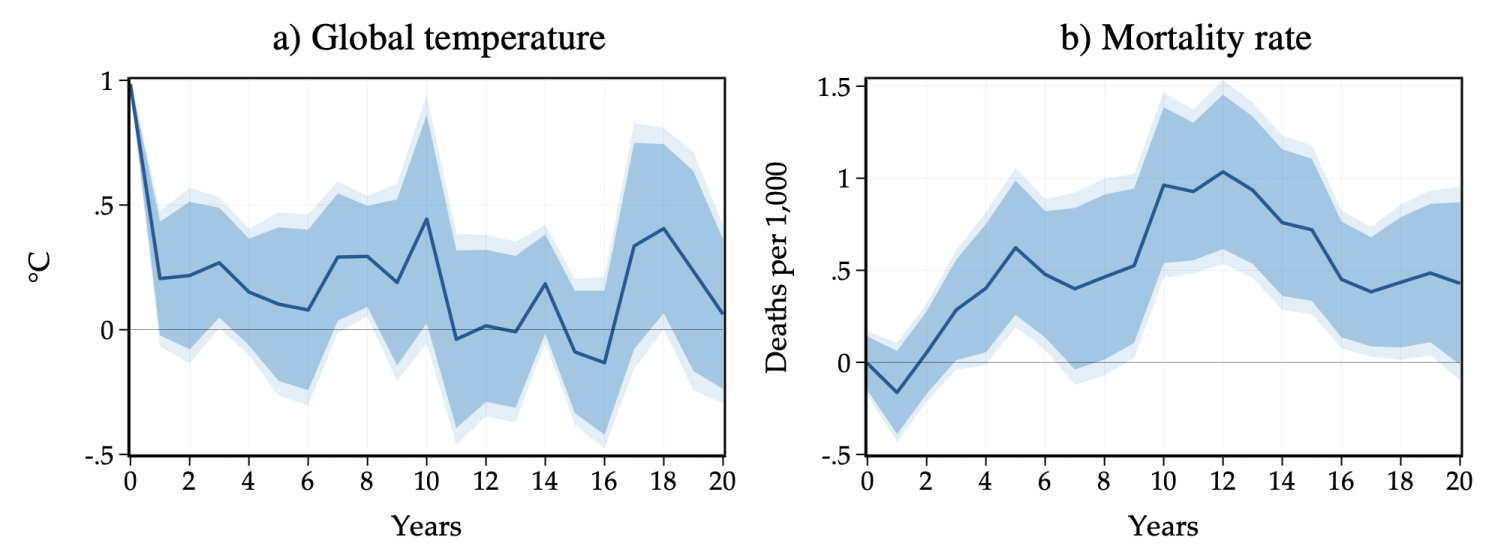
Notes: Impulse responses of global mean temperature and mortality rate (deaths per 1,000 individuals) to a 1°C global temperature shock. Shaded areas: 90% and 95% confidence bands.
After a global temperature shock of 1°C, mortality rates gradually increase, peaking at around one additional death per 1,000 individuals approximately 12 years later. Because the temperature shock is persistent but eventually diminishes, we estimate the effects of a permanent temperature increase. A sustained rise of 1°C in global temperatures translates to an increase in annual mortality of about 2.5 deaths per 1,000 individuals in the long term.
This figure is significantly higher than estimates derived from local heat exposure alone. When analyzing the same mortality data with a similar methodology, a permanent temperature rise of 1°C through extreme heat—while keeping income constant—results in an increase of only 0.1–0.3 deaths per 1,000 individuals, a figure consistent with existing research. This starkly contrasts with the effects estimated from global temperature data. Moreover, reduced exposure to extreme cold somewhat mitigates the mortality impacts of additional heat, further widening the gap.
Why Does Global Temperature Affect Mortality So Much More?
One reason for the greater impact of global temperature on mortality may be that it encompasses extreme weather events not fully captured by local heat metrics. We examined droughts, intense rainfall, and severe winds alongside extreme heat and cold. While these events do contribute, they account for only a fraction of the mortality response linked to global temperature changes.
A key missing element appears to be the economic implications of climate change. Historically, wealthier societies have experienced lower mortality rates, partly due to increased spending on nutrition, healthcare, sanitation, infrastructure, and medical advancements (Preston 1975; Cutler et al. 2006). Simultaneously, our preceding studies indicate that rising global temperatures lead to substantial and persistent decreases in global GDP (Bilal and Känzig 2026).
Figure 2 Direct exposure to extreme weather and the indirect income channel
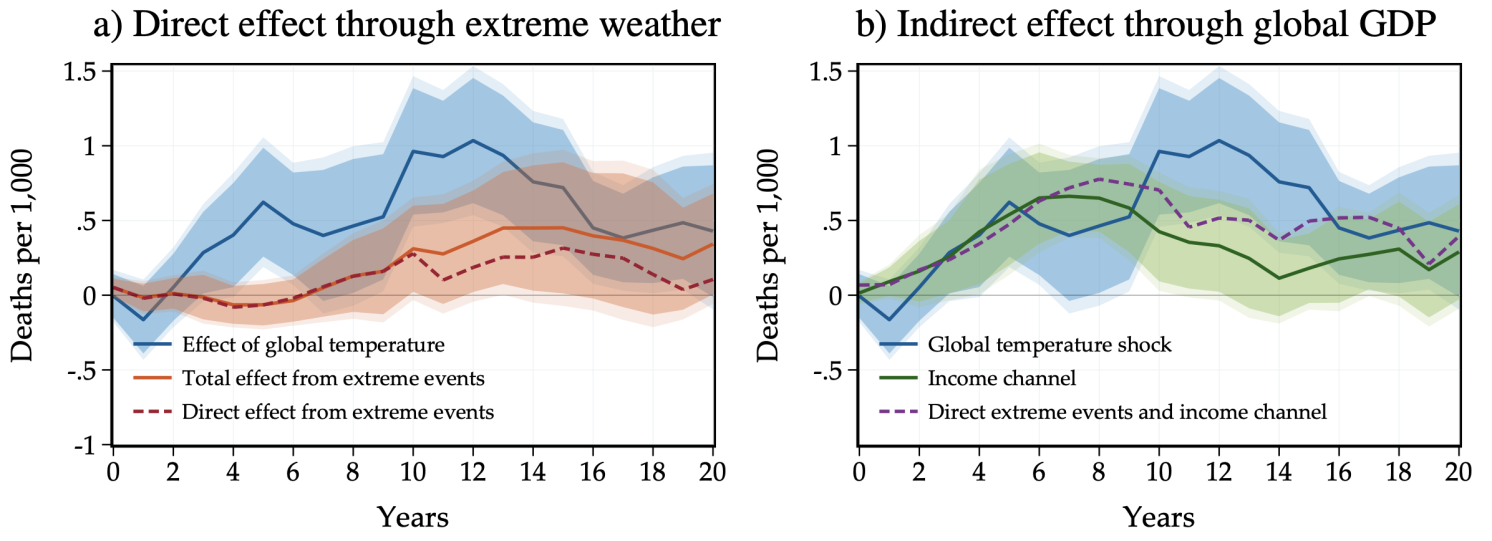
Notes: Panel (a) shows how much of the mortality response can be explained by extreme weather, with the dashed line isolating direct effects, holding global income fixed. Panel (b) shows the mortality effect operating through global income, both alone and in combination with the direct effects of extreme weather.
By merging the temperature-GDP relationship with estimates of the effect of global GDP on mortality from a corresponding study (Bilal et al. 2026b), we gauge the economic channel’s impact. The resulting indirect mortality response aligns closely with the direct mortality estimates linked to global temperature. Quantitatively, reductions in global GDP explain about two-thirds of the cumulative mortality response, with direct heat and extreme weather effects accounting for an additional 23%.
We observe further evidence supporting this mechanism. The increase in mortality following global temperature shocks is heavily influenced by cardiovascular diseases and HIV/AIDS, while deaths directly attributed to heat and cold represent a small portion of the increase. Additionally, mortality effects are more pronounced in countries where public healthcare comprises a smaller part of total healthcare expenditure. Together, these findings suggest that economic disruptions and healthcare access significantly influence mortality outcomes.
Mortality Changes the Welfare Cost of Climate Change
What implications do these estimates have for the evaluation of future climate damages? To explore this, we integrated our empirical findings into a neoclassical growth model that incorporates mortality risk and health expenditures. Households can mitigate higher mortality risks by increasing health spending, while economic growth itself contributes to better health by linking aggregate income with mortality levels. Using the observed changes in output and mortality from temperature shocks, we estimate the model’s climate damage functions.
Assuming a scenario where global temperatures rise by an additional 2°C between 2026 and 2100—reaching about 3°C above pre-industrial averages—our estimated damage functions imply an increase of around six additional deaths per 1,000 people by the century’s end.
The mortality effects are also significantly relevant for the social cost of carbon. When considering both economic and mortality damages, our baseline estimate for the social cost of carbon stands at approximately $1,640 per ton of CO₂, measured in 2026 international dollars. Of this, mortality contributes about $400 per ton, or one-quarter of the total cost. In contrast, estimates based on local temperature and heat exposure suggest a social cost of carbon of roughly $250 per ton, with a smaller mortality component.
Two important factors should be noted when interpreting these results. First, our estimates utilize moderate historical temperature fluctuations that, although persistent, eventually decline. As with many climate impact assessments, applying these findings to sustained warming of several degrees requires some extrapolation. Nonetheless, we observe minimal evidence of nonlinearities within the range of temperature shocks documented in our data.
Second, our model explicitly addresses two significant adaptation margins: changes in private health spending and the health benefits derived from economic growth. Additional forms of technological, organizational, and behavioral adaptation may further influence the consequences of climate change in the future.
Figure 3 The social cost of carbon: Mortality and the economy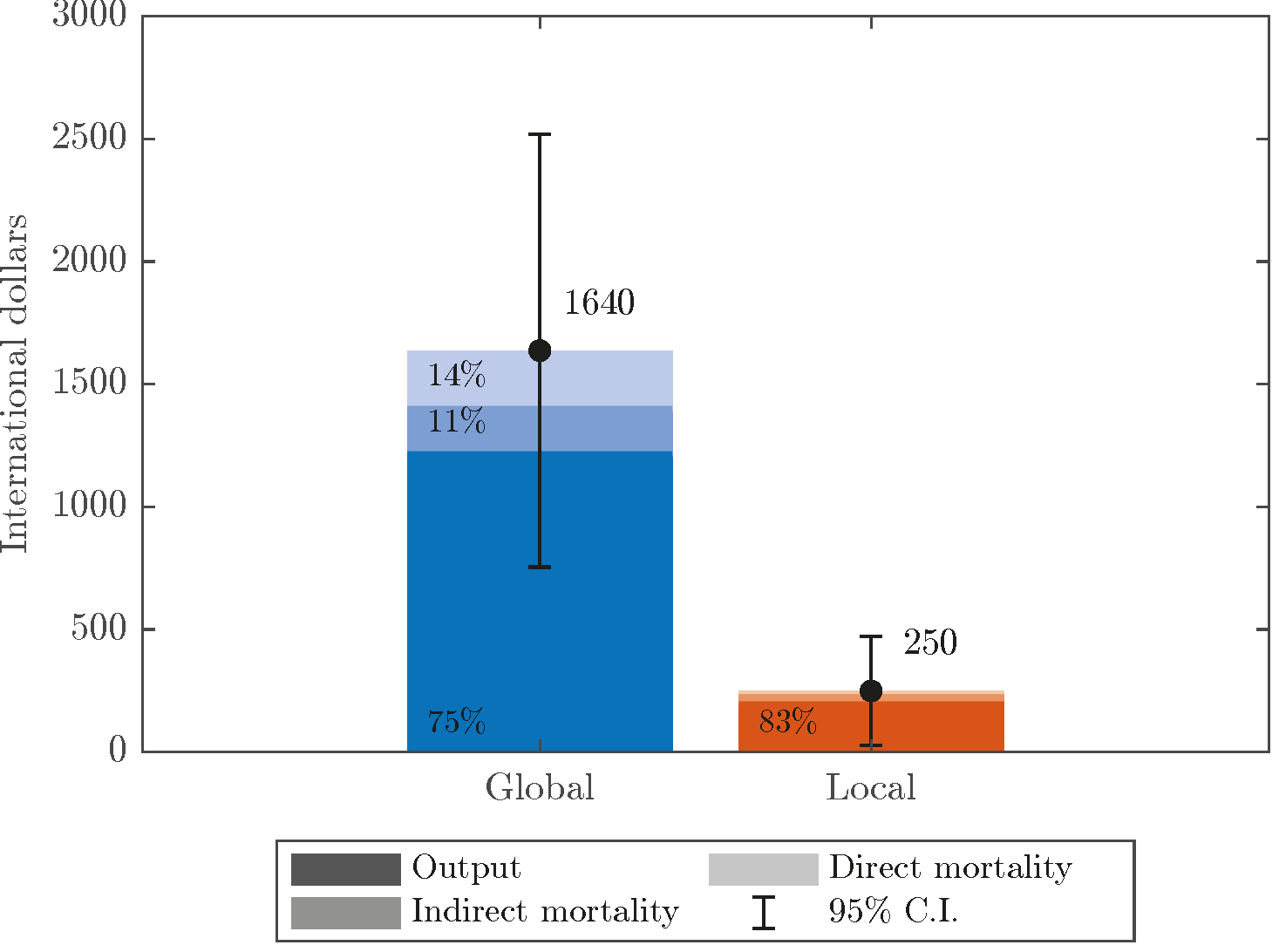
Notes: The bars illustrate the social cost of carbon divided into consumption losses (output), indirect mortality losses due to reduced output, and direct mortality losses. The left bar utilizes damages estimated from global temperature, while the right bar uses data from local temperature and extreme heat.
Economic Adaptation Can Also Be Health Adaptation
The findings also expand our understanding of adaptation concerning climate change. Traditionally, adaptation strategies focus on measures like air conditioning, heat alerts, or enhancing hospital infrastructure. While these approaches are crucial, our research indicates that enhancing economic resilience to climate disruptions can also yield significant health benefits.
This economic channel is quantitatively significant in our model. Absent underlying economic growth, the same warming scenario would result in about nine additional deaths per 1,000 people by 2100, compared to six deaths shown with economic growth factored in. Conversely, restricting households’ ability to adjust health spending has relatively minor effects.
The broader conclusion drawn from our findings emphasizes that the health repercussions of climate change cannot be solely inferred from heat exposure. While a warmer global climate alters local weather patterns, it simultaneously reshapes the global economy. If economic upheavals deteriorate health outcomes, the mortality impacts of climate change reach far beyond the fatalities associated with heatwaves.
Understanding these indirect effects is critical for accurately assessing the damages attributed to climate change and for devising effective adaptation strategies. Safeguarding individuals from a warming climate may necessitate not only protecting them from heat but also shielding the economic and healthcare systems that sustain their lives.
See original post for references