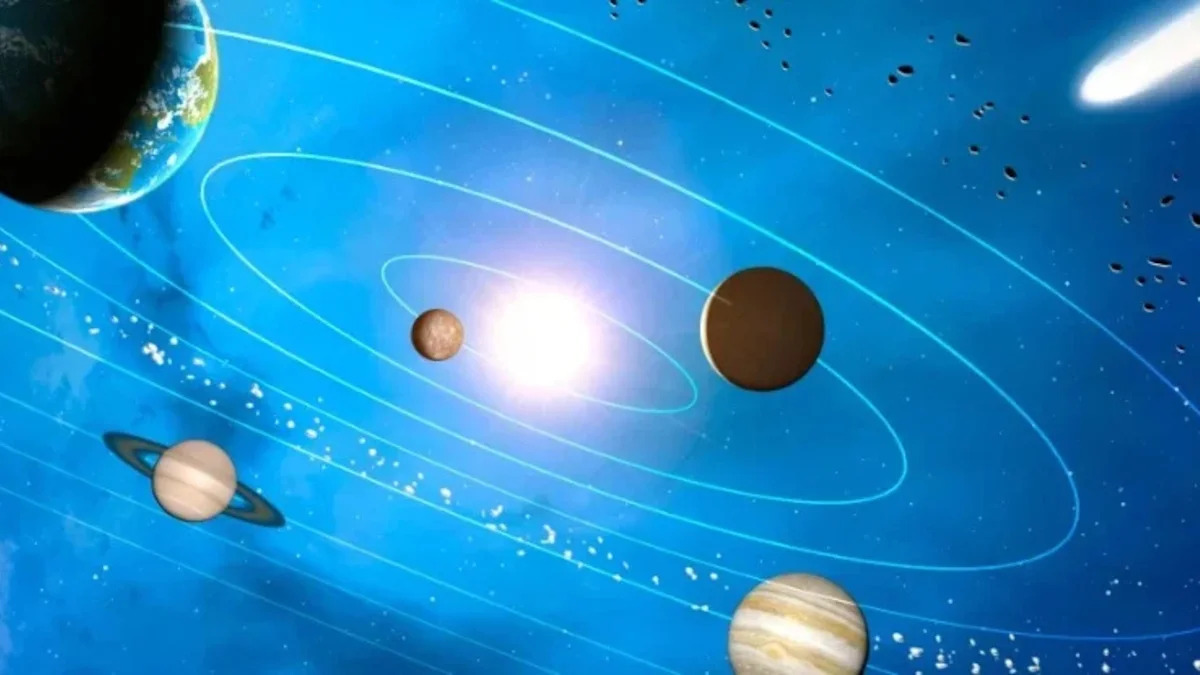
The cosmos oscillates between predictable stability and chaotic unpredictability, which can leave our sense-seeking brains unsettled. Within our own Solar System, scientists have long grappled with the stability of planetary orbits, a matter central to celestial mechanics. Ancient humans marveled at the stars, and centuries later, figures like Isaac Newton speculated about the potential unraveling of our outer planets.
Recent research indicates that our understanding of this stability may be fundamentally flawed. Mathematical models suggest that, while Uranus could appear stable for extremely long periods—over a quintillion years, or significantly longer than the current age of the universe—new findings reveal that the Sun’s transition to a white dwarf will be far from smooth. The Sun is projected to lose mass in a turbulent and unpredictable manner, resulting in thousands of individual “kicks” that could destabilize the gravitational effects on the outer planets.
Researchers from Caltech and the University of Michigan found key evidence for this phenomenon through data from the Gaia orbital observatory, which recorded wide stellar systems including white dwarfs. These studies indicate that mass loss could result in substantial shifts in the Sun’s position and gravitational pull, leading to chaotic planetary interactions much earlier than previously thought.
Simulations suggest that as the Sun dies, Uranus and Neptune might swap their orbits or even collide with Jupiter, leading to a cosmic chaos reminiscent of a demolition derby. In many of these scenarios, one or more giant planets could even be ejected into interstellar space.
The implications of this research are profound, suggesting that the Solar System may undergo disruption far sooner than expected—within a mere three billion years post-Sun’s transformation into a white dwarf, altering our views on planetary systems across the galaxy. Ultimately, our Solar System’s demise may arise from the very conditions of its formation, rendering the once-quiet retirement of celestial systems a myth.
This research marks a shift in our understanding of solar and planetary evolution, emphasizing the fragility and potential instability of many planetary systems in the universe.


