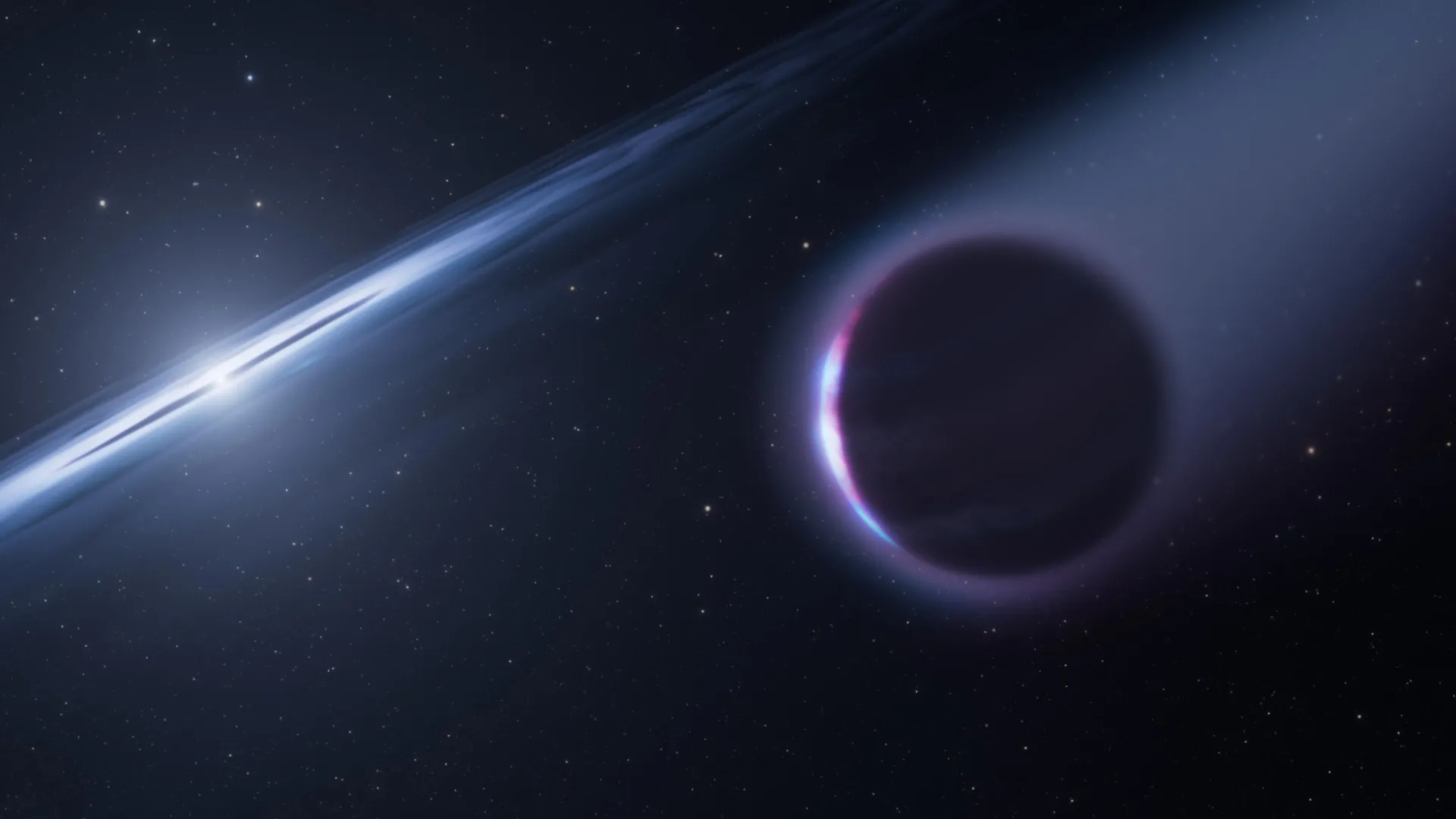
The recent discoveries regarding the white dwarf HS 0209+0832 are exciting for astronomers. Researchers revisiting data from the Hubble Space Telescope have detected an unusual chemical signature, specifically a high abundance of niobium, suggesting that this white dwarf may host a second-generation planet.
Key Points:
-
White Dwarfs: These are remnants of low-mass stars that have exhausted their nuclear fuel. Unlike typical planets formed around young stars, second-generation planets arise from material released during a star’s death.
-
Research Insights: Jamie Williams, the study’s lead author, emphasizes that this finding hints at a deeper narrative of star-planet relationships, suggesting ongoing formation and evolution even after a star has died.
-
Niobium Signatures: The presence of niobium in HS 0209+0832 is notable as it’s not commonly observed in other studied white dwarfs. This element indicates that the material originated from the dying star rather than the stellar birth process.
-
Proposed Planet Formation: Following the star’s expulsion of chemically enriched material, it’s hypothesized that some of this material could have coalesced to form a gas giant—potentially comparable in size to Jupiter—that orbits remarkably close to its white dwarf.
-
Atmospheric Loss: The planet appears to be losing its atmosphere due to the intense heat from the nearby stellar remnant, suggesting dynamic processes at play similar to those observed in cometary systems.
-
Future Research: Williams and his colleagues plan to utilize Hubble for ongoing studies to unravel the characteristics and prevalence of second-generation planets in similar systems, emphasizing the evolving understanding of celestial formations.
This research illustrates the often unpredictable journey of scientific discovery, where old data can yield new insights into the cosmos.


