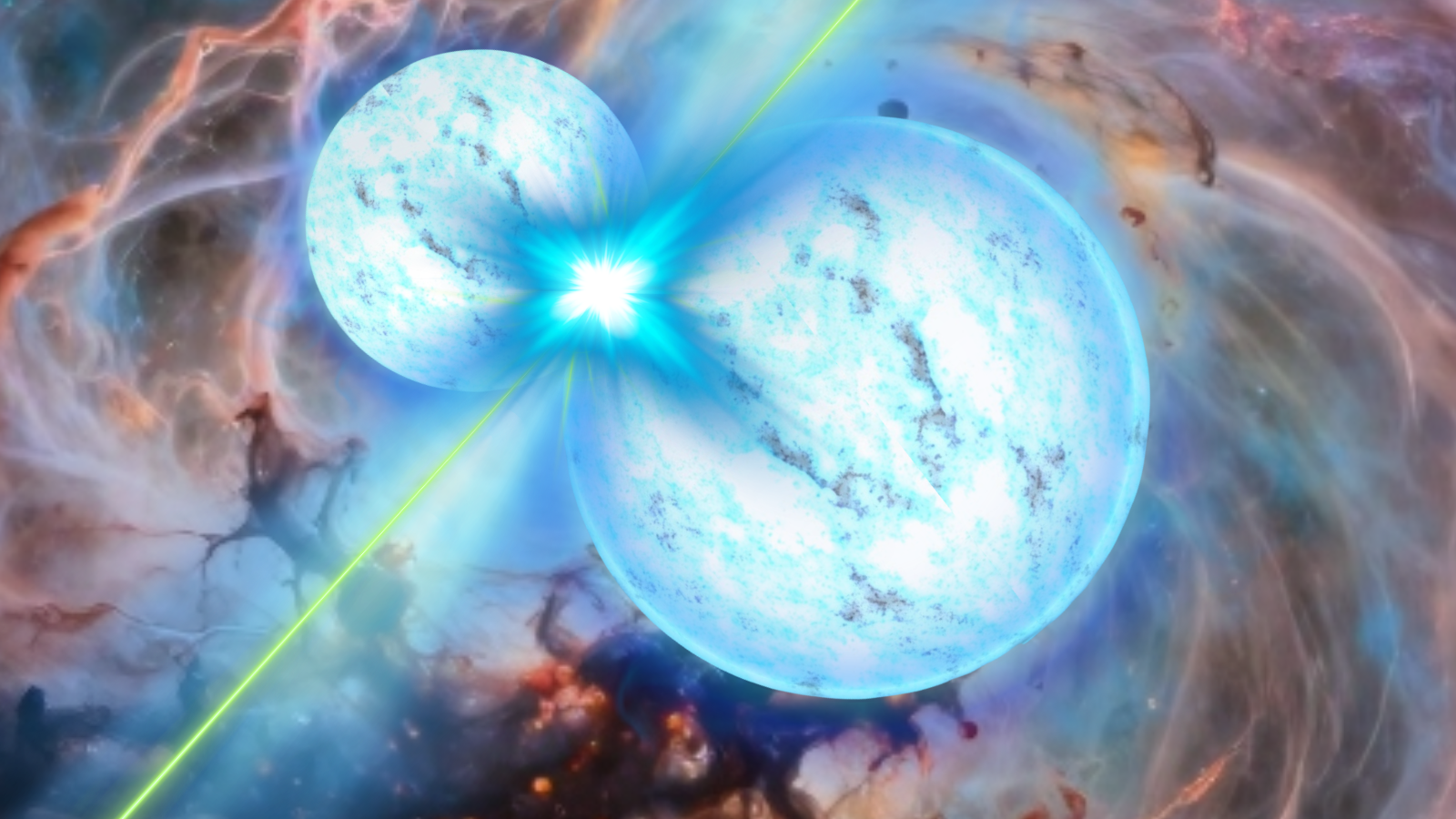
Astronomers Unravel Mystery of X-Ray Flashes from Neutron Star Collisions
Key Findings:
- Mysterious X-ray flashes may originate from colliding neutron stars.
- The event termed EP250704a was observed on July 4, 2025, involving a gamma-ray burst followed by X-ray emissions.
- This flash lasted longer than typical neutron star mergers, presenting a unique opportunity for scientific exploration.
Event Details
Astronomers began investigating the enigmatic EP250704a after it was identified through the Einstein Probe, a joint European-Chinese initiative. The initial observations revealed a gamma-ray burst lasting half a second, which was succeeded by a much longer X-ray emission lasting around 10 minutes.
Astronomical Significance
Niccolò Passaleva, leading the observations at the Very Large Telescope (VLT), highlighted the importance of this event, stating it represents the longest-lasting prompt X-ray flash recorded from a neutron star merger. Such mergers are significant as they can create heavy elements like gold and platinum.
Neutron stars are formed from the remnants of massive stars post-supernova. They are incredibly dense, with a mass equivalent to that of the sun compressed into an area similar to a city on Earth. The violence of neutron star collisions can forge elements that are typically created in supernova explosions.
New Discoveries
Historically, neutron star mergers were associated with quick, high-energy gamma-ray flashes, disappearing in seconds. However, EP250704a reveals that some mergers may produce persistent X-ray emissions lasting several minutes. This event piques curiosity about the relationship between these long-lasting X-ray bursts and neutron star mergers, sparking questions about their origins and implications.
The Role of Magnetars
A key component in understanding this phenomenon may involve magnetars—neutron stars with extraordinarily strong magnetic fields. The researchers suspected that at least one of the neutron stars involved in the EP250704a event was a magnetar. When a magnetar discharges its magnetic energy, it can boost the brightness and duration of a subsequent explosion.
The team ruled out other potential causes, including supernovae, affirming that the light from this collision has traveled to Earth for 6 billion years. This suggests that studying more X-ray flashes can enhance our understanding of how often magnetars form as a result of neutron star mergers.
Conclusion
With findings documented in the Science Bulletin, this research opens new avenues for understanding the complexities of neutron star interactions and the fundamental processes that shape our universe.


