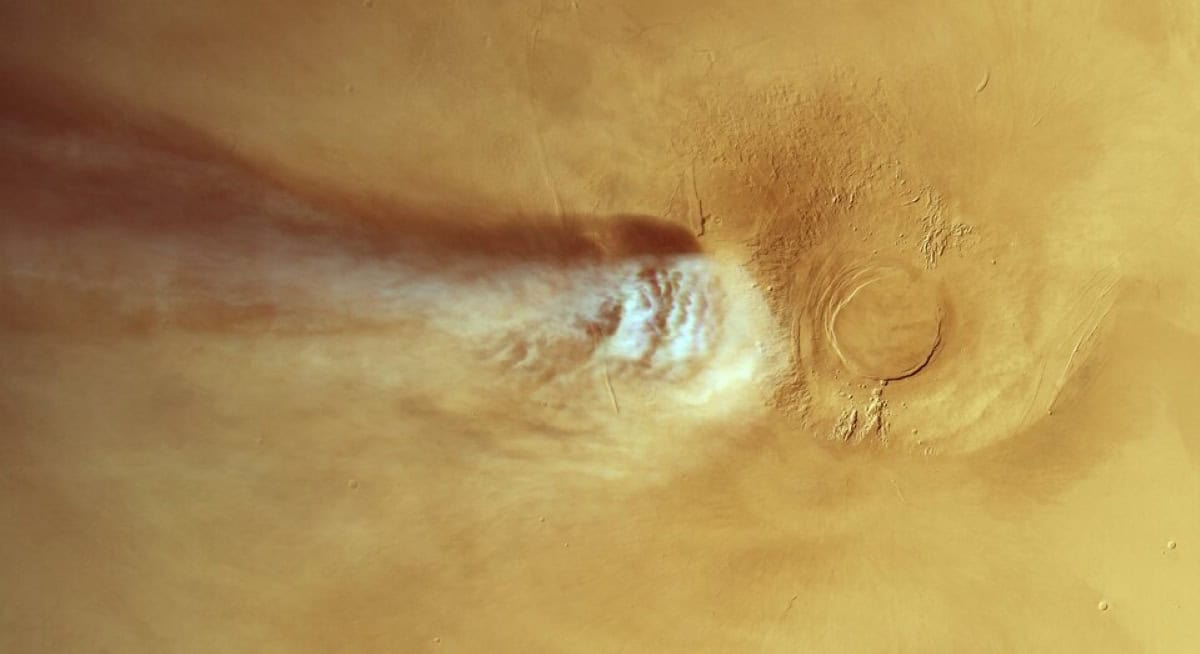
The Arsia Mons Elongated Cloud (AMEC) is a fascinating atmospheric phenomenon observed near Olympus Mons, Mars’s tallest volcano. This large white cloud, which can stretch up to 1,800 kilometers, forms during the Martian spring and summer and dissipates within hours.
Key Points:
-
Formation Process: Researchers have proposed that the cloud forms through homogeneous nucleation, where water vapor transforms directly into ice crystals without the need for dust particles, a process that has yet to be confirmed in other planetary atmospheres.
-
Mechanics of Formation: The unique conditions above Arsia Mons, including rapid cooling of air and high supersaturation levels, allow ice crystals to form spontaneously despite Mars’s thin atmosphere.
-
Comparison with Earth: Similar clouds exist on Earth, such as the Levanter cloud over Gibraltar, but the Martian version is significantly longer and cannot be modeled effectively by conventional weather models.
-
Research Innovations: Simulations incorporating the new mechanism successfully reproduced the cloud’s characteristics, indicating a potential breakthrough in our understanding of cloud formation both on Mars and beyond.
-
Future Implications: This research could alter our understanding of similar processes in the atmospheres of other planets, including Earth and Venus, and enhances our overall grasp of Martian meteorology.
The discovery, detailed in the journal Nature Geoscience, sheds light on the complexities of Martian weather and its implications for cloud formation across the solar system.


