In today’s global economy, understanding China’s export policies is crucial. This article highlights key Chinese measures that have solidified its status as an export giant while elaborating on the reasons behind the ongoing growth of its exports. The discussion explores the challenges to reversing China’s dominant position in international trade.
The significance of this analysis extends to several factors. First, persistent trade imbalances can lead to political and financial instability. Second, one of the major strategies discussed is capital controls. China’s commitment to maintaining trade surpluses, coupled with its reliance on capital controls, inhibits the renminbi from becoming a global reserve currency. A currency designated as a reserve typically needs to run trade deficits to ensure widespread international circulation, coupled with accessible capital markets for foreign investments.
By Sébastien Jean, Professor of Economics at Conservatoire national des arts et métiers; Associate Director at IFRI, and Jean-Pierre Landau, Affiliated Faculty in the Department of Economics at Sciences Po. Originally published at VoxEU
China is experiencing a rapidly expanding trade surplus and an impressive uptick in manufactured exports, leading to increasing political resistance. This column argues that China’s escalating trade surplus is not solely a reflection of macroeconomic imbalances but a deliberate growth model focused on achieving industrial and technological supremacy, supported by high savings, capital controls, and managed exchange rates. The resulting competitive advantage is self-sustaining and difficult to contest. It is crucial for international partners to unite around a strategy that includes renminbi appreciation and stricter global rules on subsidies and market entry.
Global trade imbalances are again prominent in policy discussions. While the American deficit remains significant, China’s evolving status is particularly noteworthy. Its expanding trade surplus and surging manufactured exports are met with intensifying political pushback, especially in Europe, where the automotive sector is feeling the strain.
This context has sparked a vigorous policy debate. The IMF and supporting economists highlight the macroeconomic roots of the issue (Gopinath et al., 2026; IMF, 2026). Given that the current account equates to national savings minus domestic investment, the argument posits that domestic rebalancing should take precedence. China ought to increase consumption, Europe should bolster its investments, and the US needs to address its fiscal deficit. By correcting these policies, it is believed that exchange rates would adjust and alleviate stress on the global economy (Weder di Mauro et al., 2026).
Contrarily, others point to the significant undervaluation of the renminbi, estimated between 12% and 21% according to the latest IMF Article IV consultation (Nageswaran and Srinivas, 2026; Setser, 2026). Since China operates under a controlled exchange rate system, this situation largely reflects a policy decision.
This column aligns more closely with the latter perspective but aims to take a long-term view and draw broader implications regarding the challenges posed by China. It asserts that while imbalances may appear as discrepancies among macroeconomic aggregates, they stem from fundamental differences in growth models and international trade approaches. This necessitates a renewed strategy in international economic relations and a long-term perspective on exchange rate adjustments.
We propose three main arguments.
China’s Growth Model is Unique
China employs a distinct approach to growth and integration within the global economy. Following its accession to the WTO in 2001, Western nations anticipated that this integration would gradually lead to convergence. They believed that China would adopt the liberal principles underpinning the global trade system, allowing market dynamics to take precedence and align its priorities with those of other key trading nations.
While China’s wealth has increased significantly—a notable achievement—convergence has not occurred. In fact, since 2015, its methods for engaging in international economic relations have become increasingly divergent from those of the rest of the world. Western countries trade primarily to provide their consumers with access to affordable goods. In contrast, China’s trading strategy focuses on securing a dominant position for its producers and technology. The ultimate aim is to achieve self-sufficiency and establish industrial and technological superiority across various sectors. This strategic intent was made clear with the introduction of the “Made in China 2025” initiative and has been reiterated in more recent plans. For China, industrial capacity is not only about meeting existing demand; it is a vital resource for technological advancement, national resilience, and geopolitical leverage.
Creation of Comparative Advantage
Our second argument is centered on analytical insights. China’s economic strategy is built on the understanding that comparative advantage is not merely inherited; it can be established. As Krugman (1987) pointed out decades ago, competitive advantages can develop through scale and learning. The more an industry produces, the more efficient it becomes, fostering cumulative success. Initially, protectionist measures and subsidies may assist certain sectors in scaling up, after which the improvement can lead to heightened learning and redefine comparative advantages. China has adeptly grasped and applied this concept more effectively than many Western governments. Recent empirical data supports the notion that domestic subsidies have boosted net exports in sectors targeted by China (Jean, 2026).
Collectively, the effects of scale and learning create robust dynamics. China’s achievements in sectors like electric vehicles, batteries, solar panels, and various advanced manufacturing processes are not a product of pre-existing comparative advantages. Instead, they are the result of an intricate interplay among scale, learning, industrial policy, and global market engagement. Once established, a technological lead can be challenging to contest, as the learning process itself acts as a barrier to entry. This dynamic is illustrated in Figures 1 and 2 concerning the automotive industry.
Figure 1 Average subsidies by firm headquarters in the automotive sector (percentage of annual firm revenue)
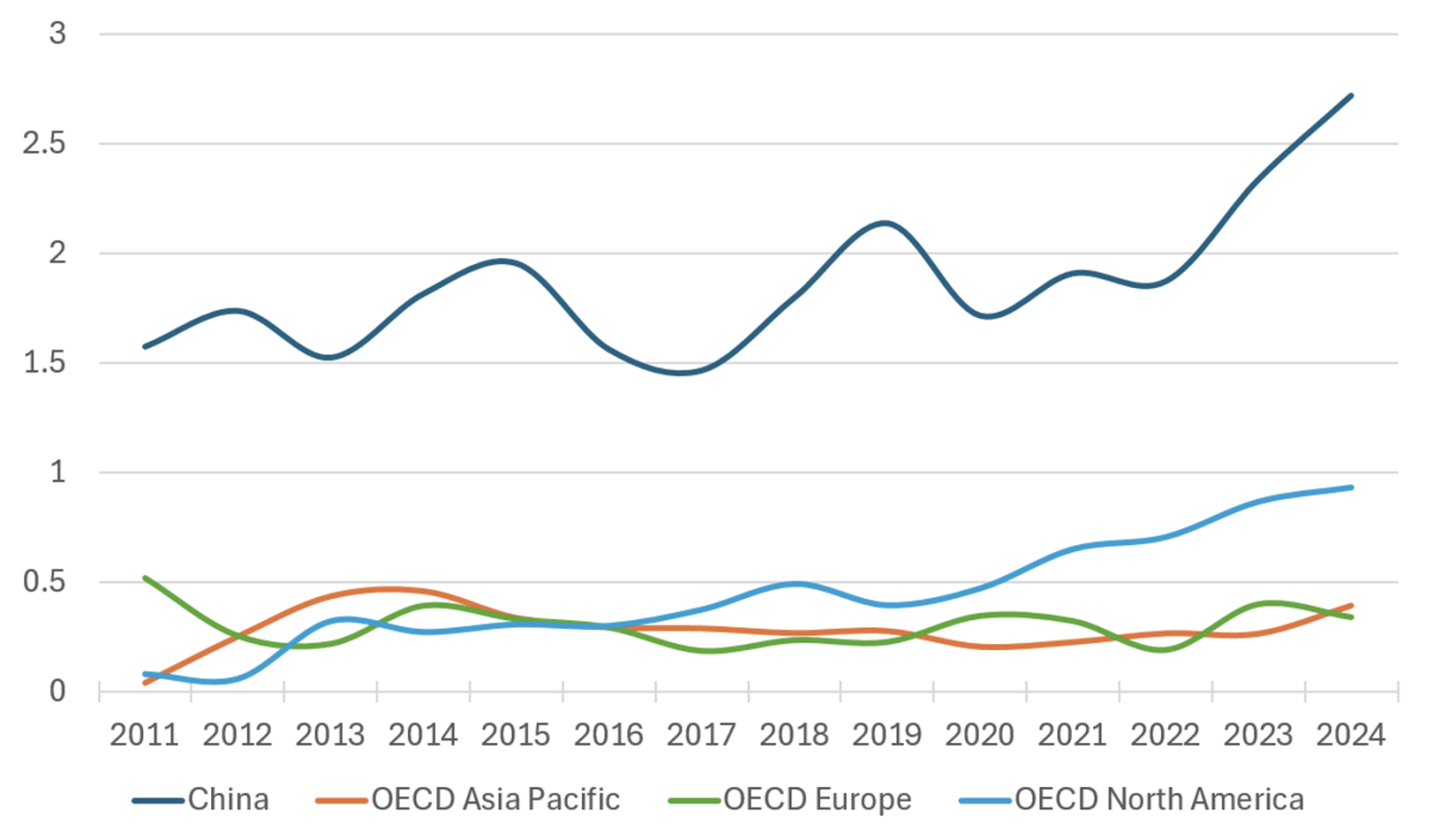
Note: Subsidies include government grants, income tax concessions, and below-market financing.
Source: OECD MAGIC database.
Figure 2 China’s car exports (thousands of vehicles, trailing 12-month total)
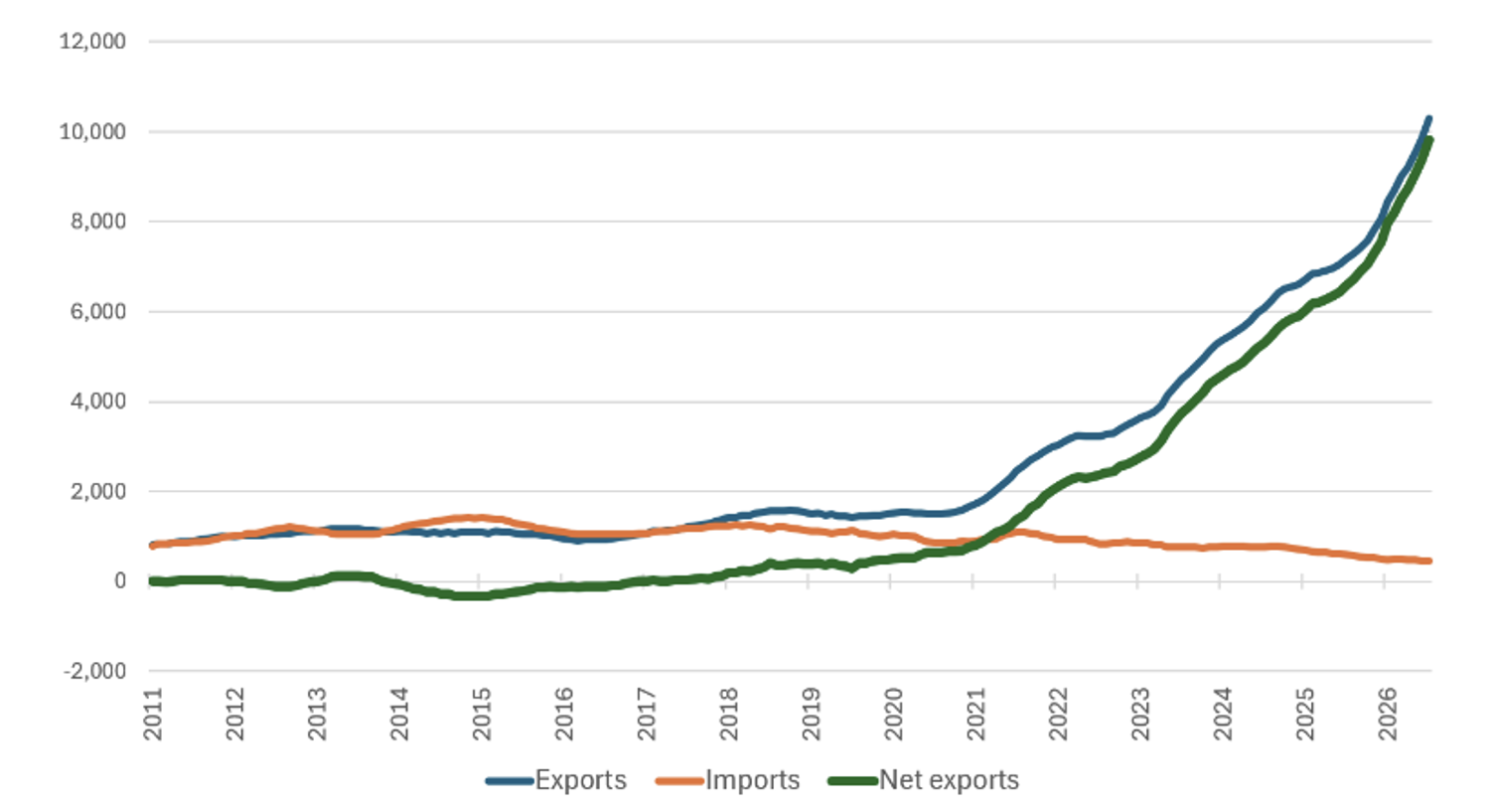
Source: Authors’ calculations based on China’s customs statistics (heading HS8703), retrieved from Global Trade Tracker.
However, for China, relying solely on domestic demand is insufficient. To achieve the scale needed, companies must engage in exports. Therefore, capturing a greater share of the global market is not just a by-product of success; it is essential for it. The external surplus and excess production capacity are mere indicators rather than goals. They are inevitable results of a developmental model that depends on international markets to sustain industrial growth.
The framework for such strategies has been established for years. What is often overlooked is the associated costs. This model entails significant resource transfers, both to foreign buyers and within the Chinese economy.
On an international scale, foreign consumers benefit from affordable Chinese electric vehicles, batteries, and solar panels, subsidized by Chinese labor and taxpayers. While this provides a short-term advantage, importing countries may perceive these low-cost goods as a threat. Although they enhance purchasing power temporarily, they risk undermining the industrial foundation needed for future prosperity. This static gain comes at the expense of dynamic losses.
Domestically, Chinese households must be encouraged, and at times compelled, to support producers and exporters through high savings and limited social safety nets, as well as through favorable loans and subsidies. Although household consumption is rising quickly, it remains lower than what China’s income and productivity would allow.
This context highlights the importance of the exchange rate system and capital controls. Currency appreciation can negatively impact exports in the short term, which is why China resists it. However, the long-term effects are even more significant. Real exchange rate fluctuations affect the relative pricing of tradable and non-tradable goods. A real appreciation diminishes profitability in the tradable sector, diverting labor and capital toward non-tradable segments. This outcome contradicts the overarching strategy. Therefore, preventing appreciation is essential. Moreover, since investment depends on long-term expectations, a stable exchange rate must credibly limit the risk of future appreciation. To this end, potential gross foreign inflows attracted by productive sectors’ high returns also need to be regulated; similar to how natural-resource surpluses can crowd out manufacturing (what some refer to as a ‘financial resource curse’; see Benigno et al., 2025).
This policy strategy combines high savings rates, capital controls, exchange-rate management, and an industrial framework. These instruments are typically analyzed in isolation—capital controls focusing on financial restrictions, exchange-rate management as mercantilism, subsidies as distortions in trade, and high savings as a macroeconomic imbalance. When viewed collectively, however, they form a cohesive strategy. They limit domestic adjustments, preserve resource allocation in tradable sectors, maintain competitiveness, and help develop dynamic comparative advantages.
A Unified Agenda to Address Realities
Our final assertion concerns the necessary policy responses. China’s partners must recognize three key realities. First, the issue isn’t merely a lack of policy coordination; it reflects conflicting national strategies. Whether willingly or not, Chinese consumers tend to exhibit greater patience, often sacrificing current consumption for long-term, sometimes non-economic, objectives.
Second, the dynamics of comparative advantage have operated unchecked for over a decade, with competitive positions solidified through scale and learning. China’s dominance in critical minerals, manufacturing, and essential supply chains endows it with considerable leverage.
Third, the multilateral trading system has weakened significantly, and international economic relations increasingly resemble transactional exchanges. Numerous nations, especially those in emerging markets, are now more inclined to pursue opportunistic strategies, often accommodating China rather than presenting a challenge.
For advanced economies, particularly in Europe, tariffs or trade barriers may offer only transitory relief. The partners need to establish a new framework for rebalancing economic relations, if not an entirely new order. Henry Kissinger, who is not typically seen as an advocate of confrontation with Beijing, spoke of the necessity to create a “network of incentives and penalties” to influence China’s actions and facilitate cooperation (Kissinger, 1994: 717). Over time, China’s key trading partners should coalesce around a shared agenda that incorporates stricter and more effective regulations on industrial policies and subsidies alongside improved reciprocity in market access.
In the near term, adjusting exchange rates represents the most direct solution. The IMF is particularly well-positioned within its surveillance mandate to advocate for the renminbi’s appreciation, a move that is entirely justified. Although such an appeal may not directly impact Chinese actions, it would aid in harmonizing perspectives and expectations regarding global imbalances and their implications. Appreciating the renminbi would alleviate competitive pressure on China’s trade partners while redistributing purchasing power towards Chinese households; while this could induce deflationary trends, it would provide the government with further motivation to adopt more proactive fiscal policies. Ideally, this approach should be supplemented by a commitment to a credible long-term path toward further appreciation, as China progresses towards income levels comparable to advanced economies. When paired with stricter regulations on subsidies, this strategy would promote both external rebalancing and the internal reallocation of resources from production to consumption.
See the original post for references