
NEW YORK
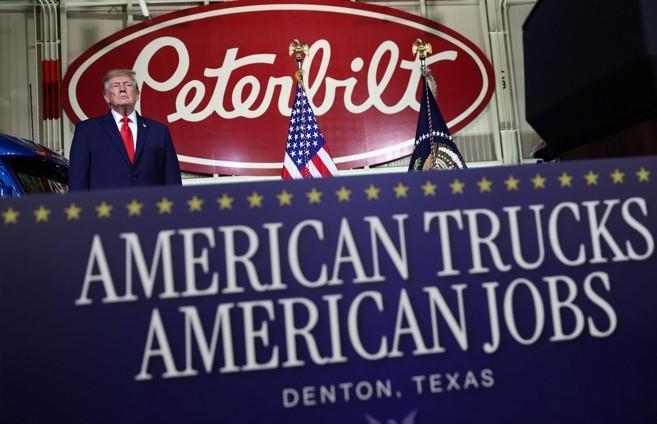
President Donald Trump has claimed a “roaring comeback” in American auto manufacturing following aggressive trade policies, but analysts view the cumulative impact as more of a mixed bag.
Since Trump returned to the White House, General Motors, Toyota, Ford, and other carmakers have announced plans to expand U.S. plants or shift production from overseas to utilize underutilized factories, navigating measures such as a 25-percent levy on imported autos.
However, as the president’s allies in the Republican party look forward to mid-term elections in November, the gains for U.S. carmakers appear more incremental than decisive, coupled with reduced spending in some cases due to trade uncertainty.
“It’s a partial win,” says Stephanie Brinley, an automotive analyst at Mobility Global, referring to the benefits Trump’s tariffs have brought to the U.S. auto industry.
Experts in the auto industry view the unsettled nature of Trump’s trade measures as an obstacle to larger successes. This issue was recently highlighted by the disputes between the United States and Canada, which have clouded prospects for the North American trade agreement, known as the USMCA.
In August, a top Honda executive mentioned that while the company is operating near full capacity at its North American facilities and is considering building a new plant, the ongoing uncertainty around USMCA might force a change in plans.
Moreover, disruptions from tariffs and Trump’s reversals of U.S. policies supporting electric vehicles have affected the U.S. auto supplier sector, which employs about 930,000 people.
There has been “a noticeable slowdown” in investment by suppliers due to policy uncertainty regarding tariffs, according to Tyler Harp, an industry economist at the Center for Automotive Research (CAR). Investment by suppliers fell from more than $8 billion in the first quarter of 2025 to about $600 million in the next two quarters before rebounding, per CAR data.
“Suppliers are more exposed to tariffs,” Harp explained. “They’re not in a position to absorb them as well as automakers.”
After a decline throughout most of 2025, U.S. auto employment has been recovering for much of 2026. In September, the sector employed just under 1.8 million workers, which is nearly one percent higher than in January 2025 when Trump took office but over 2 percent lower than the peak level from 2024 under Joe Biden’s presidency.
Overall U.S. auto production has remained stable, with expected increases around 2030, influenced by significant investments from GM and Toyota.
Global Mobility anticipates U.S. car production to be 10 million vehicles in 2026, roughly the same as last year, but expecting to rise to approximately 11.3 million by 2030.
“There is definitely an increase, and it’s partially related to tariffs,” Brinley noted, implying that automakers are reconfiguring plants to optimize underused capacity.
According to a report, suppliers identified changes in government trade policy as the industry’s “greatest threat” over the next year. Nearly 80 percent of companies ranked trade policy changes among their top four threats, next to a weak U.S. economy, unforeseen events, and poor vehicle sales.
The industry has managed to recover only about half of the costs related to tariff policies, leading to sustained margin pressure that is likely to impact supplier financials adversely. Deloitte has indicated that the industry is adopting a “discipline-over-growth” approach while increasing investments in automation and robotics.

