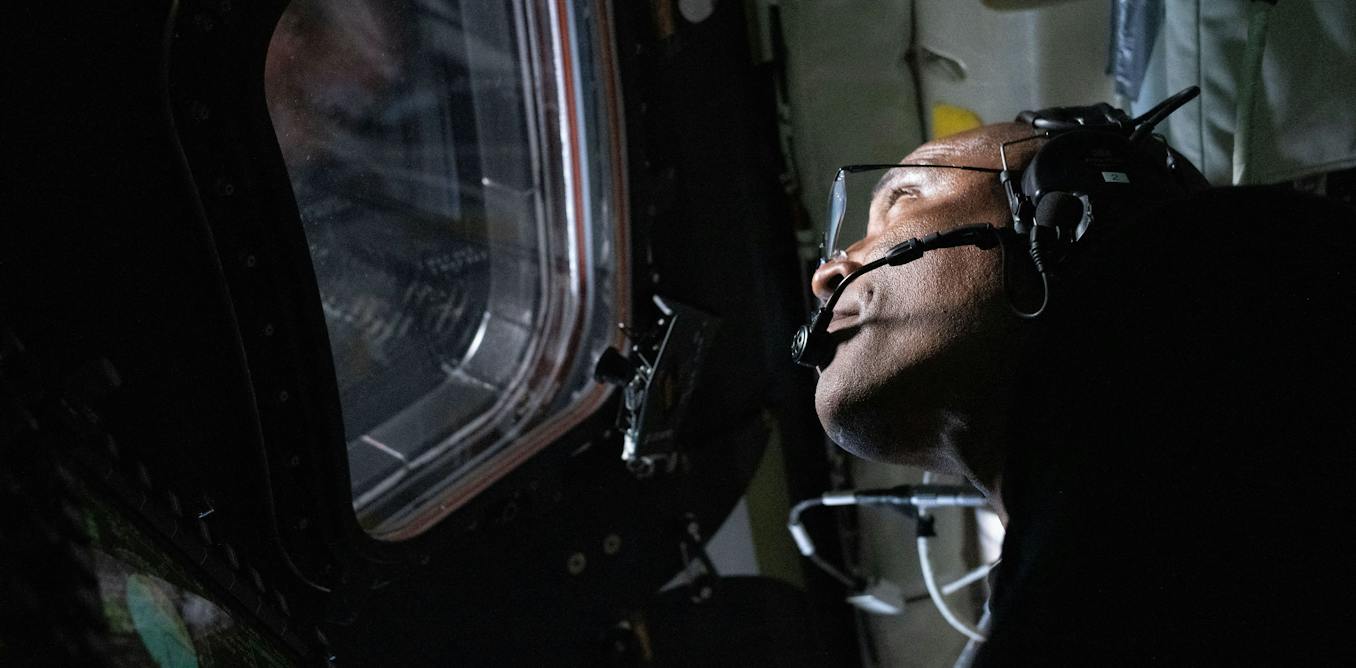
The text discusses the challenges astronauts face regarding sleep in space due to the absence of reliable natural light cues from the Sun. On Earth, our circadian rhythms are synchronized with the 24-hour day-night cycle, but in space, astronauts experience multiple sunrises and sunsets each day as the spacecraft orbits Earth every 90 minutes. This disruption can lead to significant sleep loss, as astronauts may receive only 6-6.5 hours instead of the 8.5 hours of sleep opportunity provided.
The article highlights the interplay between the circadian clock (which regulates sleep and wake cycles) and sleep pressure (the urge to sleep that builds over time). Various methods, such as optimizing schedules around exercise and tailored lighting, have been researched to mitigate sleep loss and circadian disruption. However, astronauts may still struggle to sleep even when given the opportunity, indicating that timing plays a crucial role in sleep quality.
Ongoing missions, like Artemis II, aim to investigate sleep patterns and test interventions to enhance sleep quality, such as using pink noise during sleep opportunities. The article also mentions that light is a critical component of the biological life-support system on spacecraft, but adjustments can affect other functions, like color discrimination, impacting safety.
Looking ahead, the transition to a Martian day (24 hours, 40 minutes) creates another challenge, as this slight adjustment could lead to persistent circadian misalignment for those living under Martian time. The article concludes that future explorers may experience extreme forms of jet lag, emphasizing how integral timing is for maintaining health and performance in space.


