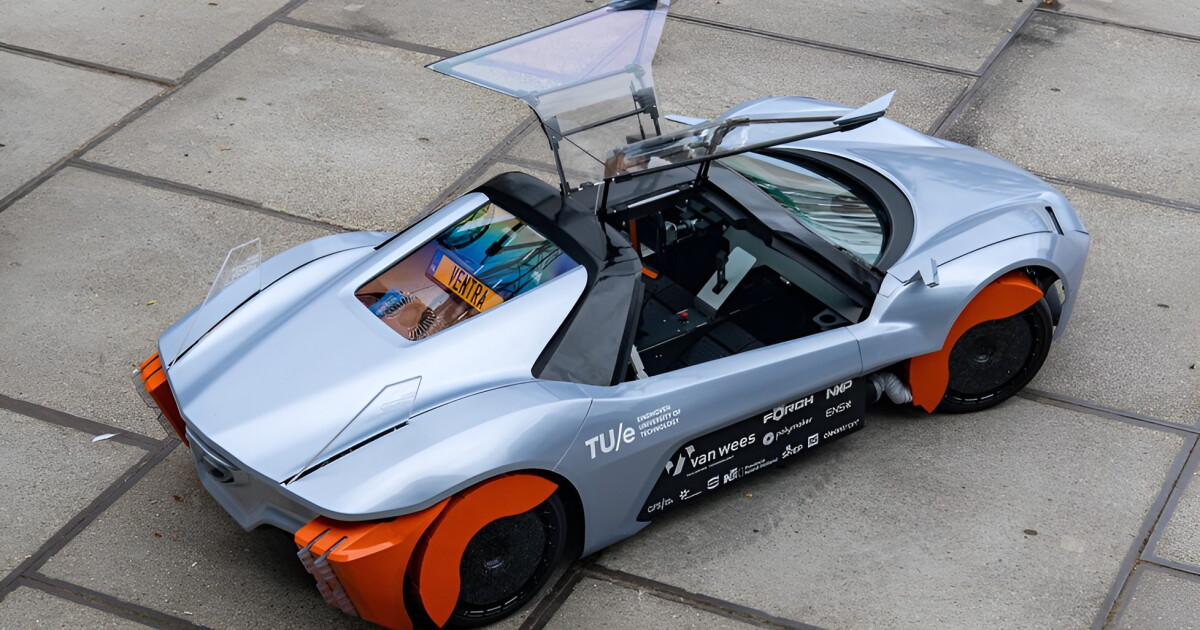
Dutch Students Innovate with Electric Car Design to Capture Particulate Matter
The concept car Ventra, developed by TU/ecomotive at Eindhoven University of Technology, addresses a critical gap in electric vehicle (EV) emission concerns—tire and brake wear particles. While EVs produce no tailpipe emissions, they still contribute to airborne pollution through wear and tear, particularly since they tend to be heavier and accelerate more quickly than traditional vehicles.
Key Features of Ventra:
-
Particle Capture System: Ventra employs a unique technology that gives harmful particles a static charge and directs them to a grounded surface that collects these particles, akin to how a balloon attracts lint.
-
Efficient Design: The car’s chassis utilizes carbon-fiber-reinforced thermoplastic panels, reducing the car’s weight by nearly 100 kg (or about 220 lb). This reduction translates to less pressure on tires, thereby minimizing wear.
-
Driving Coaching Tool: A system called Clean Drive monitors driving behavior, providing feedback to enhance acceleration, braking, and cornering techniques, further extending the lifespan of the tires and brakes.
-
Recycling Capability: The collected particle material can be vacuumed or rinsed from the collecting surface and even reused within the cabin, making the interior a creative tribute to brake dust.
-
Performance Metrics: Initial simulations suggest that at speeds between 31 and 50 mph, Ventra can capture approximately 24% of particle emissions, improving to 42% at lower speeds. However, it’s noted that over half the particles remain uncaptured.
Regulatory Context and Future Implications:
As regulations intensify, particularly with Europe’s upcoming Euro 7 rules set to address brake and tire wear emissions by November 2026, Ventra’s design could play a crucial role in meeting stricter benchmarks. Team manager Tim Spencer emphasizes that despite EVs lacking tailpipe emissions, there is still a pressing obligation to mitigate particles that can lead to health issues like cardiovascular and respiratory diseases.
Conclusion:
Ventra serves as a provocative exploration of future automotive innovation, urging the industry to look beyond traditional exhaust emissions. The team hopes that their ambitious prototype will inspire advancements that not only acknowledge but actively address all dimensions of vehicle-related emissions.
For additional details, you can visit TU/Ecomotive’s official announcement.

