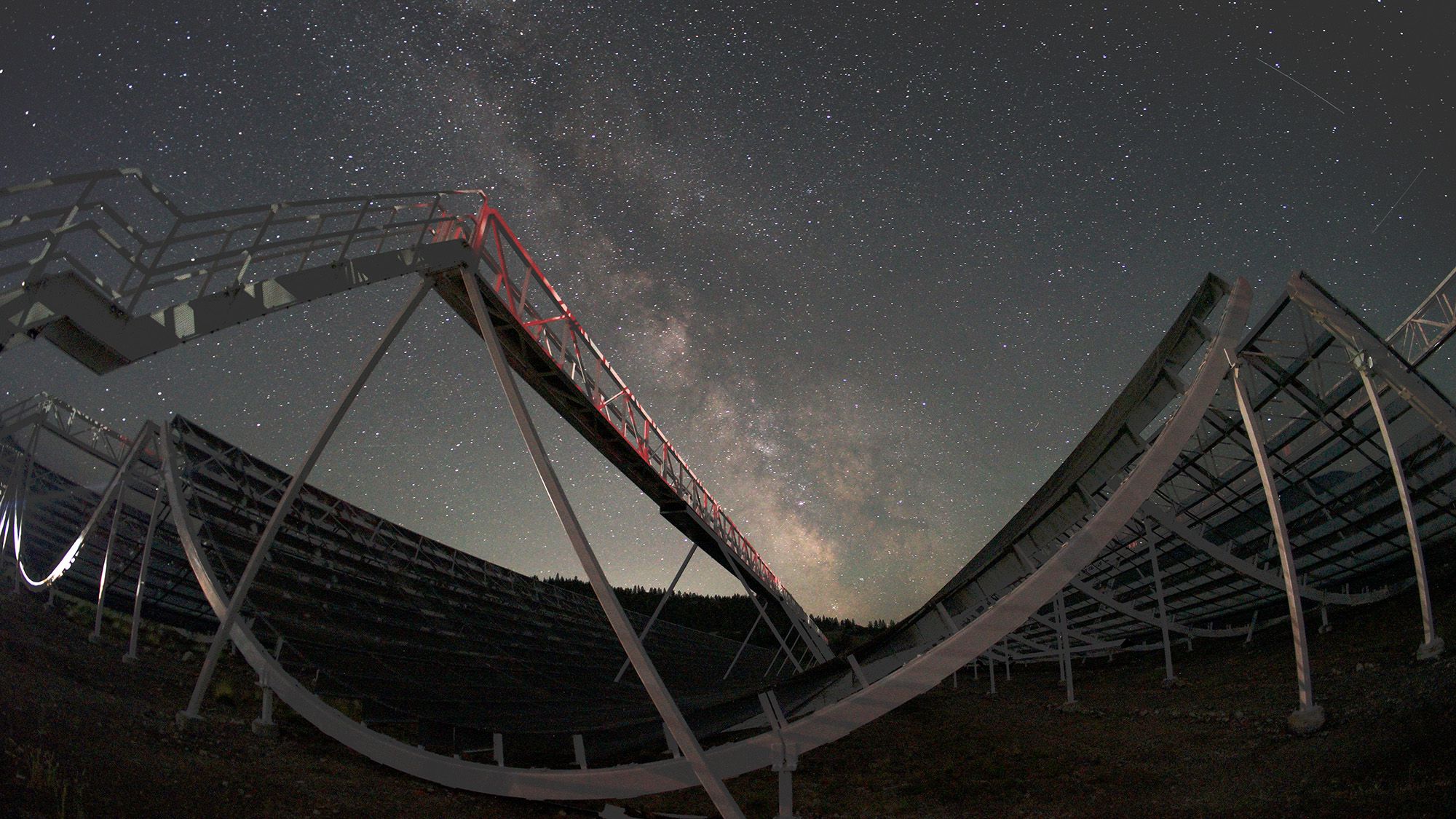
New Breakthrough in Cosmic Mapping by Canadian Telescope
Scientists have revealed a groundbreaking method for mapping the universe’s acceleration with a Canadian telescope capable of charting the distribution of hydrogen gas in the ancient cosmos using only its own data. This achievement marks a significant advancement after seven years of validation.
Key Findings:
- The Canadian Hydrogen Intensity Mapping Experiment (CHIME), located near Penticton, British Columbia, can now independently observe and analyze cosmic hydrogen without relying on other telescopes, streamlining the data collection process.
- According to a recent study published in The Astrophysical Journal, this new method offers a cost-effective way to investigate dark energy, the enigmatic force accelerating the universe’s expansion.
Hydrogen, the universe’s most abundant element and the building block of stars, emits faint radio signals that act as a cosmic marker, allowing scientists to study matter distribution in the universe.
Observational Achievements
CHIME efficiently scans the entire northern sky daily. Prior to the latest findings, it needed to collaborate with other telescopes for cross-verification, a time-intensive and costly process. The new research represents a major leap, demonstrating CHIME’s ability to stand alone in its observations—a vital aspect for ensuring data accuracy and reliability.
Study Details:
- The research focused on observations collected over 94 nights in 2019, carefully confirming the authenticity of the signals before publication.
- The telescope can detect signals dating back to just 3 billion years after the Big Bang, enhancing our understanding of the universe’s early conditions.
Future Research Prospects
The research team, including postdoctoral fellow Arnab Chakraborty, emphasizes the importance of ensuring the reliability of their findings. Additional studies will explore the remaining seven years of CHIME’s data to gather further insights into cosmic hydrogen distribution and its implications for the universe’s expansion.
An accompanying study suggests that approximately 2% of the detected hydrogen is “neutrally atomic,” aligning with previous measurements from other telescopes, further validating CHIME’s findings.
With this new capability, CHIME promises to unlock deeper insights into the universe’s evolution and the mysterious forces at play in its expansive fabric.


