Fossil Discovery Alters Understanding of Chile’s Atacama Desert Climate
Key Discovery:
Scientists found a fossilized capybara tooth in northern Chile’s Atacama Desert, dating back nearly 9 million years. This suggests that the region, now one of the driest in the world, once had a much wetter climate that could sustain capybara populations.
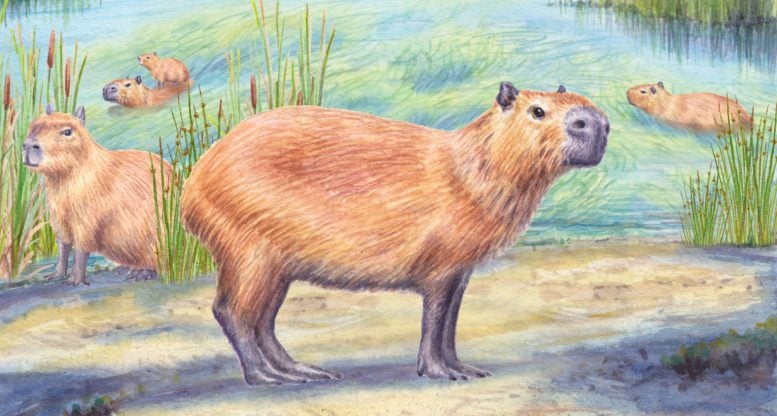
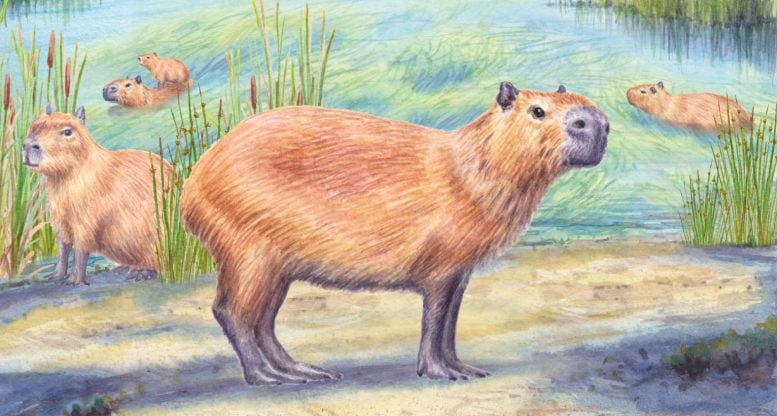
Paleoenvironmental reconstruction of Cardiatherium in the late Miocene coastal wetlands of northern Chile. Credit: Mauricio Alvarez
Significance:
Previously, it was believed that the Atacama has been mostly dry for 40 million years. The discovery challenges this view, indicating that the area once had a diverse ecosystem, including freshwater crocodiles and aquatic plants.
Research Insights:
The tooth was found in sediment layers at El Morro, a location known for its rich fossil deposits. Microscopic plant remains suggest that palms and flowering plants once thrived there, contrasting sharply with today’s desert landscape.
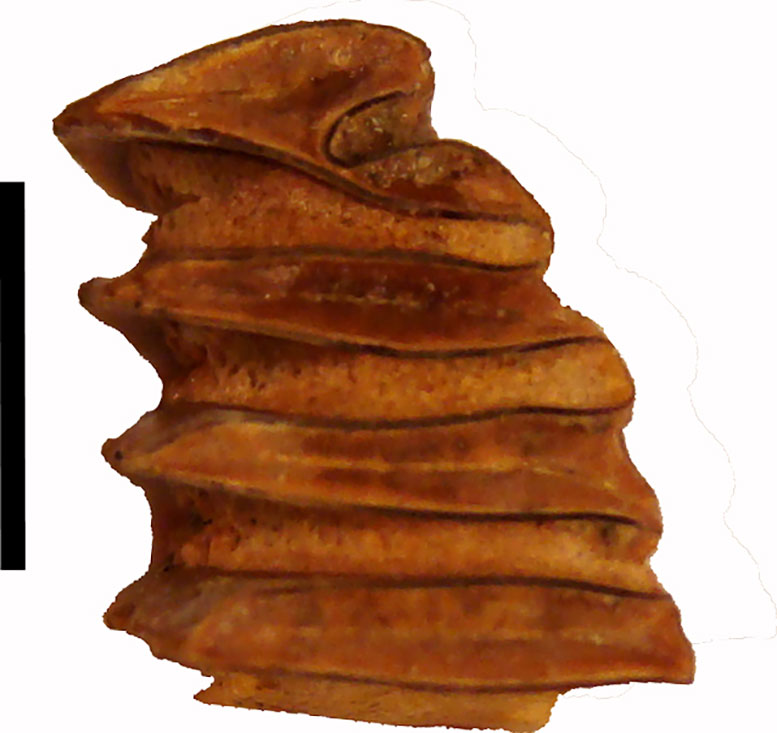
Close-up of the fossilized capybara tooth. Credit: Carolina Gutstein et al.
Ecological Context:
The presence of fish and freshwater crocodile fossils supports the idea that capybaras had a suitable habitat with ample food resources to thrive. The research indicates that there was an established ecological community capable of sustaining these semi-aquatic herbivores long-term.
Geological Questions:
Researchers discuss possible routes capybaras may have taken from wet lowlands east of the Andes to the Atacama coast. This raises questions about the evolutionary pathways of species in relation to changing climates over millions of years.
Conclusion:
The findings highlight the importance of studying historical climate changes to understand present and future ecological dynamics. Such discoveries redefine our perceptions of past environments and inform our understanding of climate resilience.
Reference:
The study, titled “Late Miocene capybara in the Atacama Desert reveals a wetter climate and a transcontinental dispersal pathway,” was published in Scientific Reports.
For further details, you can read the full research paper here.


