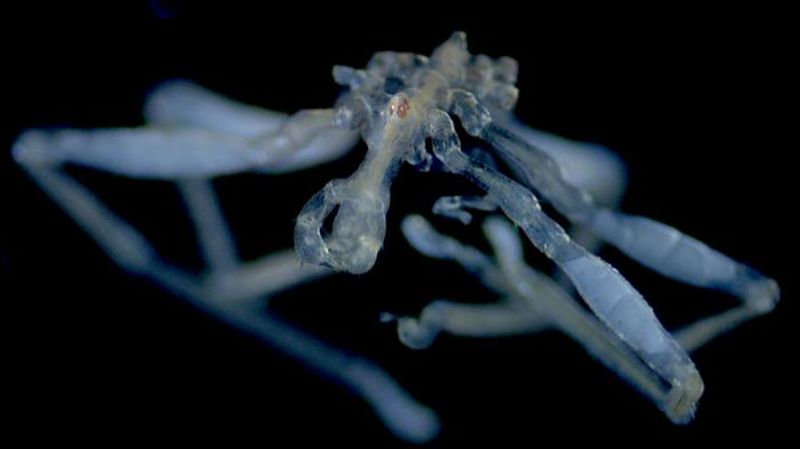
Newly Discovered Sea Spiders in the Salish Sea
If the sight of a spider typically makes you squeamish, the emergence of two recently discovered sea spider species may heighten your unease.
Researchers in Canada uncovered these previously unknown sea spider species during scuba dives at depths of up to 18 meters (59 feet) in the Salish Sea, located between British Columbia and the state of Washington.
One species, named Callipallene pilosuspedes, features long, curved spines adorning its lower legs. The term “pilosus” means “hairy” in Latin, and “pedes” translates to “feet.” This species sports red eyes, three lips around its triangular mouth, and claws.
Additionally, it has “highly dexterous” ovigers—appendages resembling legs that serve as grooming tools. Under microscopic examination, researchers observed the spider using these appendages to wrap around its legs and clean itself with comb-like spines.
In contrast, the other newly discovered species, Tanystylum kiixin, possesses smaller and less dexterous egg-carrying limbs, restricting its ability to groom effectively.
Visual Highlights
- Image of Tanystylum kiixin

The name “kiixin,” pronounced “Kee-hin,” is inspired by the sound of crashing waves near the site of an ancient indigenous village where this species was discovered. It features an hourglass-shaped abdomen, black eyes, and knob-like claws; it has also been noted that this spider is frequently covered with tiny parasites of its own.
Sea Spider Insights
Scientists have identified nearly 1,400 sea spider species, which have been around for about 500 million years. These marine arthropods can crawl along ocean floors, traverse animals and plants, and even tread water. Their sizes range from less than a centimeter to 70 centimeters (28 inches). Though titled “spiders,” they are more closely related to scorpions and horseshoe crabs, featuring four trunk segments and four pairs of legs.
Marine life in the Salish Sea remains largely undocumented, with only 17 sea spider species reliably cataloged thus far. As climate change poses increasing threats to the biodiversity of this region, the researchers underscore the importance of understanding the existing species to better plan conservation efforts. Lead author Cormac Toler-Scott expressed concern over the lack of knowledge regarding sea spider species in the area, highlighting the necessity of this research.


