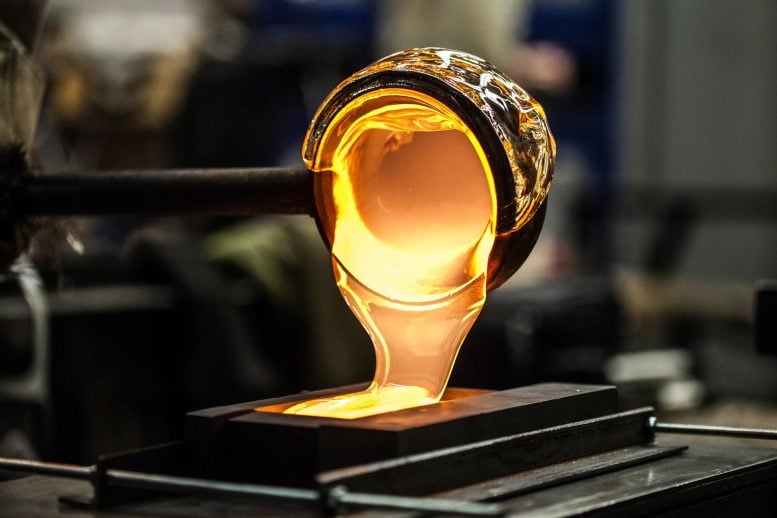
Researchers at TU Dortmund University and partner institutions have developed a groundbreaking method to alter the chemistry of metal-organic framework (MOF)-derived glasses while they’re still in a molten state. This innovation, detailed in Nature Materials, utilizes the molecule 1,10-phenanthroline to both lower the melting temperature and reorganize metal atom bonds during the manufacturing process.
Historically, creating glasses from MOFs posed challenges as some materials decompose before melting, leading to impurities that negatively affect their properties. The team’s approach involves mixing phenanthroline with the starting materials before heating them, allowing the molecule to act both as a flux (reducing melting temperature) and a chemical agent (binding to metal atoms and changing their coordination environment).
By varying the amount of phenanthroline, researchers can fine-tune the glass properties, such as magnetism and light emission. Their method also prevents the decomposition of sensitive materials, facilitating the study of intrinsic behaviors, like magnetism, without interference from impurities.
Using techniques like X-ray absorption spectroscopy, the researchers confirmed that while the local arrangements of atoms changed, their oxidation states remained stable. This indicates that the method can potentially work with various organometallic structures.
Overall, this approach signifies a shift in how scientists can manipulate the melting process, treating it as a creative reaction space rather than a mere phase transition. The findings could enable the design of specialized glasses for applications in catalysis, sensing, and optoelectronics.


