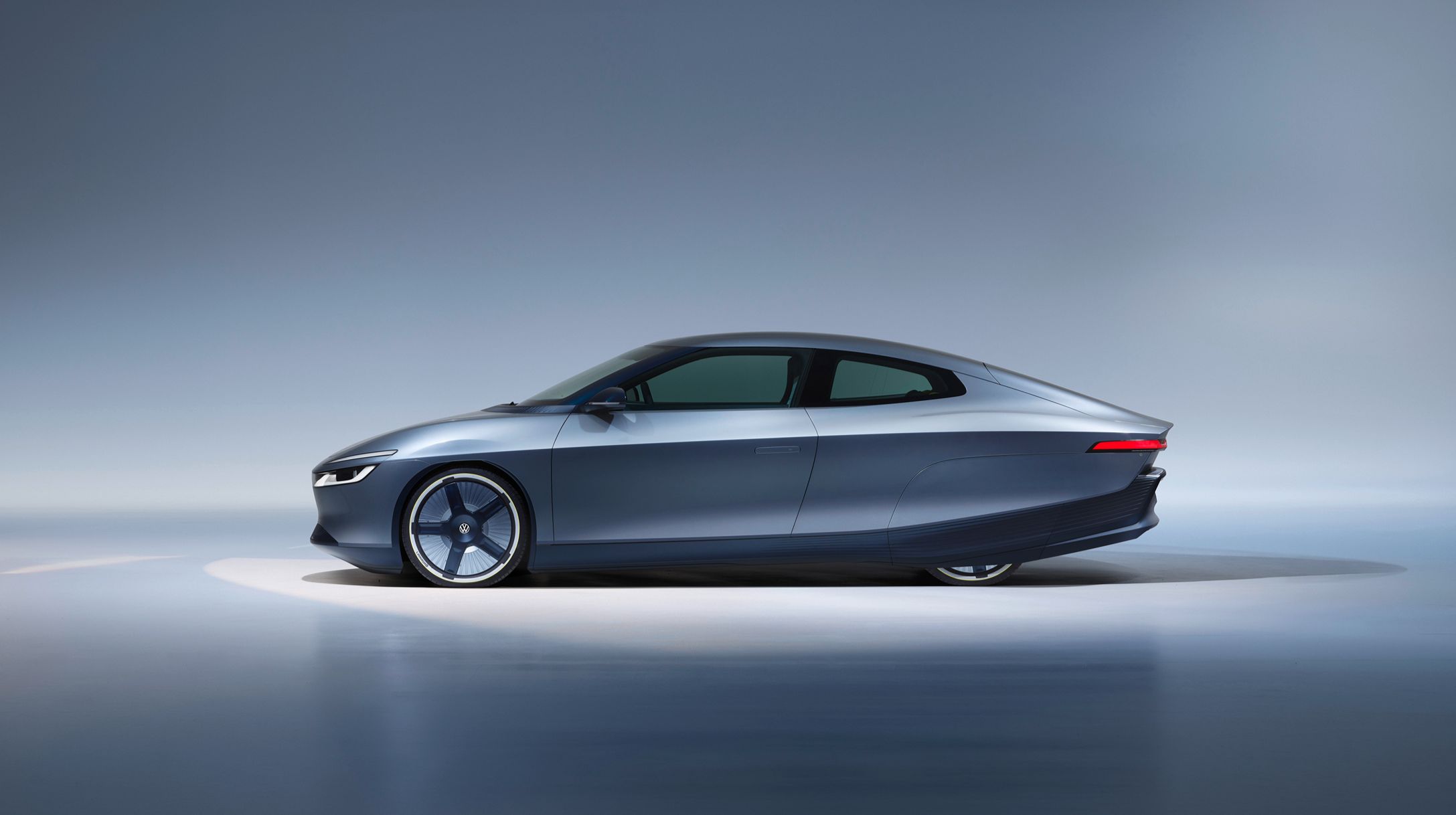
Volkswagen has unveiled the Mission Efficiency, touted as the world’s most economical near-production electric vehicle. This prototype has set records for aerodynamics, efficiency, and fuel consumption, achieving an impressive drag coefficient (Cd) of 0.158, a record for road-legal vehicles. During an “ideal trip,” it recorded an energy consumption of 6.48 kWh/100 km, achieved at a steady speed of 68 km/h with minimal external influences.
A recent test drive of 1,278.36 km, starting from Volkswagen’s German Development Center and ending in Vienna, showed real-world consumption of 7.51 kWh/100 km with charging losses accounted, while achieving an average speed of 67.72 km/h. The vehicle’s 54.9 kWh battery was charged only once during this journey, maintaining a remaining range of 164 km upon arrival.
Thomas Schäfer, Volkswagen’s CEO, emphasized that the Mission Efficiency showcases the brand’s commitment to providing accessible technology, utilizing affordable production techniques from the ID. Polo and ID. Cross on the MEB+ platform. The vehicle employs a 99 kW (135 PS) electric motor and a high-voltage battery, reflecting the potential of the new electric systems in the ID. Polo.
The aerodynamic design, with a Cd of 0.158 and a frontal area of 2.08 m², incorporates features like active cooling air flaps and a fully clad underbody. This design significantly reduces energy consumption, especially at speeds above 80 km/h.
Andreas Mindt, Volkswagen’s chief designer, noted that the Mission Efficiency not only signifies functionality and aerodynamics but also takes inspiration from the legendary VW XL1, previously the world’s most economical production car.
Measuring 4,775 mm long and 1,392 mm tall, the Mission Efficiency offers a 2+2 seating arrangement with 481 liters of luggage capacity. It includes features designed for practicality, like additional storage compartments and a photovoltaic system that can extend the vehicle’s real-world range by approximately 30 km per day. The vehicle’s lightweight design incorporates an aluminum structure and high-strength materials, facilitating performance efficiency.
In related news, BMW is progressing with its iX5 Hydrogen project, moving towards series production.

