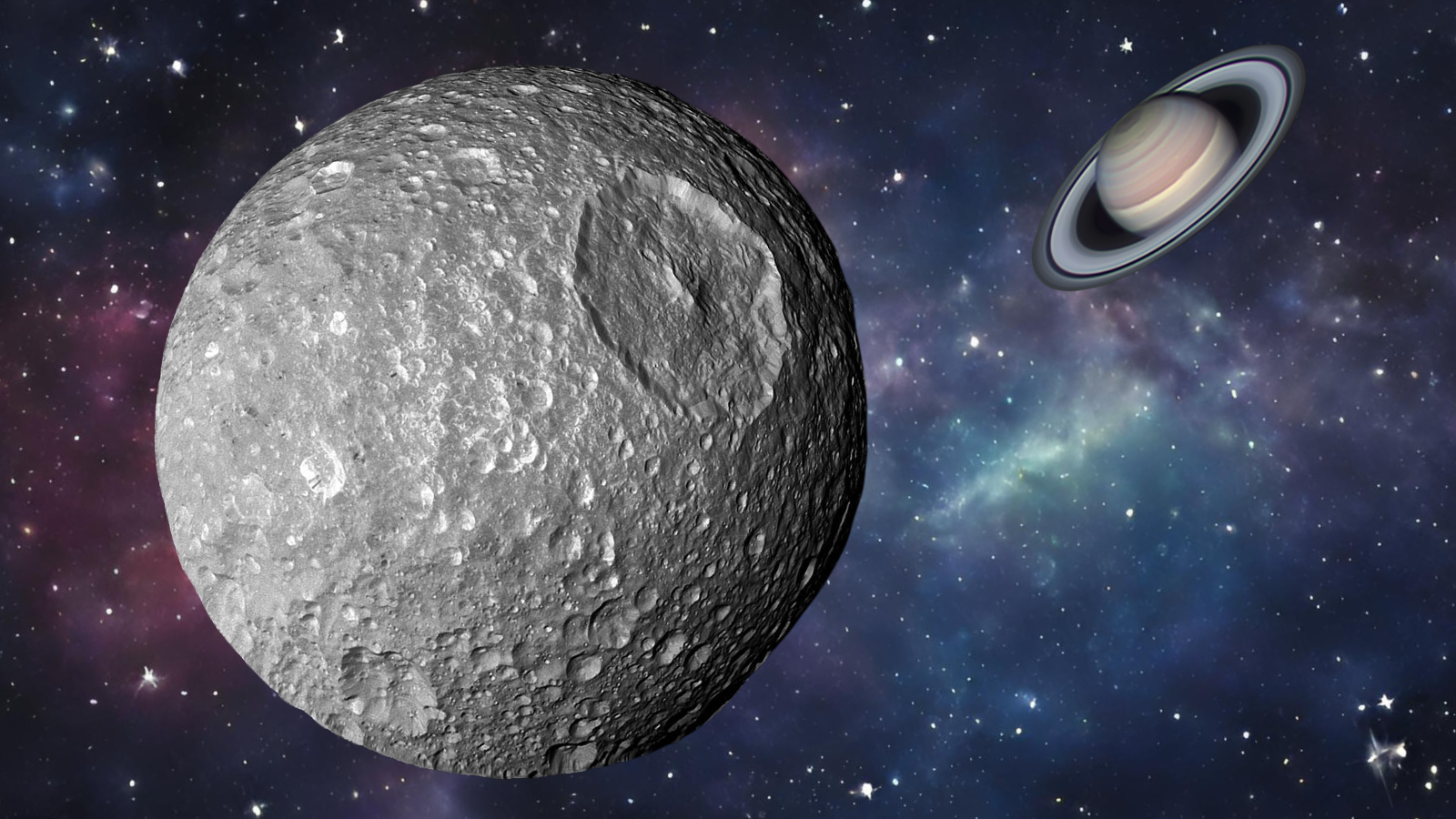
Discovering the “Death Star” Moon: Mimas
On September 17, 1789, British astronomer William Herschel discovered Saturn’s moon Mimas, famously known today as the “Death Star” moon due to its resemblance to the fictional space station from Star Wars. Although Star Wars hadn’t yet been conceived, the moniker has stuck thanks to Mimas’s distinctive appearance, highlighted by the large crater named Herschel, which dominates one side of the moon.
About William Herschel
Herschel was a pioneering telescope maker who also discovered Uranus and several moons of Jupiter and Saturn. After enhancing the design of reflecting telescopes, he was able to spot Mimas orbiting Saturn shortly after its discovery.
With a diameter of approximately 245 miles (394 kilometers), Mimas is the smallest known spherical body in space bound by self-gravity, and it’s also the innermost of Saturn’s major moons.

Image Credit: NASA/JPL/Space Science Institute
Importance of the Discovery
At the time of its discovery, Mimas was merely viewed as a bright dot next to Saturn, lacking the details we can appreciate today. The moon remained largely uncharacterized until the Voyager 1 and Voyager 2 spacecraft captured detailed images of it in 1980. However, it wasn’t until the Cassini spacecraft‘s mission from 2004 to 2017 that we gained a full understanding of Mimas’s features.
The moon’s Herschel crater, measuring 80 miles (130 km) across, is striking—taking up about one-third of Mimas’s surface. This crater illustrates the aftermath of a monumental impact that nearly shattered the moon. The shock waves from this impact may have formed the fractures observed on the opposite side of Mimas.
Composition and Characteristics
Mimas is primarily composed of water ice and is mostly frozen solid. Its orbital characteristics show that it orbits Saturn approximately every 22 hours at an average distance of about 115,000 miles (186,000 km), remaining tidally locked with one side always facing the planet.
The name “Mimas” was suggested by John Herschel, William Herschel’s son, who drew upon mythology to honor a giant who fought Mars in ancient lore.
NASA’s Space Shuttle Enterprise
Coincidentally, September 17 also marks the unveiling of NASA’s first space shuttle, Enterprise, in 1976, named after the iconic starship from Star Trek. This shuttle, although never launched into space, was utilized for important glide and landing tests.
You can still visit the Enterprise at the Intrepid Sea, Air & Space Museum in New York City.
For more insights into space history, check out the full On This Day In Space Story archive and watch related videos on YouTube.


