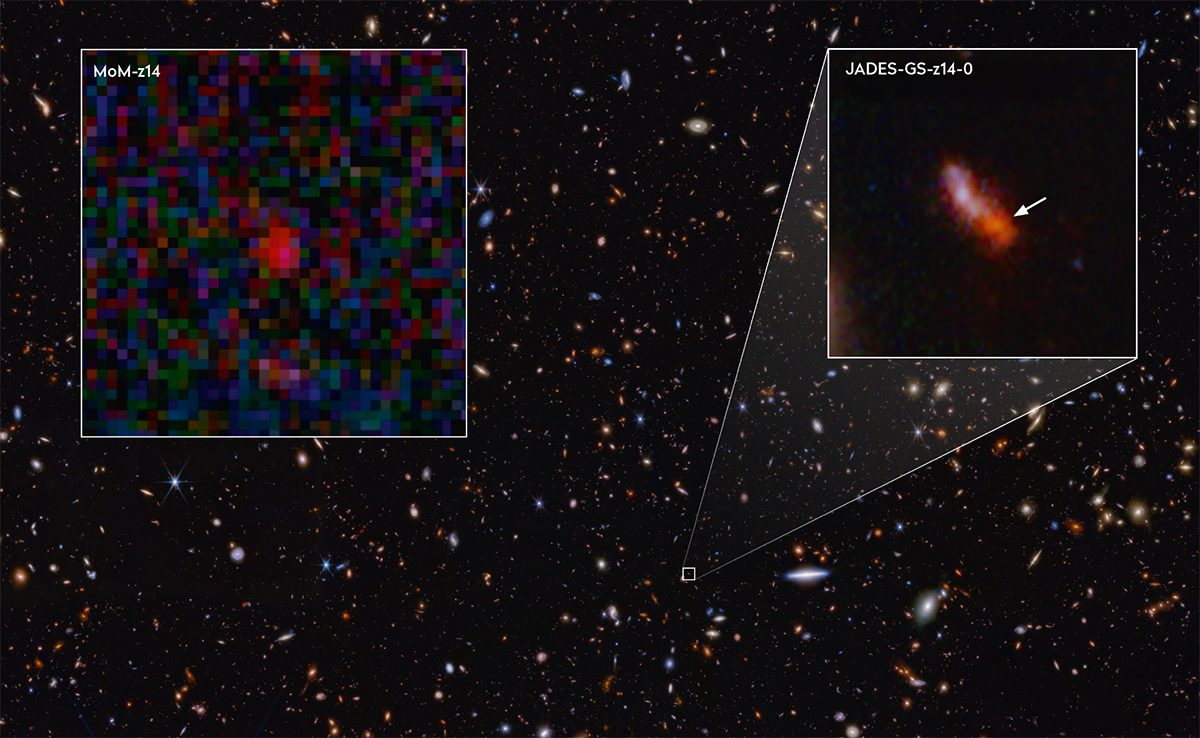
The James Webb Space Telescope (JWST) has made a remarkable discovery by detecting light from the galaxy MoM-z14, which existed only 280 million years after the Big Bang, making it the most distant galaxy observed to date. This finding surpasses the previous record held by JADES-GS-z14-0, which existed 300 million years post-Big Bang.
How JWST Sees Early Galaxies
JWST investigates primordial galaxies by looking for high levels of redshift—a phenomenon where the wavelength of light stretches as it travels through the expanding universe. The higher the redshift, the farther away and older the galaxy is. This can be likened to how the pitch of an ambulance siren drops as it speeds away from you. Through its infrared instruments, JWST can measure this redshift and glean important information about the distance and composition of early galaxies.
Findings from MoM-z14
MoM-z14 has a redshift of approximately 14. While detecting such a distant galaxy is impressive, it’s even more surprising that galaxies exist in this era. The detection of over 100 bright galaxies previously predicted to be absent during this period has changed astronomers’ expectations. Additionally, JWST has identified heavier elements like carbon and nitrogen within MoM-z14, indicating that even more primitive galaxies made up solely of hydrogen and helium likely exist and await discovery.
Researchers express optimism that JWST will continue to push the boundaries of our understanding of the early universe, opening avenues toward understanding the first stars and galaxies formed after the Big Bang.


