Venus: A Celestial Frustration
Venus, often hailed as the brightest planet, captivates stargazers with its brilliance, especially when appearing close to a crescent moon. However, it offers little more than a dazzling point of light, lacking the detail that can be observed with other planets like Mars or Saturn. While Mars showcases its reddish hue and Saturn displays magnificent rings, Venus reflects sunlight from its thick cloud cover, making it resemble a star to the untrained eye.
The Beauty of a Crescent Venus
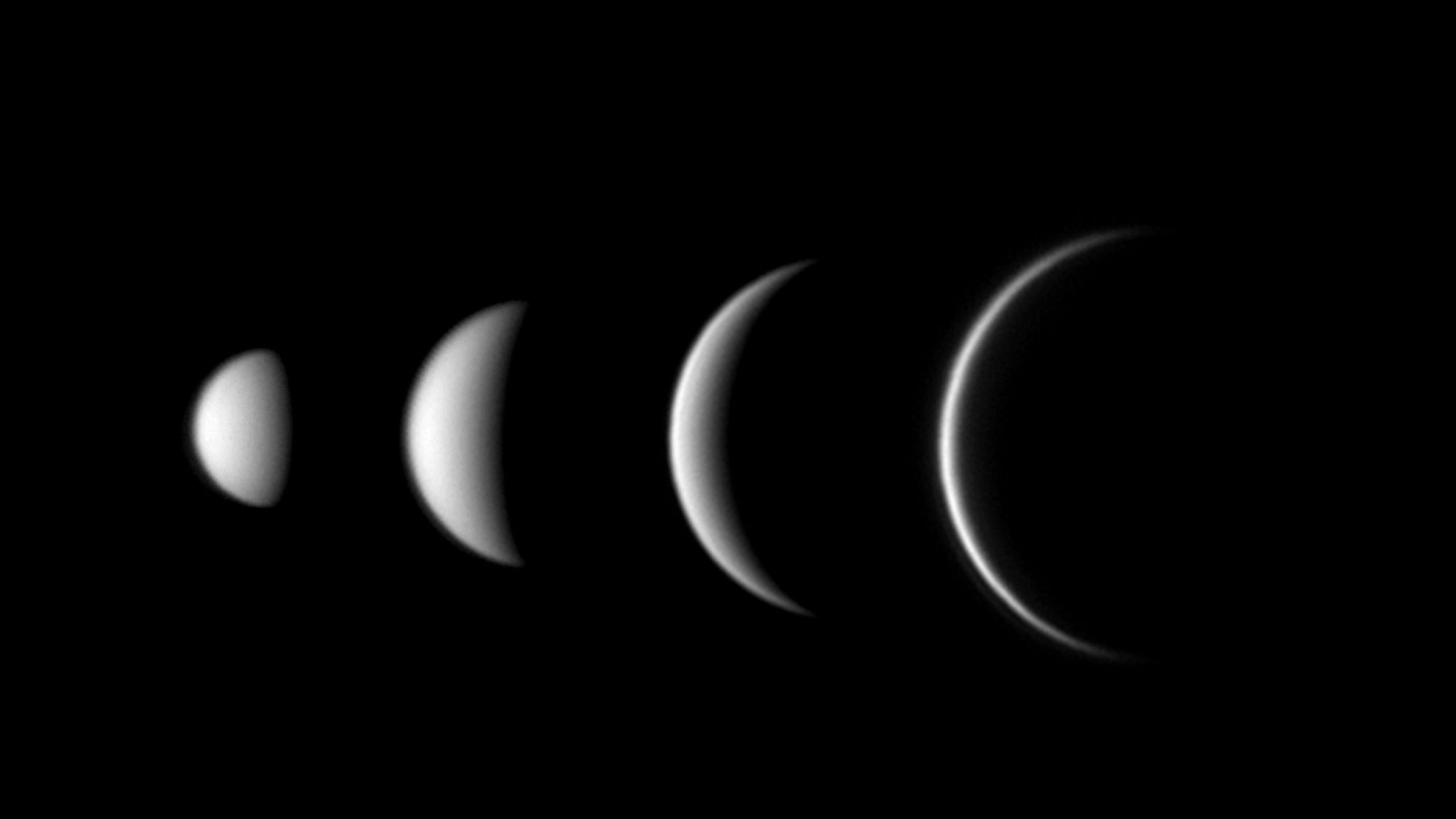
Occasionally, Venus morphs into a crescent shape, providing insight into its nature as an inner planet relative to Earth. Currently, its disk is dimming, with a decrease from 36% to 32% lit, as it moves closer to Earth and shrinks toward a crescent. This geometrical change marks an interesting time for observers, especially after Venus reached its greatest eastern elongation on August 15.
On September 18, Venus will shine brightest at magnitude -4.8 while being only 26% illuminated—this phenomenon highlights the conjunction of its increasing size and decreasing brightness.
Observing Venus
Catching a glimpse of a crescent Venus is a visually stunning experience. As it aligns with the sun from Earth’s perspective, we see more of its night side, akin to observing a crescent moon. Historically, Galileo’s observations of Venus’ phases in the early 17th century were crucial in disproving the Ptolemaic model of the universe.
From now until late October, Venus promises to be a source of fascination for amateur astronomers. In the coming days, it will pass through the constellation Virgo and enjoy a notable conjunction with a crescent moon on September 14.
Stargazing Recommendations
For an optimal viewing experience, stargazers should wait until sunset to observe Venus, which remains prominent in the evening sky. Using a small telescope or binoculars can enhance the viewing experience, revealing its crescent shape without the expectation of surface details. Atmospheric effects may create distortions, but the phase of Venus typically shines through.
Upcoming Events: Stargazer’s Corner
As the moon moves past its last quarter, the sky provides an excellent opportunity to view both Venus and the Milky Way. Over the next weeks, keep an eye on the expanding evening star as it becomes a striking point of interest low in the west soon after sunset.
Constellation of the Week: Pisces
Currently, Pisces is visible in the southern sky. Recognizable by its faint stars forming a broad V-shape beneath the Great Square of Pegasus, this constellation is a subtle but key indicator of the shifting autumn sky. Notably, Neptune reaches opposition within Pisces soon, enhancing the visibility of this distant planet, although binoculars or telescopes will be required to spot it.
Embrace the beauty of Venus and the stars this September—it’s a perfect time for celestial exploration!